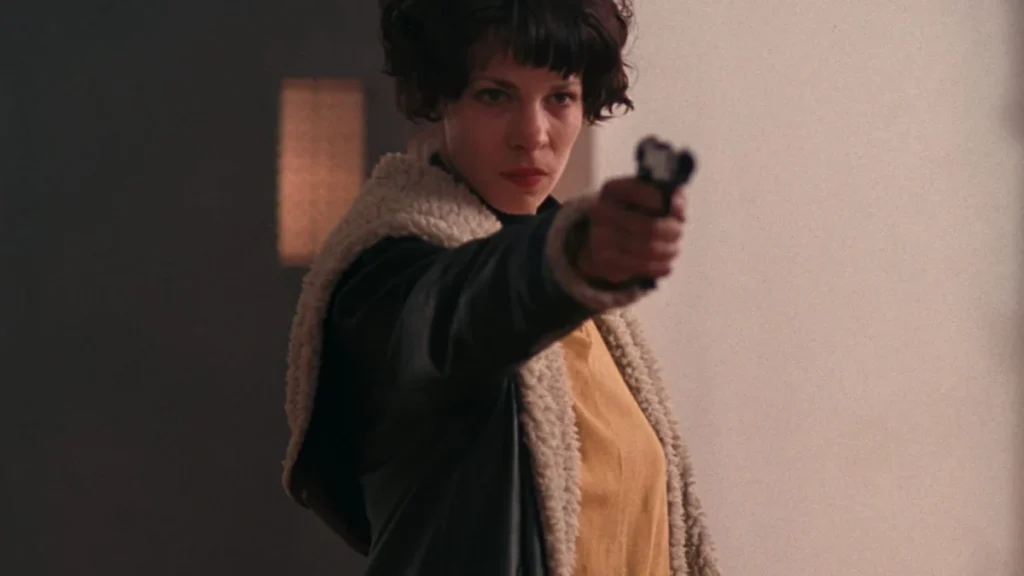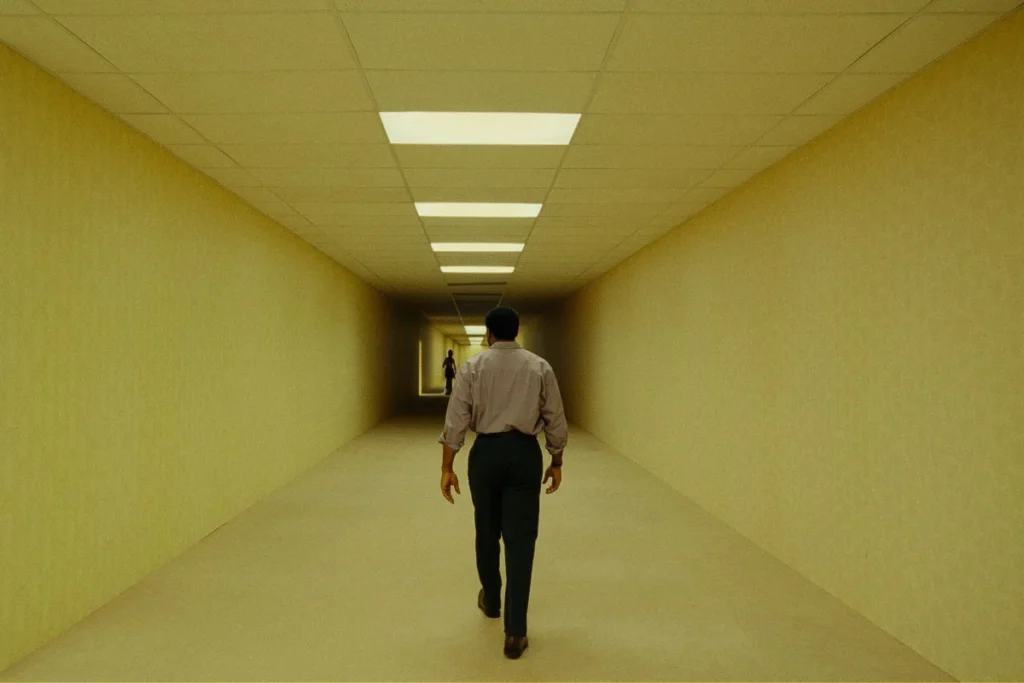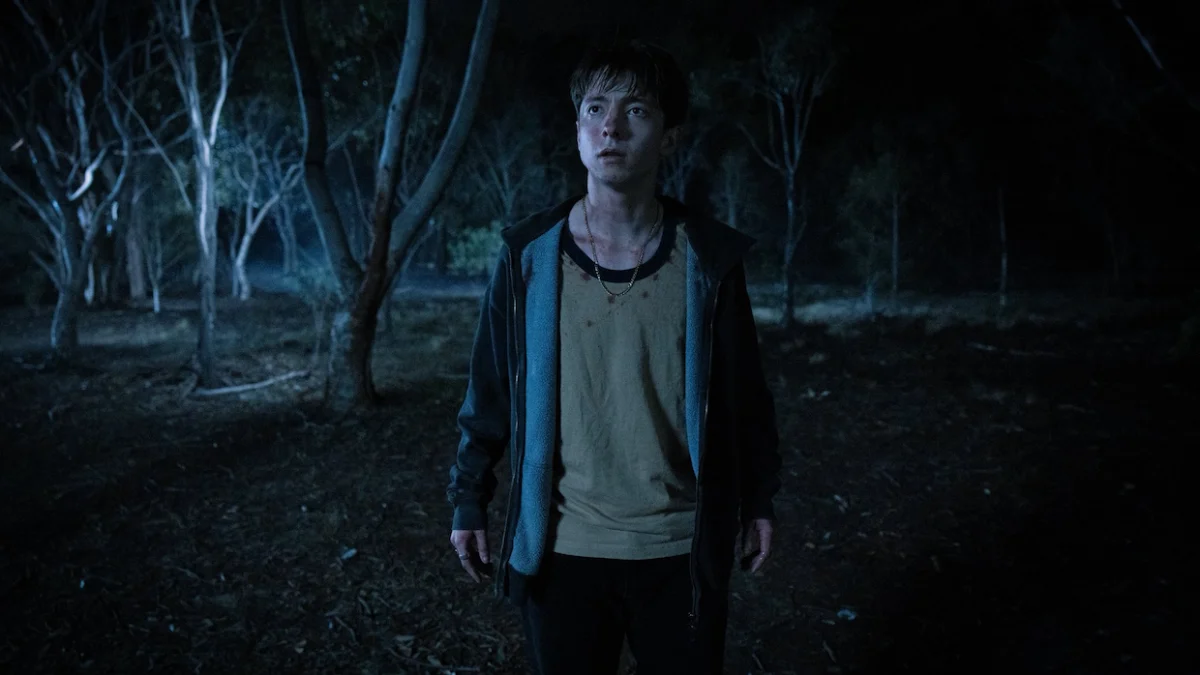
Adrian Chiarella’s debut feature begins with an archetypal horror image: a “little death” that begets a big one. In this cold open, a lesbian lifeguard succumbs to the lubricious persuasions of an invisible lover in a poolside shower, a moment of illicit pleasure that ends in her murder. The sinister seducer, which appears to its victims as the person they desire most, is the spawn of a hex cast upon gay teens by their local church as a form of conversion therapy. This conceptual hook, already a clever spin on the horror genre’s predilection for teenage sex and death, is premised upon the pious dictum so often used to keep queer youth in line: your desires will kill you.
As a metaphor for homophobia—permeant and inescapable, twisting private lust into public fear—the film serves as a blunt instrument of identification, a brute-force appeal for empathy in a callous age. Chiarella’s creative impulsion was a response to the recent global rise in bigotry and a perceived backward slide in progress toward queer security and safety. By utilizing the visceral language of horror, Chiarella attempts to bridge the gap between the internal psychological trauma of marginalized youth and the external reality of institutional oppression.
The Narrative Core and Psychological Stakes
Spiritually and spatially confined to an industrial town in the Australian boondocks, the film explores a cultlike religious community that constricts the lives of its inhabitants. The story follows Naim, played by Joe Bird, a shy newcomer who finds himself drawn to his brashly charismatic classmate Ryan, portrayed by Stacey Clausen. Their relationship serves as the emotional anchor of the film, evolving from a macho skirmish in an abandoned building to a tentative, high-stakes romance.
The inciting incident occurs when Naim, overwhelmed by self-fear and a brief moment of jealousy involving Hunter (Jeremy Blewitt), the preacher’s closeted son, reveals their secret to the authorities of the church. Expecting a minor disciplinary action, Naim instead triggers a supernatural curse. Chiarella notes that horror movies are fundamentally about transgression and the "horrible thing" that follows. In Leviticus, the "horrible thing" is a monster that weaponizes intimacy. The creature only manifests when the victim is alone, but it possesses the ability to mimic the person they love most. This mechanic creates a paradox: to stay safe, the boys must stay together, but the monster’s ability to replace a lover means they can never truly trust the person standing next to them.
Production Background and Cinematic Style
Leviticus represents a significant step in Adrian Chiarella’s career, following his acclaimed short films such as Black Lips and Dwarf Planet, which also dealt with themes of queer identity and isolation. Produced within the burgeoning Australian independent film sector, the project utilized the bleak, weathered architecture of industrial New South Wales to create a sense of "vacant hostility."
The production design intentionally contrasts man-made industrial decay with pastoral landscapes, evoking what Chiarella describes as a "modern biblical parable." This aesthetic choice highlights the tension between human nature and the rigid edicts of society. Visually, the film relies heavily on themes of perception. Much of the action is glimpsed through windows, mirrors, and security cameras, or viewed impassively by bystanders who are literally unable to see the monster. This "blinkering" serves as a direct commentary on the willful ignorance often displayed by those outside the LGBTQ+ community regarding the dangers and pressures queer youth face.
Historical Context and Genre Lineage
The film enters a long tradition of "Queer Horror," a subgenre that has historically used monsters and shadows to represent the "otherness" imposed on queer individuals. Chiarella cites several foundational texts as inspirations, most notably A Nightmare on Elm Street 2: Freddy’s Revenge (1985). Long considered a landmark in queer cinema, Freddy’s Revenge used the horror of body possession as a metaphor for the struggle of living in the closet.
Additionally, Chiarella points to John Carpenter’s The Thing (1982) as a primary influence regarding the "tension between the self and the other." In The Thing, the horror stems from the inability to trust one’s companions—a theme Leviticus adapts into a romantic context. By placing these classic tropes within a contemporary Australian setting, Chiarella joins a wave of "New Queer Horror" filmmakers who are moving away from subtext and making the themes of identity and persecution overt.
Supporting Data: The Reality of Conversion Practices
While the "hex" in Leviticus is a supernatural invention, its real-world inspiration is rooted in the ongoing practice of conversion therapy. According to data from the Australian Institute of Family Studies and various LGBTQ+ advocacy groups, conversion practices—often rebranded as "reparative therapy" or "sexual orientation change efforts"—continue to persist in religious and conservative communities despite being condemned by major medical associations.
In Australia, several states, including Victoria and Queensland, have passed legislation to ban these practices, yet survivors report that underground networks still operate, often using psychological pressure and isolation techniques similar to those depicted in the film. A 2021 study by the Williams Institute found that individuals who underwent conversion therapy were twice as likely to attempt suicide compared to those who did not. Leviticus translates these statistics into a physical threat, making the invisible psychological damage of such practices visible through the lens of a supernatural predator.
Cast Performances and Character Dynamics
The casting of Mia Wasikowska as Naim’s mother adds a layer of prestige and complexity to the film. Wasikowska, known for her roles in Alice in Wonderland and Crimson Peak, portrays a character who blurs the line between protection and oppression. Her character’s assertion that "we need fear" to survive encapsulates the film’s critique of how parental love can become predatory when filtered through religious extremism.
The chemistry between Joe Bird and Stacey Clausen has been highlighted as a standout element of the production. Their performances ground the supernatural elements in a recognizable teenage reality. Jeremy Blewitt’s portrayal of Hunter provides a tragic counterpoint to the leads, representing the self-destructive path of those who fully internalize the church’s teachings.
Chronology of Development and Release
The development of Leviticus began in early 2024, following the success of Chiarella’s short film circuit.
- Late 2024: Script finalized; Mia Wasikowska joins the project, bringing international attention to the Australian indie production.
- Early 2025: Principal photography takes place over eight weeks in regional Australia, utilizing natural light and practical effects to enhance the "grounded horror" feel.
- Late 2025: The film enters post-production, with a focus on a soundscape that emphasizes the isolation of the industrial setting.
- 2026: Leviticus premieres at major international film festivals, including Sundance and the Sydney Film Festival, before its wider theatrical and streaming release.
Broader Impact and Implications
The release of Leviticus comes at a time when queer media is diversifying. While recent years have seen an influx of "joyful" queer narratives, Chiarella’s film argues that there is still a vital need for stories that confront the darkness. By returning to the "horror of crisis," the film serves as a reminder that for many, the struggle for safety is not a thing of the past.
The film’s ending departs from the traditional "doom" associated with older queer cinema. While it acknowledges that the trauma the characters have endured may never truly go away, it offers a modern, complex view of survival. Chiarella’s use of the "final frame" trope—where the monster is revealed to be potentially alive—is recontextualized as a metaphor for the persistence of systemic homophobia and the resilience required to live with its scars.
In the broader context of the Australian film industry, Leviticus reinforces the country’s reputation for high-quality "Outback Gothic" and genre-bending horror. It follows in the footsteps of films like The Babadook and Talk to Me, using supernatural elements to explore deeply human, often uncomfortable, psychological truths. As the film reaches global audiences, it stands as a testament to the power of genre cinema to act as both a mirror and a warning, using the visceral tremors of horror to unearth truths that are as intimate as they are terrifying.