



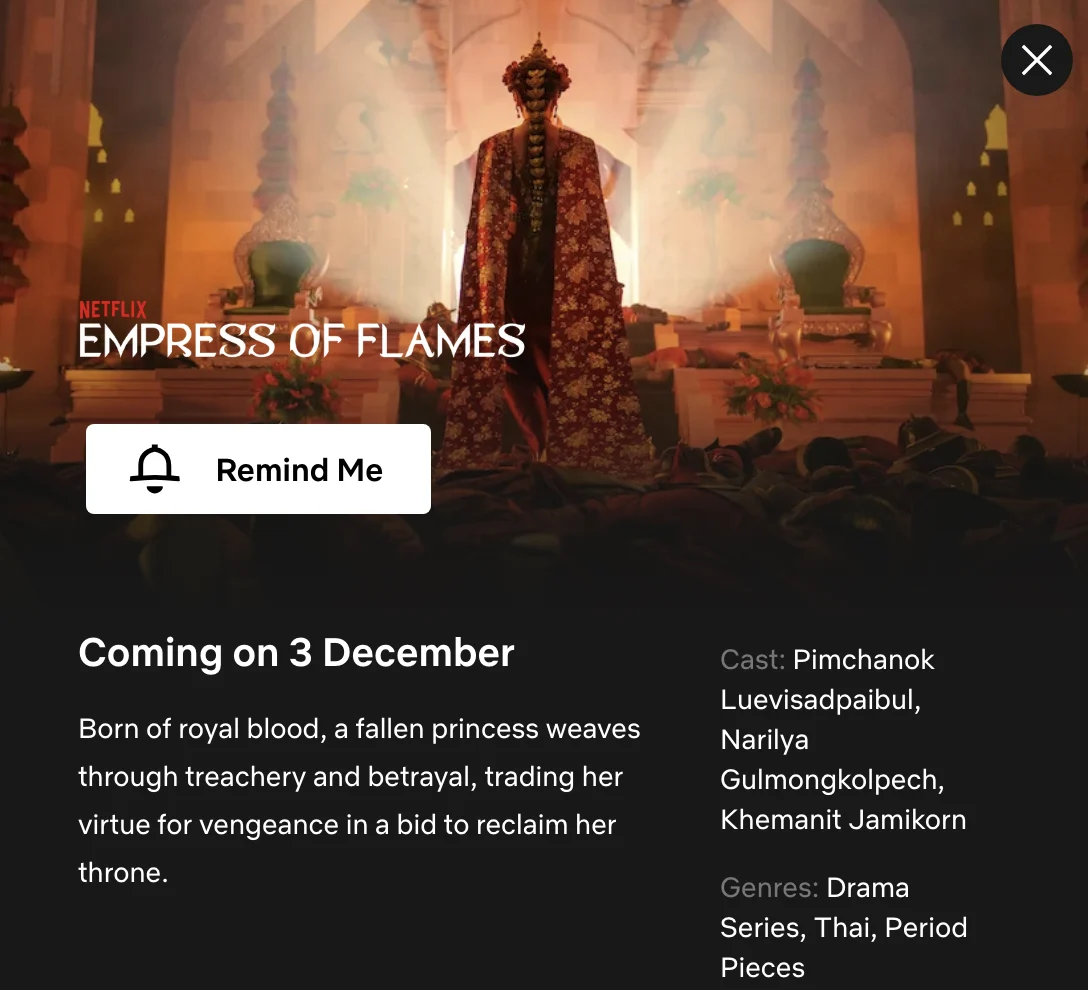
The production of Empress of Flames represents a major technical and creative investment for Netflix. Directed by Karn Sivaroj Kongsakul, the series is built upon a foundation of extensive historical research and literary adaptation. The script, a collaborative effort by writers Titipong Chaisati, Nuttapot Potchumnean, Gift Nattamol Paethanom, Nut Nualpang, and Jan Weerasu Worrapot, draws heavily from Prince Damrong’s seminal work, Journey through Burma. This source material has a storied history in Southeast Asian media, having previously served as the basis for the 1996 motion picture The Royal Fire. By revisiting this narrative, the production team aims to bring a contemporary, prestige-television lens to a story that has long resonated within the cultural consciousness of the region.
A Strategic Production Timeline
The development of Empress of Flames did not happen in a vacuum. It follows a multi-year trend of Netflix investing in "Thai Originals" that prioritize high production values and A-list talent. The project has been in active development for several months, with the official announcement arriving in September 2026 to coincide with the platform’s promotional rollout.
The production cycle for such an ambitious historical drama is rigorous. Unlike standard contemporary dramas, historical epics require meticulous period-accurate costume design, architectural reconstruction, and choreographed sequences that reflect the royal court dynamics of the era. The decision to release the series in December serves a dual purpose: it aligns with the holiday season, which historically sees higher engagement rates across streaming services, and it provides a "prestige" anchor for the end of the 2026 fiscal year. Subscribers can currently access the landing page on the Netflix interface to set reminders, a feature that provides the streaming giant with valuable data regarding user anticipation and potential viewership metrics.

Narrative Scope and Historical Context
At its core, the series explores the intersection of political ambition and personal sacrifice. The official logline provided by the studio emphasizes this tension: "Born of royal blood, a fallen princess seeks to reclaim the throne that was torn from her bloodline. In a kingdom ruled by treachery, she trades her virtue for vengeance, ready to spill the blood of those she once trusted."
This narrative arc serves as a classic exploration of the "palace intrigue" genre, a staple of historical fiction that has seen global success in recent years. By focusing on the figure of the last queen of Burma, the writers are exploring a period characterized by shifting allegiances, colonial pressures, and the erosion of traditional power structures. For international audiences, the series offers a window into Burmese history, filtered through a dramatic narrative that emphasizes character-driven conflict over purely academic recitation of facts.
Character Profiles and Cast Contributions
The ensemble cast is led by three of Thailand’s most prominent performers, each bringing a unique background to their roles.
Pimchanok Luevisadpaibul, widely known as "Fern," takes on the mantle of the protagonist, Ananthip. Her involvement is expected to be a primary driver for local and regional viewership, given her recent success in the Netflix action-thriller My Dearest Assassin and the romantic fantasy AI Love You. Her filmography, which includes titles such as Beauty Newbie and The Curse of Saree, demonstrates a range that spans from lighthearted comedy to intense dramatic roles. Her performance as Ananthip is being framed by the studio as a potential career-defining turn.

Narilya Gulmongkolpech, cast as Sekkharathewi, brings significant momentum from her previous work in the critically acclaimed Netflix series Master of the House. Her performance in that project helped solidify her reputation for handling complex, emotionally demanding roles. Rounding out the primary trio is Khemanit Jamikorn, who portrays Tawanthip. Her transition into the Netflix ecosystem is noteworthy; previously recognized for her work in the Thai adaptation of the thriller Voice and the period-bending drama Time, her inclusion in this series marks her debut as a lead in a major Netflix original production.
The casting strategy reflects a deliberate effort to blend established television stars with actors who have already proven their capability in the streaming format. This balance is essential for maintaining a high "completion rate," a key metric for Netflix when evaluating the success of its regional content.
Market Implications and Regional Expansion
The investment in Empress of Flames is part of a larger, data-driven strategy by Netflix to dominate the Southeast Asian content landscape. Data from the last three years suggests that high-budget, local-language dramas are increasingly competitive with Hollywood imports. By focusing on regional history, Netflix is not only catering to local audiences but also exporting cultural content that finds a niche among global viewers interested in international period pieces.
From an economic perspective, the production of such a series provides a significant boost to the local creative economy in Thailand. This includes employment for local crews, investment in domestic post-production houses, and the use of regional filming locations. Furthermore, the global availability of this content on Netflix provides Thai artists with an unprecedented platform to reach audiences in over 190 countries.
The Evolution of Thai Streaming Content
Historically, the Thai television industry was dominated by free-to-air networks that favored long-running soap operas. The shift toward the streaming model, led by companies like Netflix, has necessitated a change in production standards. Empress of Flames is expected to reflect these higher standards, featuring longer development phases, tighter scripting, and higher-quality cinematography compared to traditional broadcast dramas.
Industry analysts note that as the competition for "eyeballs" intensifies—with platforms like Disney+, Amazon Prime, and local players like Viu vying for market share—the quality of "prestige" content has become the primary differentiator. Empress of Flames is a clear signal that Netflix intends to maintain its lead by commissioning stories that feel both culturally authentic and structurally ambitious.
Conclusion and Looking Ahead
As the December 3, 2026, release date approaches, the anticipation surrounding the series continues to build. The combination of a well-researched historical backdrop, a cast of high-caliber Thai talent, and the global reach of the Netflix distribution network positions the series to be one of the most-watched international titles of the fourth quarter.
While the ultimate success of the project will depend on audience reception and critical consensus, the preliminary indicators—the depth of the writing team, the pedigree of the actors, and the strategic timing of the release—all point toward a significant achievement for Thai television production. For subscribers, Empress of Flames promises to be a complex, visually arresting exploration of power and identity, further cementing the role of the streaming service as a bridge between regional narratives and a global audience. Whether the series succeeds in matching the heights of other international hits remains to be seen, but the intent behind its creation is a testament to the growing maturity and global aspirations of the Thai entertainment industry.