


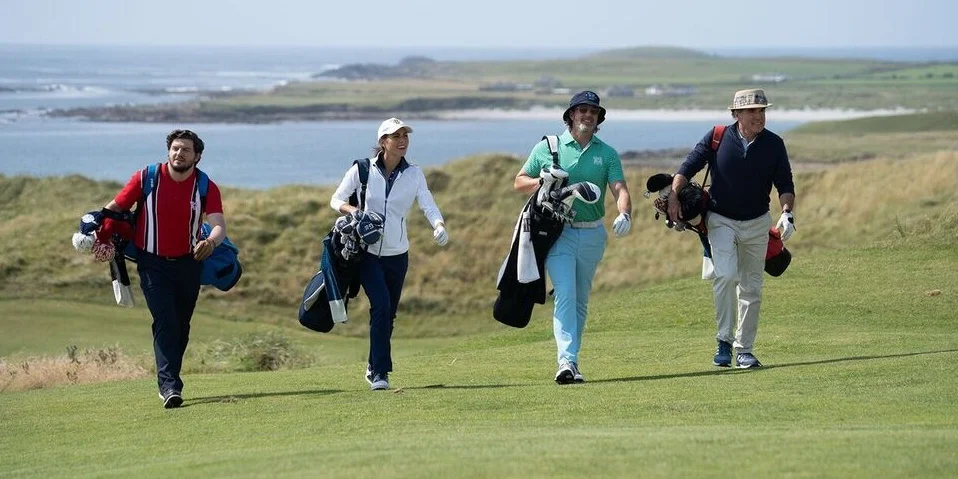
Filmmaker Edward Burns, a veteran of independent cinema known for his intimate portrayals of Irish-American families, returns with his latest feature, "Finnegan’s Foursome," a film that, despite its promising premise, struggles to translate its emotional core into a compelling cinematic experience. The movie, which premiered at the Tribeca Film Festival, centers on two Irish-American brothers and their children as they journey to their ancestral homeland for a golf tournament steeped in family tradition and in honor of their late father. While the narrative attempts to weave together themes of grief, rivalry, and familial legacy, the execution falls short of the poignant storytelling Burns achieved in his breakout film, "The Brothers McMullen."
The Legacy of the Links: A Family’s Golfing Pilgrimage
"Finnegan’s Foursome" introduces the Finnegan family, a group bound by a shared passion for golf, inherited from patriarch Jack Finnegan, a former professional golfer. The story unfolds as Jack’s sons, Freddy (Edward Burns) and Teddy (Brian d’Arcy James), along with their respective children, Frankie (Brian Muller) and Marie (Erica Hernandez), gather for their annual family golf tournament. This year’s event, however, is overshadowed by the recent death of Jack Finnegan himself, who passes away at the beginning of the tournament.
The narrative then pivots to the Finnegan siblings and their children embarking on a pilgrimage to Ireland, the spiritual home of their golfing heritage. Their mission is twofold: to complete the tournament as a tribute to their father and to scatter his ashes across the hallowed grounds of the Irish golf courses that shaped his life and career. This journey is intended to be a cathartic experience, a chance to confront their grief, rekindle their competitive spirits, and ultimately, to honor the man who instilled in them a love for the game.
A Deep Dive into the Finnegan Family Dynamics
Edward Burns, who not only stars as Freddy Finnegan but also penned and directed the film, portrays a character grappling with his father’s demanding legacy. Freddy, unlike his brother Teddy, harbors a weariness stemming from his father’s overbearing presence, particularly during the intensely competitive family tournaments. He expresses a desire to opt out of this year’s event, intending to confront his father directly about their strained relationship. This confrontation, however, is tragically cut short by Jack’s untimely death, forcing Freddy and Teddy to re-evaluate their motivations and their shared grief.
Brian d’Arcy James as Teddy Finnegan, presents a different facet of the sibling dynamic. While also a participant in the golf tournament, Teddy’s character is depicted as an author experiencing writer’s block, adding another layer of personal struggle to his emotional landscape. The film suggests that Teddy’s journey to Ireland is also an attempt to find inspiration and overcome his creative impasse, drawing parallels between the challenges of writing and the precision required on the golf course.
The younger generation, Frankie and Marie, are introduced as integral parts of this golfing dynasty. Brian Muller as Frankie, is shown to be navigating the aftermath of a personal setback, with his band having broken up and his relationship having ended. His participation in the tournament represents a potential avenue for rediscovery and resilience. Erica Hernandez as Marie, is presented as a breath of fresh air, a character who injects much-needed energy into the predominantly male-dominated family tradition. She is highlighted as the first woman in the Finnegan family to be included in the ancestral golf tournament, a subtle yet significant nod to evolving family dynamics and the breaking of old molds.
The Shadow of "The Brothers McMullen"
"Finnegan’s Foursome" arrives at a point in Edward Burns’ career where comparisons to his early success are almost inevitable. "The Brothers McMullen," his debut feature, garnered critical acclaim and commercial success after its premiere at the Sundance Film Festival in 1995. This independent darling, funded through Burns’ own resources, showcased his knack for authentic dialogue, relatable characters, and a grounded portrayal of working-class Irish-American life. Since then, Burns has consistently pursued his vision, often acting as writer, director, and producer on his projects, demonstrating a steadfast commitment to independent filmmaking.
While Burns has made notable appearances in larger productions, such as Steven Spielberg’s "Saving Private Ryan" and the HBO series "Entourage," his artistic identity remains deeply rooted in his personal storytelling. "Finnegan’s Foursome" represents another chapter in this ongoing narrative, a film born from his distinctive directorial voice. However, the current offering appears to fall short of recapturing the magic that defined his initial breakthrough. Critics have suggested that the film leans into a more conventional, almost "Hallmark-esque" comedic style, which dilutes its potential for deeper emotional resonance and risks alienating audiences seeking more nuanced storytelling.
The Golf Course as a Crucible for Conflict and Connection
The narrative’s core conflict arises from the intense, often acrimonious, sibling rivalry between Freddy and Teddy. Their interactions are characterized by a competitive spirit that, while rooted in their father’s influence, frequently devolves into sniping and passive-aggression. The film attempts to portray these exchanges as a form of endearment, a testament to their shared history and their father’s competitive nature. However, the repetition of these squabbles, often followed by quick reconciliations, begins to feel formulaic and loses its comedic impact over time.
Despite the repetitive nature of the familial banter, the chemistry between the four leads—Burns, d’Arcy James, Muller, and Hernandez—is frequently cited as a strong point. Hernandez, in particular, is noted for her ability to inject vivacity into the proceedings, her character’s presence serving as a catalyst for disruption and change within the established family dynamic. Her role as the first female participant in the tournament signifies a potential departure from the rigidly traditional expectations of the Finnegan lineage.
Script and Direction: A Missed Opportunity for Depth
The screenplay for "Finnegan’s Foursome" has been criticized for its superficial character development. Beyond basic defining traits—Freddy’s resentment over perceived favoritism, Teddy’s writer’s block, Brian’s post-breakup malaise, and Marie’s general enjoyment of the experience—the characters lack substantial depth. This shallowness makes it difficult for audiences to fully invest in their emotional journeys or connect with their struggles.
Edward Burns’ direction, while striving for a certain aesthetic, is also a point of contention. The cinematic depiction of the golf sequences is described as unflattering, with visually indistinct shots that fail to capture the nuances of the game. The narrative relies heavily on explicit exposition, with characters or narration verbally explaining who is leading or trailing, rather than allowing the visual storytelling to convey this information. While cinematographer Jeff Mulshtok occasionally captures the scenic beauty of Ireland and its golf courses, these moments are not sufficient to compensate for the repetitive gameplay and the lack of engaging narrative progression.
The Struggle to Recapture Early Success
When the film attempts to delve into the emotional underpinnings of the characters’ relationships and their grief over their father’s passing, the impact is largely diminished. The eulogies and speeches intended to honor Jack Finnegan are described as falling flat, lacking the sincerity and emotional weight necessary to resonate with the audience. This struggle to evoke genuine emotion suggests a broader challenge for Burns in recapturing the raw, authentic spirit that made "The Brothers McMullen" such a beloved film.
While "The Family McMullen," a follow-up to his directorial debut, was considered a solid continuation, "Finnegan’s Foursome" appears to be a departure that has not yet found its footing. The critical sentiment suggests that Burns might benefit from revisiting the characters and familial dynamics that have already endeared themselves to audiences, rather than embarking on new narrative territories that have yet to prove as captivating. The film’s two-hour runtime, while standard for features, feels prolonged given the perceived lack of substantial plot development and emotional payoff.
The film’s release at the Tribeca Film Festival provided a platform for early critical reception, and the consensus points to a film that, despite its talented cast and Burns’ established directorial presence, fails to deliver on its initial promise. The narrative’s reliance on predictable comedic beats and underdeveloped characters leaves audiences wishing for a more profound exploration of family, grief, and the enduring power of legacy, themes that Burns has demonstrated he can masterfully portray in his past work.
Supporting Data and Context
Edward Burns’ career trajectory since "The Brothers McMullen" (1995) offers a valuable context for evaluating "Finnegan’s Foursome." The initial success of "The Brothers McMullen" was a significant moment in independent filmmaking, demonstrating that personal stories, told with authenticity, could resonate deeply with audiences and critics. The film was produced on a modest budget of approximately $27,000 and grossed over $4 million worldwide, a remarkable return that validated Burns’ approach.
Burns’ subsequent independent films, such as "She’s the One" (1997), "Sidewalks of New York" (2001), and "The Groomsmen" (2006), have largely explored similar themes of relationships, family, and the Irish-American experience, often with a focus on the dynamics between brothers and friends. This consistent thematic exploration has built a dedicated following for his work.
"Finnegan’s Foursome," with its 120-minute runtime, is a feature-length film, a common length for narrative cinema. The presence of established actors like Brian d’Arcy James, known for his work on Broadway and in films like "Spotlight," alongside the directorial and acting contributions of Burns himself, indicates a certain level of production value and talent behind the project. The involvement of actors like Ian McElhinney, a respected Irish actor with credits in "Game of Thrones," further suggests an aspiration for a certain gravitas in the film’s presentation.
The film’s premiere at the Tribeca Film Festival, established in 2002 by Robert De Niro and Jane Rosenthal, is a significant event in the independent film circuit. Festivals like Tribeca serve as crucial launchpads for new films, offering exposure to distributors, critics, and the public. The reception at such a festival often shapes the initial perception and subsequent distribution strategy for a film.
Broader Impact and Implications
The critical reception of "Finnegan’s Foursome" raises questions about the evolution of independent filmmaking and the challenges faced by established filmmakers in maintaining artistic momentum. For Edward Burns, whose early work was lauded for its raw authenticity, the perceived shift towards a more conventional, less impactful style in "Finnegan’s Foursome" suggests a potential disconnect between his past successes and his current creative output.
The film’s narrative, centered on family traditions and the impact of a deceased patriarch, touches upon universal themes. However, the lack of depth in its execution implies a missed opportunity to explore these themes with the nuance and emotional resonance that audiences have come to expect from Burns. The critique that the film resembles a "Hallmark-esque comedy" suggests a softening of the edgier, more grounded storytelling that characterized his earlier films.
The implications for Burns’ future projects are subject to speculation, but a lukewarm reception to "Finnegan’s Foursome" could influence studio interest or independent funding for subsequent endeavors. The film’s performance at the box office, once it moves beyond festival screenings, will provide further data on its commercial viability and audience reception. The analysis suggests that a return to the core strengths that defined his breakout success, perhaps with a renewed focus on the specific familial dynamics that resonated with audiences in "The Brothers McMullen" and its follow-up, might be a strategic direction for the filmmaker. The enduring appeal of familial sagas in cinema remains strong, and the potential for compelling storytelling within these narratives is vast, provided the execution matches the ambition.