

On October 26, 2001, Richard Kelly’s directorial debut, Donnie Darko, arrived in American theaters, marking the culmination of a tumultuous path that began at the Sundance Film Festival earlier that year. While the film’s initial theatrical run yielded a modest global box office return of just over $8 million, the legacy of the project has far outstripped its early commercial performance. Two decades later, the film stands as a foundational text in the subgenre of surrealist suburban satire, serving as a launchpad for the careers of Jake Gyllenhaal and Jena Malone while illustrating the volatile relationship between ambitious independent filmmaking and traditional distribution models.
The Sundance Genesis and Initial Reception
The premiere of Donnie Darko at the 2001 Sundance Film Festival served as a litmus test for the then-26-year-old Richard Kelly. The atmosphere surrounding the screening was notably polarized. Critics and attendees found themselves caught in what observers described as a generational divide: younger audiences, particularly those attuned to the burgeoning aesthetic of teen-centric existentialism, responded with enthusiasm to the film’s blend of dark humor and psychological trauma. Conversely, older demographics often struggled with the film’s fragmented narrative structure and its departure from conventional storytelling tropes.
The original critical assessment of the film highlighted a "generational abyss," noting that while segments of the audience found the film’s anarchic spirit infectious, others remained unmoved by its erratic pacing. This dissonance would become a hallmark of the film’s reputation, contributing to its slow-burn transformation from a box-office footnote into a revered cult phenomenon.
Chronology of Development and Distribution
The trajectory of Donnie Darko was hampered by the socioeconomic climate of 2001. Following its festival debut, the film faced significant hurdles regarding domestic distribution. The landscape for independent cinema was shifting, and the film’s complex themes—involving time travel, mental illness, and suburban malaise—made it a difficult sell for major studios.
- January 2001: The film premieres at the Sundance Film Festival. Despite mixed reviews regarding its narrative coherence, it garners attention for its visual style and performances.
- Late 2001: Newmarket Films secures distribution rights. The release is scheduled for late October, a window that proved problematic following the geopolitical instability caused by the September 11 terrorist attacks. The film’s marketing materials, which featured a prominent image of a crashing jet engine, were deemed sensitive, further complicating promotional efforts.
- October 26, 2001: Official theatrical opening. The film struggles to find a broad audience, hampered by the somber post-9/11 mood and limited marketing budget.
- 2002-2004: The film gains momentum through the emerging home video market (DVD/VHS). It begins to build a grassroots following, leading to midnight screenings and, eventually, the release of the "Director’s Cut" in 2004.
Narrative Framework and Character Dynamics
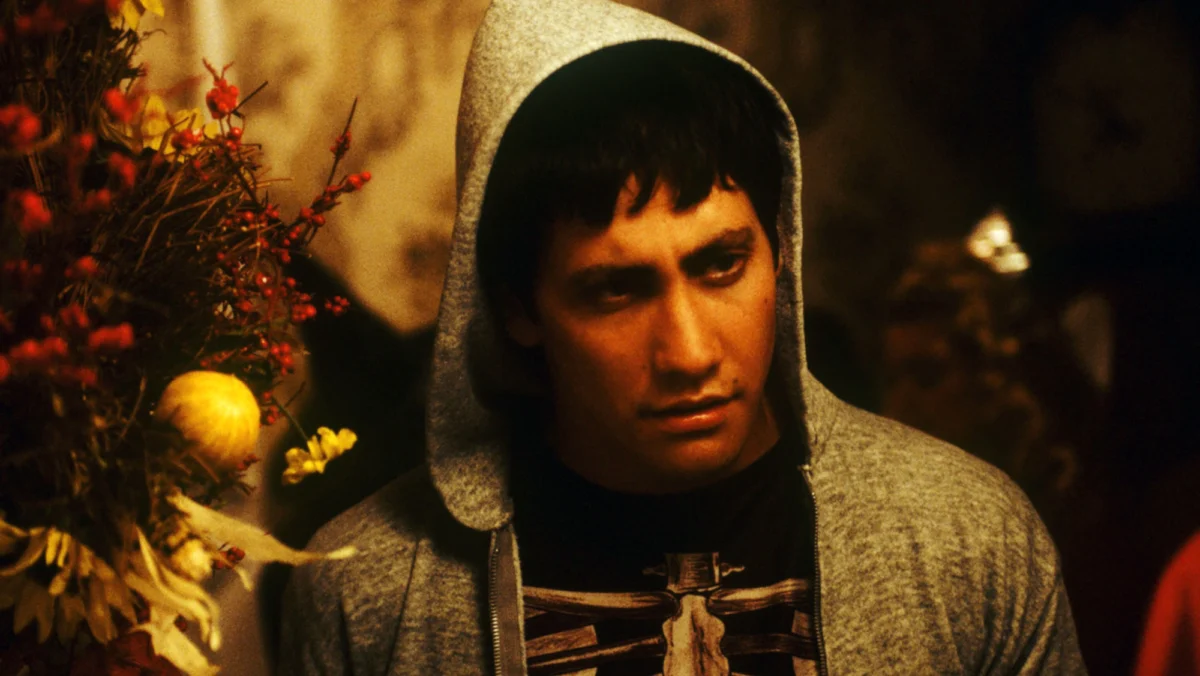
At its core, the film explores the life of Donnie Darko, a high-achieving but deeply troubled teenager living in an affluent, manicured suburb. Played with a brittle, morose intensity by Jake Gyllenhaal, the character serves as an archetype of the "alienated youth," struggling with the contradictions of a society that demands conformity while failing to address the underlying psychological realities of its inhabitants.
The film utilizes a supernatural catalyst—a six-foot-tall, menacing rabbit named Frank—to drive the narrative forward. This device acts as a manifestation of Donnie’s paranoid schizophrenia, pushing the protagonist into a series of rebellious, anti-establishment acts. The film’s supporting cast, including Patrick Swayze, Mary McDonnell, and Drew Barrymore, provided a veneer of prestige that helped ground the surrealist elements. Swayze’s portrayal of a charismatic motivational speaker provided a sharp, satirical contrast to the existential dread experienced by the younger characters.
Critical Fact-Based Analysis: The "Half-Baked" vs. "Visionary" Debate
From a structural standpoint, critics of the era pointed to what they described as a "confusing meltdown" in the film’s final act. The integration of speculative science fiction—specifically the Tangent Universe and the physics of time travel—was often cited as the point where the narrative’s "cinematic synapses" became overextended.
However, from an analytical perspective, this structural density is precisely what fueled the film’s longevity. The complexity of the screenplay invited repeated viewings, fostering an online community of fans dedicated to decoding the film’s internal logic. While the original 2001 reviews often critiqued the story for its "innate half-baked nature," the modern consensus suggests that the film’s willingness to prioritize mood and aesthetic over airtight exposition allowed it to transcend the limitations of traditional teen dramas.
Economic and Cultural Implications
The $8 million global box office figure is a misleading metric for the success of Donnie Darko. The film’s financial viability was ultimately realized through ancillary markets. The DVD release, bolstered by special features that explained the film’s complex lore, turned the project into a profitable enterprise for its investors.
Furthermore, the film’s success had a quantifiable impact on the careers of its participants:
- Jake Gyllenhaal: The role of Donnie Darko is widely credited with establishing Gyllenhaal as a serious dramatic actor, transitioning him from youth-oriented roles to critically acclaimed performances in films such as Brokeback Mountain and Zodiac.
- Richard Kelly: Despite the challenges he faced during the initial release, Kelly gained a reputation as a visionary director, although his subsequent projects faced similar difficulties in achieving mainstream consensus.
- The "Indie" Aesthetic: Donnie Darko helped define the look and feel of the early 2000s independent film movement, characterized by a specific blend of cynical humor, suburban detachment, and stylized cinematography.
Legacy and Modern Reception
In retrospect, the initial reviews of Donnie Darko appear to have underestimated the durability of its thematic concerns. While contemporary critics were correct in identifying the film’s narrative flaws and its "sophomoric" tendencies, they failed to account for how effectively these elements resonated with a generation experiencing its own profound disconnect from traditional societal structures.
The film remains a case study in how a project, once dismissed by mainstream critics as a "mixed bag," can be reclaimed by an audience that finds depth in its ambiguity. Its legacy is not found in the clarity of its plot, but in its ability to capture the anxieties of adolescence through a lens of dark, speculative fantasy. Today, Donnie Darko is frequently screened at revival houses and remains a staple in academic studies of independent cinema, proving that even a "confusing meltdown" can, with time, solidify into a masterpiece of modern culture.
The transition of Donnie Darko from a misunderstood festival entry to a permanent fixture of pop culture serves as a reminder that the value of a cinematic work is rarely determined at the box office. Instead, it is measured by its capacity to sustain discourse, inspire analysis, and remain relevant long after the initial theatrical window has closed.