The recent ascent of Sho Miyake within the international film circuit marks a significant turning point for contemporary Japanese drama, positioning the director as a vital successor to the humanistic traditions of Yasujirō Ozu and the formalist rigor of the Japanese New Wave. Miyake, a graduate of the Film School of Tokyo, has spent the last decade cultivating a filmography defined by its quiet observation and profound interest in the minutiae of human interaction. While he remains a burgeoning name for general Western audiences, his recent accolades—including the prestigious Golden Leopard at the Locarno Film Festival—signal his transition from a cult favorite to a central figure in world cinema. His latest work, Two Seasons, Two Strangers, serves as a sophisticated diptych that explores the boundaries between fiction and reality, loneliness and connection, and the transformative power of the Japanese landscape.
The Evolution of Sho Miyake’s Narrative Style
Sho Miyake’s career trajectory reflects a consistent preoccupation with how individuals inhabit space and time. His 2012 debut features, Playback and Good for Nothing, established his ability to handle disparate subject matters with a unified aesthetic sensibility. Playback utilized a non-linear, almost surrealist approach to memory, drawing comparisons to the works of Alain Resnais, while Good for Nothing offered a gritty, localized look at youth culture in his native Hokkaido.
As his style matured, Miyake shifted toward character-driven narratives that emphasize collective experiences. And Your Bird Can Sing (2018) was widely praised for its portrayal of a summer romance and the fluid dynamics of a three-person friendship. This was followed by the critically acclaimed Small, Slow But Steady (2022), a rhythmic exploration of the life of a deaf female boxer, and All the Long Nights (2024), which examined the shared solitude of two colleagues at a science toy company. In each of these works, Miyake demonstrates a keen interest in "gestures"—the small, physical movements that define a character’s internal state more effectively than dialogue.
Structural Complexity in Two Seasons, Two Strangers
Two Seasons, Two Strangers represents Miyake’s most ambitious formal experiment to date. The film is a two-part adaptation of short stories by Yoshiharu Tsuge, a legendary figure in the "Gekiga" (dramatic manga) movement. Tsuge’s work is characterized by its surrealism, existential dread, and focus on the mundane, often featuring protagonists who are struggling artists or wanderers.
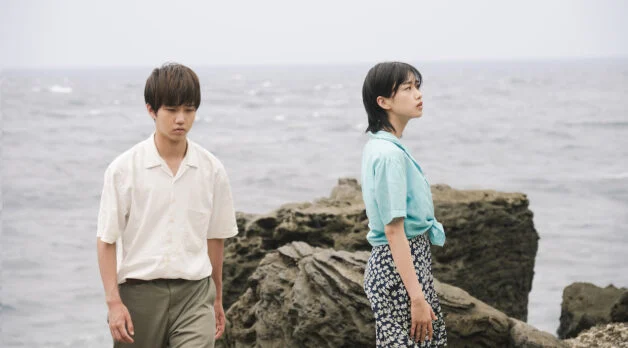
Miyake bridges these two stories through a "film-within-a-film" structure. The first segment, an adaptation of Tsuge’s "A View of the Seaside," follows two young people whose lives intersect at a coastal resort. However, Miyake frames this narrative through the eyes of a screenwriter named Li (portrayed by Shim Eun-kyung). As the internal film reaches its climax, the audience is abruptly pulled out of the fiction and into a classroom setting where Li and a director are conducting a post-screening Q&A session.
The second half of the film follows Li as she seeks creative inspiration for her next project. Mirroring the travel-heavy themes of Tsuge’s "Mister Ben of the Igloo," she journeys to a remote, snow-covered town. There, she stays at a crumbling inn managed by Benzo (Shinichi Tsutsumi), a brusque and enigmatic host. This shift from the vibrant, romantic warmth of the summer resort to the stark, realistic isolation of the winter inn creates a thematic resonance regarding the nature of storytelling and the reality of human displacement.
The Legacy of Yoshiharu Tsuge and "Gekiga"
To understand the cultural weight of Two Seasons, Two Strangers, one must consider the influence of Yoshiharu Tsuge. Emerging in the 1960s, Tsuge’s work deviated from the mainstream "manga for children" to create a more adult, literary form of graphic storytelling. His stories often lack traditional resolution, focusing instead on atmosphere and the psychological states of his characters.
In interviews regarding the adaptation, Miyake has noted that Tsuge’s protagonists often served as avatars for the artist himself. By making the protagonist of the film a screenwriter, Miyake attempted a "core-level" adaptation rather than a literal one. This choice allowed the director to explore the creative process itself—the act of projecting one’s experiences and anxieties onto a fictional canvas. Miyake’s approach respects the subcultural, "outsider" status of Tsuge’s work while translating its unique visual language into a cinematic mise-en-scène that evokes the domestic stillness of Ozu.

Theoretical Foundations: The Influence of Shiguéhiko Hasumi
Miyake’s directorial philosophy is deeply rooted in the teachings of Shiguéhiko Hasumi, a towering figure in Japanese film criticism and the former president of the University of Tokyo. Hasumi’s influence on Japanese cinema is extensive; he was a mentor to renowned directors such as Kiyoshi Kurosawa and Shinji Aoyama.
Miyake has credited Hasumi with shaping his foundational understanding of cinema, particularly through the lens of film history and the importance of the "image" over abstract concepts. Miyake worked with Hasumi on the essay film John Ford and Throwing, an experience that reinforced his focus on physical gestures. Hasumi’s critical approach emphasizes that everything necessary for understanding a film is present on the screen, provided the viewer knows how to look. This "aesthetic of the obvious" is visible in Two Seasons, Two Strangers, where the narrative often pauses to observe the way a character grills a fish or navigates a cluttered room.
Themes of Happenstance and Loneliness
A recurring theme in Miyake’s work is the concept of "circumstance versus happenstance." In his previous films, characters were often brought together by shared environments—a workplace or a neighborhood. However, Two Seasons, Two Strangers investigates the more precarious connections formed through travel.
Tourism, by its nature, involves shallow and temporary interactions. Miyake’s challenge was to determine if these fleeting moments could possess depth. The conversations between Li and the innkeeper, Benzo, are marked by a distinct awkwardness and a lack of "frictionless" communication. These interactions mirror the source material’s humor and existential weight, suggesting that true connection often requires navigating the discomfort of being strangers.
Miyake also utilizes visual motifs to underscore the duality of these experiences. A notable example is the use of a dead fish in both halves of the film. In the summer sequence, the dead fish serves as an ominous, almost surreal foreshadowing of a character’s emotional state. In the winter sequence, a fish being grilled in a traditional fire pit becomes a moment of warmth and humor. This repetition highlights Miyake’s belief in the "richness of film expression," where the same object can hold entirely different meanings depending on the context and the season.
Critical Reception and Broader Industry Implications
The success of Two Seasons, Two Strangers at international festivals like Locarno and its subsequent screenings at Lincoln Center and MoMA’s New Directors/New Films series underscore a growing appetite for Japanese indie cinema that moves beyond the established "prestige" names like Hirokazu Kore-eda or Ryusuke Hamaguchi.
The film’s North American run at venues like the Metrograph indicates a robust interest in Miyake’s specific brand of "slow cinema." Industry analysts suggest that Miyake represents a new wave of Japanese directors who are successfully blending traditional Japanese cinematic tropes with experimental narrative structures. This "New Wave" is characterized by a move away from Tokyo-centric stories toward the "outer prefectures" and rural landscapes, reflecting a broader demographic shift and a desire to capture the reality of a shrinking, aging Japan.
Furthermore, Miyake’s move from Tokyo to a more rural area in his personal life mirrors the journeys of his characters. This shift from the "normative" urban experience to the peripheral regions of Japan provides his work with a unique perspective on the country’s social fabric. By focusing on the "islands" and the "snow country," Miyake captures a side of Japan that is often overlooked in contemporary media, one defined by silence, history, and the persistent presence of the past.
Conclusion
Sho Miyake’s Two Seasons, Two Strangers is a testament to the enduring power of the cinematic diptych. By weaving together the subcultural legacy of Yoshiharu Tsuge with a modern meditation on the creative process, Miyake has crafted a film that is both a tribute to film history and a bold step forward for Japanese cinema. His focus on the "core" of human experience—the gestures, the silences, and the accidental meetings—confirms his status as a master of contemporary drama. As the film continues its international run, it stands as a pivotal work that invites audiences to not only watch but to truly see the world through a more patient and considered lens.