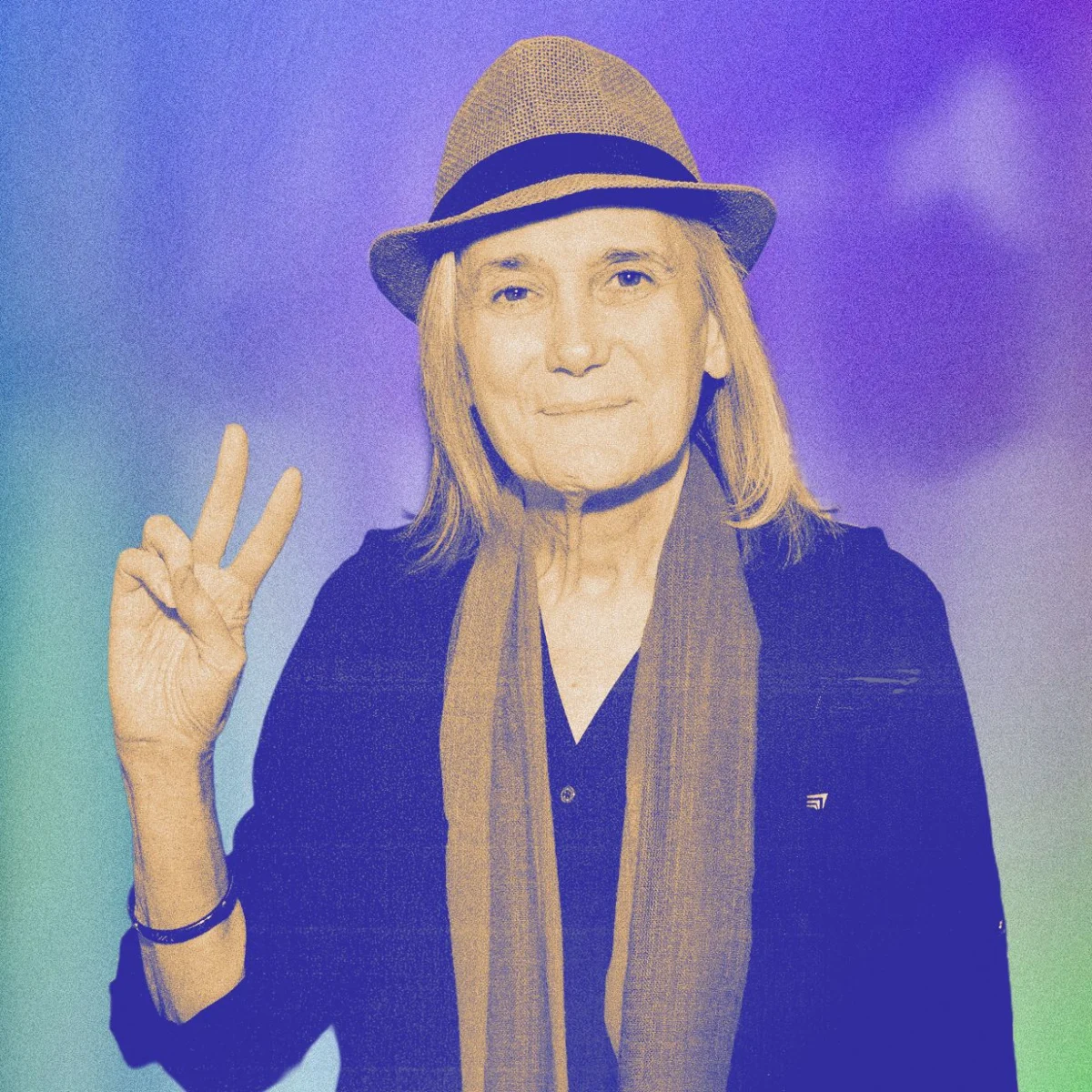
In the opening sequence of the new documentary film directed by Academy Award nominees Tia Lessin and Carl Deal, veteran journalist Amy Goodman is seen navigating a crowded convention hall at a United Nations climate summit in Katowice, Poland. The camera captures a persistent, high-stakes pursuit as Goodman attempts to interview P. Wells Griffith III, a senior energy adviser to the Trump administration. Despite Griffith’s attempts to evade the press and a staffer’s efforts to block the camera by closing a door in the reporter’s face, Goodman remains stationary, waiting for the slightest opening to fulfill her journalistic mandate. This scene serves as a microcosm for Goodman’s thirty-year career: a relentless, often physical commitment to confrontational reporting in the face of official obfuscation.
The documentary, which opened in theaters this week, provides a comprehensive retrospective of Democracy Now!, the independent news organization Goodman co-founded in 1996. The film chronicles the outlet’s evolution from a fledgling program on a handful of Pacifica Radio stations to a global media powerhouse broadcast on more than 1,500 public radio and television stations worldwide. While the film functions as a tribute to Goodman’s tenacity, it also places her in the rare position of being the interviewee. Goodman described the experience of being the subject of a documentary as "painful," calling it a "taste of my own medicine," yet she consented to the project to highlight the systemic necessity of independent media in a period of increasing corporate consolidation.
A Chronology of Adversarial Journalism
The historical arc of Democracy Now! is inextricably linked to the major geopolitical shifts and social movements of the late 20th and early 21st centuries. The documentary utilizes a vast archive of footage to trace Goodman’s trajectory, beginning with her early work as a producer at WBAI in New York.
One of the most pivotal moments in the film’s chronology is the 1991 Santa Cruz Massacre in Dili, East Timor. While covering the independence movement against the Indonesian occupation, Goodman and fellow journalist Allan Nairn witnessed Indonesian soldiers open fire on thousands of peaceful protesters. Goodman was badly beaten by soldiers, and Nairn suffered a fractured skull while attempting to protect her. This event solidified Goodman’s commitment to "trickle-up journalism," a philosophy that prioritizes the voices of those on the ground over the narratives provided by government officials and pundits.
Following the formal launch of Democracy Now! in 1996, the program became a vital alternative to mainstream coverage during the 1999 World Trade Organization protests in Seattle. However, it was the events of September 11, 2001, that cemented the program’s role as a critical dissenter. Operating from a converted firehouse just blocks from the World Trade Center, Goodman and her team provided on-the-ground reporting that questioned the subsequent rush to war in Afghanistan and Iraq, often standing alone as mainstream outlets adopted a more patriotic, less critical tone.
The documentary also highlights Goodman’s frequent encounters with the legal system. In 2008, during the Republican National Convention in St. Paul, Minnesota, Goodman was arrested and charged with obstructing a legal process while attempting to inquire about the arrest of two of her producers. In 2016, she faced "riot" charges in North Dakota after Democracy Now! aired footage of security guards using dogs and pepper spray against Native American protesters at the Standing Rock Sioux Reservation. The charges were eventually dismissed by a judge, a moment the film frames as a victory for the First Amendment.
The Philosophy of "Trickle-Up" Media
Central to the documentary’s narrative is the ethical framework Goodman calls "trickle-up journalism." This approach stands in direct opposition to the "top-down" model employed by many corporate media outlets, which rely heavily on a rotating cast of former government officials, military generals, and think-tank academics.
"We don’t believe in turning to the pundits, who know so little about so much," Goodman explains in the film. Instead, the program focuses on activists, community leaders, and subject-matter experts who are directly impacted by the policies being discussed. This model has allowed Democracy Now! to provide early and consistent coverage of movements that were initially ignored by the mainstream press, including the Occupy Wall Street movement, the fight for a $15 minimum wage, and contemporary protests regarding the conflict in Gaza.
The title of the film, Steal This Story, Please!, encapsulates Goodman’s unconventional view of journalistic competition. In an industry where "exclusives" are the primary currency, Goodman argues that a story only reaching a limited audience is a failure. By encouraging other outlets to "steal" or pick up their reporting, Democracy Now! aims to saturate the public discourse with information that might otherwise be marginalized. This open-source philosophy is reflected in the program’s distribution model, which allows any non-commercial station to broadcast the show for free.
Sustainability in the Post-Corporate Era
The documentary provides a rare look at the operational and financial mechanics of a successful non-profit newsroom. Unlike the majority of American media outlets, which are owned by a shrinking number of massive conglomerates, Democracy Now! refuses all corporate sponsorship, government underwriting, and advertising revenue.
According to Julie Crosby, the executive director of the non-profit, the outlet’s growth has been fueled by a direct-to-audience support model. While many independent outlets have struggled with the transition to digital-first consumption, Democracy Now! has thrived by avoiding the "paywall" model. Crosby notes that the absence of a subscription barrier is a primary engine of their growth, ensuring that their reporting remains accessible to low-income communities and international audiences.
Data regarding the program’s reach illustrates its significant impact:
- Broadcast Reach: Over 1,500 stations globally.
- Digital Footprint: Millions of monthly views on YouTube and social media platforms.
- Financial Independence: 100% listener and viewer-supported.
The film also explores the outlet’s relationship with emerging technologies. While Democracy Now! was an early adopter of RSS feeds and digital MP3 distribution, it maintains a cautious stance toward artificial intelligence. Crosby emphasizes that while AI is used for efficiency in transcription and translation, the organization refuses to use the technology for content generation, citing the need to maintain absolute audience trust. This "conservative" approach to tech is designed to insulate the program from the volatility of Silicon Valley algorithms, which have recently decimated the traffic of many digital-upstart news sites.
Implications for the Future of the Press
The release of Steal This Story, Please! comes at a precarious moment for the American media landscape. The documentary contextualizes Goodman’s career against a backdrop of mass layoffs at legacy institutions like The Washington Post and the impending merger of Paramount and Warner Bros. Discovery. Goodman expresses deep concern over the "skittishness" of media executives who may prioritize corporate stability over adversarial reporting.
The film posits that the survival of democracy is contingent upon the existence of a press that is not beholden to the interests of the powerful. Former President Bill Clinton once described Goodman as "hostile and combative," a characterization she wears as a badge of honor. To Goodman, being viewed as "combative" by those in power is the definitive proof that a journalist is doing their job.
As the documentary concludes, the focus shifts from Goodman’s past achievements to the future of the profession. The film argues that the Democracy Now! model is no longer a fringe experiment but a necessary blueprint for the future of journalism. By documenting the rise of an icon who refuses to be silenced, Lessin and Deal’s film serves as both a historical record and a call to action for the next generation of reporters.
Goodman’s final reflections in the film underscore the urgency of the moment: "Independent media is essential to the functioning of a democratic society. We have to fight for it. We have to stand up for it. We have to make the country safe for dissent." In an era of misinformation and corporate retrenchment, Steal This Story, Please! suggests that the most radical act a journalist can perform is simply to keep asking questions until the door is forced open.