Haruhiko Arai’s latest cinematic offering, "The Stars and the Moon Are Holes in the Sky" (Hoshi to tsuki wa ten no ana), has recently made its international debut at the prestigious Hong Kong Film Festival, following its initial release in Japan in December 2025. This film marks a significant moment for the veteran Japanese filmmaker, known primarily for his prolific work as a screenwriter within the established genre of softcore sex films, or "pink eiga," a subgenre that has garnered international recognition over several decades. Arai’s directorial journey, which began later in his career, continues to explore complex psychological narratives often tinged with an arthouse sensibility, a characteristic that is once again evident in his newest work.
A Legacy Forged in "Pink Eiga" and Arthouse Cinema
Haruhiko Arai’s deep roots in Japanese cinema are inextricably linked to the "pink eiga" genre. His formative years were spent as an assistant under the tutelage of the legendary Koji Wakamatsu, a filmmaker synonymous with the genre’s early golden age. Wakamatsu’s radical and often scandalous works, such as "Violated Angels" (1967) and "Ecstasy of the Angels" (1972), pushed the boundaries of cinematic expression and societal norms. Arai absorbed this ethos, channeling it into his own screenwriting for prominent directors like Tatsumi Kumashiro ("The Woman with Red Hair," 1979) and Ryuichi Hiroki ("Vibrator," 2003). These scripts largely adhered to the established conventions of "pink eiga," exploring themes of desire, alienation, and societal constraints through an erotic lens.
However, Arai’s creative trajectory took a turn towards directorial endeavors in 1997, at the age of 50, with his debut feature, "Body and Soul." This marked a departure, or rather an evolution, from his screenwriting past. While his directorial efforts, including "The Stars and the Moon Are Holes in the Sky," continue to feature erotic elements, they are consistently imbued with a distinct arthouse aesthetic. This fusion of genre exploration with artistic ambition has become a hallmark of Arai’s directorial output, leading to films that are both provocative and aesthetically sophisticated.
A Cinematic Homage to a Pivotal Era
"The Stars and the Moon Are Holes in the Sky" resonates visually with the groundbreaking Japanese New Wave of the 1960s and 1970s. This period, often associated with the output of the Art Theatre Guild production company and visionary directors such as Nagisa Oshima, Masahiro Imamura, and Seijun Suzuki, was characterized by experimental filmmaking, social commentary, and a rejection of traditional narrative structures. Arai’s deliberate choice to set the film in 1969 is no accident. This year was a particularly fertile period for Japanese cinema, witnessing the release of landmark films like "Boy" (Masaki Kobayashi), "Double Suicide" (Masahiro Shinoda), and "Funeral Parade of Roses" (Toshio Matsumoto), all of which challenged cinematic conventions and explored complex human conditions.
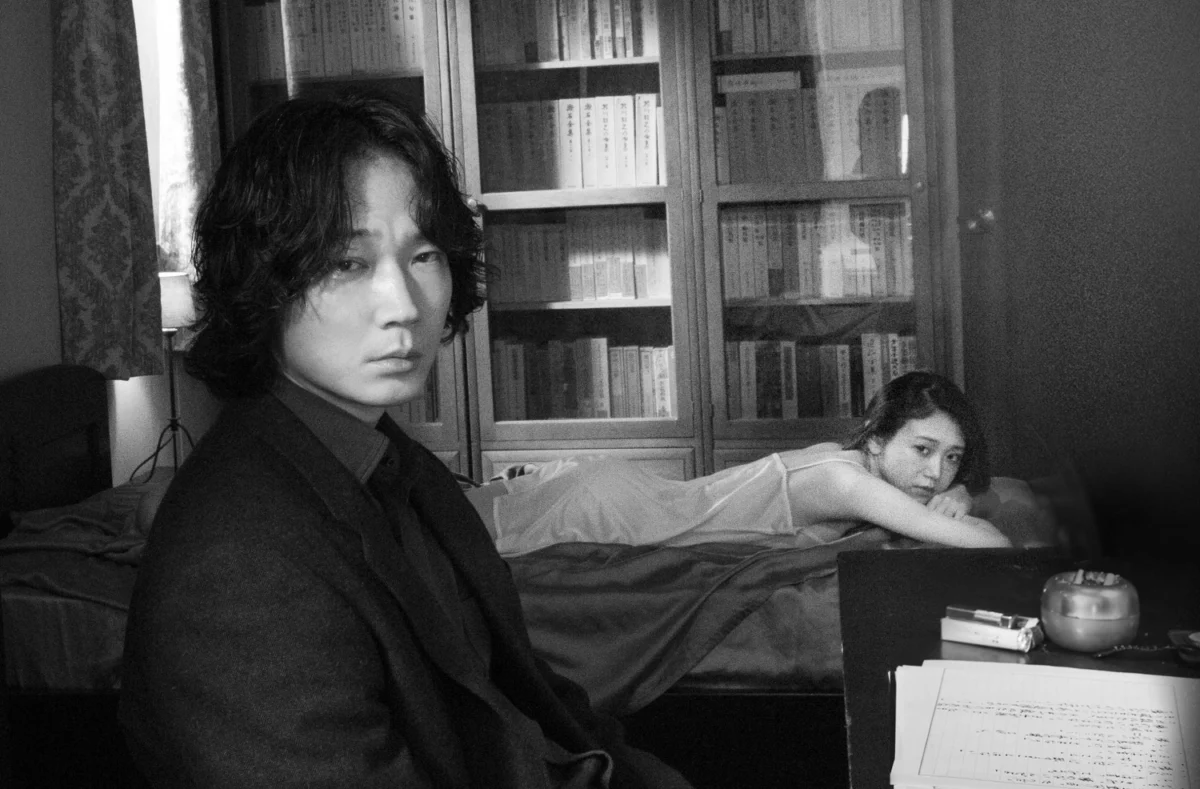
The film’s source material, Junnosuke Yoshiyuki’s novel, also hails from 1966, further anchoring the narrative within this influential era. Arai’s visual language in "The Stars and the Moon Are Holes in the Sky" pays homage to this cinematic heritage. The use of grainy black-and-white cinematography, with images that are not always in sharp focus, contributes to a sense of atmospheric introspection and artistic intentionality. Occasional, striking splashes of red, such as a child’s lips sealing a letter with a lick, serve as visual punctuation, drawing attention to moments of subtle emotional intensity or symbolic significance. This experimental approach extends to the narrative style, which deliberately eschews strict conventionality. For instance, passages of text written by the protagonist, the writer Katsuji Yazoe, are presented on screen for extended periods, creating moments of temporal suspension where the visual action halts, allowing the audience to engage with Yazoe’s internal world.
The Enigma of Katsuji Yazoe: A Man Out of Time
The film’s central figure, Katsuji Yazoe, exclusively referred to as such throughout the narrative, is a man who seems to exist in a state of arrested development, particularly in his perception of women and relationships. Set in 1969, Yazoe embodies an image of masculinity and relational dynamics that was arguably already becoming anachronistic. He views women primarily as objects of sexual desire and intellectual study, evaluating them solely on their physical attributes and actively avoiding any form of deeper emotional connection.
However, the film gradually peels back the layers of Yazoe’s seemingly impenetrable emotional armor. Beneath the façade of a macho man lies a man burdened by significant emotional wounds. These are partly attributed to the departure of his ex-wife thirteen years prior, a trauma that has clearly left an indelible mark. A more peculiar, and perhaps deliberately obscure, source of his internal turmoil is revealed: at the age of 43, Yazoe already wears a full set of dentures. This detail, which he frantically tries to conceal from the women in his life, hints at a deeper vulnerability and a profound fear of aging and physical decay, a fear that contrasts sharply with his outward persona. This internal conflict, between his projected image and his hidden insecurities, forms the crux of his character development.
A Triumvirate of Female Encounters
Yazoe’s interactions with three distinct women form the narrative backbone of "The Stars and the Moon Are Holes in the Sky." Each encounter offers a different facet of his complex and often troubled psyche.
First, there is Chieko (Rena Tanaka), a prostitute with whom Yazoe maintains a form of "long-term relationship." Chieko, pragmatic and perhaps weary of Yazoe’s emotional games, does not appear to take him overly seriously, offering a grounding counterpoint to his introspective struggles. Her character provides a stark view of transactional relationships, yet her interactions with Yazoe hint at a complex understanding of human need.
Next, Yazoe encounters Noriko (Sakuya), a student he meets at an art gallery. Noriko appears devoted to Yazoe, and their connection is characterized by shared, and at times, peculiar sexual preferences. As their relationship develops, Yazoe begins to recognize that Noriko possesses her own burgeoning sense of agency and individuality, a development that challenges his preconceived notions of female submissiveness. This encounter probes the dynamics of power and control within relationships, and the unexpected emergence of independent thought.
Finally, a very young girl, referred to by Yazoe as "B-ko" (Akari Misaki), is introduced to him through Chieko’s employer. Yazoe sees in B-ko a project, an opportunity to mold her into the idealized female protagonist for his long-unfinished autobiographical novel. This desire to control and shape another person reflects his own deep-seated insecurities and his attempt to impose order on his chaotic inner world through creative fiction. B-ko represents a potential for both creation and exploitation, a mirror to Yazoe’s own conflicted desires.
Critical Reception and Lingering Questions
Despite the artistic merits and the strong performances from its lead actresses, "The Stars and the Moon Are Holes in the Sky" has also drawn criticism for certain narrative inconsistencies. While the female characters are generally perceived as well-developed and compelling, the film struggles to convincingly explain their collective attraction to Yazoe, a character described as moderately attractive and moderately successful, who repeatedly exhibits rather boorish behavior. The justification of sexual passion, even in the case of the seemingly docile Noriko, is not always a sufficient explanation for their continued engagement with him.
The film’s exploration of Yazoe’s self-pity, while central to his character, is noted by some critics as veering into maudlin territory, at times making the viewing experience challenging. Even with an understanding of Arai’s intent to provoke and portray a character out of touch with contemporary sensibilities, the sheer intensity of Yazoe’s self-absorption can be difficult to endure. The film’s provocative nature, intended to challenge audiences, is sometimes perceived as lacking sufficient sharpness, becoming repetitive and eventually, even annoying. The leisurely pacing and the film’s considerable runtime of 122 minutes have also been cited as factors contributing to this effect.
Technical Prowess and Artistic Collaborations
On a technical level, "The Stars and the Moon Are Holes in the Sky" is widely regarded as proficient. Cinematographer Koichi Kawakami, a frequent collaborator with Arai, has been instrumental in crafting the film’s distinctive arthouse visual style. His work imbues the film with a specific mood and texture that complements the narrative’s introspective and experimental nature.
The musical score is provided by the renowned composer Itsuro Shimoda. Shimoda’s involvement is particularly noteworthy, given his historical connection to the Japanese New Wave. At the age of 23, in 1971, he composed the score for Shuji Terayama’s seminal pamphlet film, "Throw Away Your Books, Rally in the Streets." This earlier collaboration with Arai on the 2018 film "It Feels So Good" underscores a long-standing artistic partnership and a shared sensibility that likely informs the atmospheric and evocative soundscape of "The Stars and the Moon Are Holes in the Sky."
Performances and the Unveiling of Vulnerability
The film’s greatest strength, as acknowledged by many viewers and critics, lies in its ensemble of actresses. Rena Tanaka, in particular, is lauded for her robust portrayal of Chieko, a character who navigates Yazoe’s machismo with a notable degree of clear-sightedness and resilience, appearing least swayed by his self-aggrandizing pronouncements. The younger actresses, Sakuya and Akari Misaki, are also commended for their convincing performances in demanding roles that require them to convey complex emotional states and evolving character arcs.
Go Ayano, an experienced actor with an extensive filmography, plays Katsuji Yazoe. While he delivers a competent performance, there are instances where he appears somewhat constrained by the character’s limitations. The narrative, as written by Arai, offers Yazoe little room for outward expression beyond his self-absorbed pronouncements and internal turmoil, leaving Ayano to convey much of the character’s hidden vulnerability through subtle nuances. This artistic choice, while central to Arai’s thematic exploration, can sometimes present a challenge for the actor in fully animating the character’s inner life beyond his stated insecurities.
Contextualizing "The Stars and the Moon Are Holes in the Sky"
The film’s release and international premiere at the Hong Kong Film Festival place it within a broader context of global arthouse cinema and the continued interest in auteur-driven narratives. The festival, a significant platform for Asian cinema, provides an international audience with exposure to the work of established Japanese filmmakers like Haruhiko Arai. The film’s thematic concerns—identity, masculinity, the lingering impact of past traumas, and the complexities of human connection—are universal, yet are explored through a distinctly Japanese cinematic lens shaped by a rich history of artistic experimentation and social commentary.
The critical reception, while mixed in certain aspects, highlights the film’s artistic ambition and its commitment to exploring challenging subject matter. The debate surrounding the believability of female attraction to Yazoe and the perceived excesses of his self-pity speaks to the film’s success in provoking thought and discussion, even if not always in universally positive ways. Arai’s persistent exploration of the darker, more uncomfortable aspects of human psychology, rooted in his "pink eiga" background and elevated by his arthouse sensibilities, continues to carve out a unique space in contemporary Japanese cinema. The film’s inclusion in international festivals suggests a continuing appetite for such nuanced and artistically driven narratives, even when they push the boundaries of conventional storytelling and audience comfort.