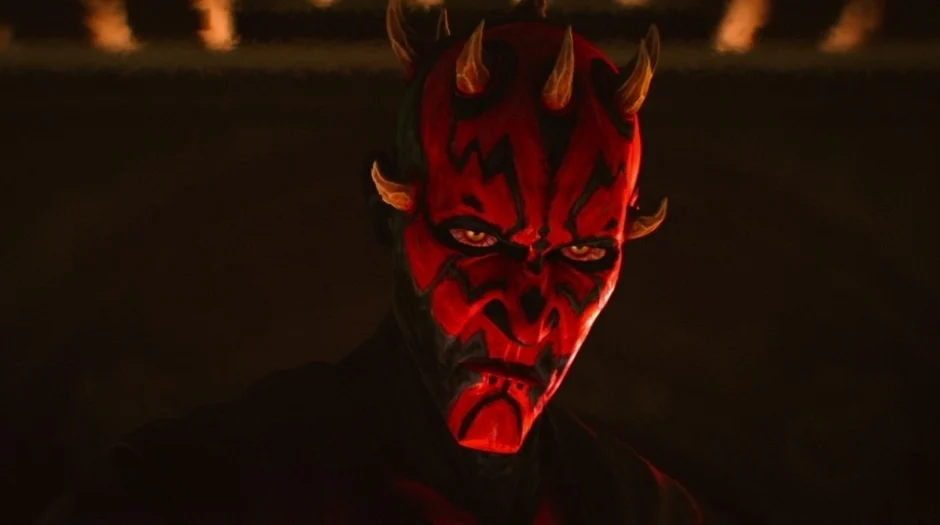
The highly anticipated Star Wars: Maul – Shadow Lord has officially landed on Disney+, offering fans an in-depth exploration of one of the saga’s most enduring and complex villains. The series, which premiered today, delves into the post-Clone Wars era, charting Maul’s attempts to re-establish his criminal empire on a galaxy sector untouched by Imperial rule. This new narrative arc introduces a compelling dynamic as Maul encounters a disillusioned young Jedi Padawan, hinting at a potential, albeit unconventional, apprenticeship.
The project marks a significant milestone for Sam Witwer, the Emmy-nominated actor who has lent his distinctive voice to Darth Maul for an impressive 15 years. His journey with the character began in 2011 with Star Wars: The Clone Wars, a role that, he reveals, was not a matter of auditioning but rather of being chosen.
A Voice Discovered: The Genesis of Witwer’s Maul
"The only Star Wars audition I’ve ever had was for Star Wars: The Force Unleashed game in 2007," Witwer shared in a recent interview. "My pal David Collins slipped my headshot into the pile to get me that audition. And once Force Unleashed was successful, director Dave Filoni brought me and Adrian Wilkinson in to do three Clone Wars episodes. I was a character called The Son of Mortis, who was meant to be an avatar for the Dark Side of the Force. Dave started hinting that there was something down the road but I had no clue George [Lucas] had told him they were bringing back Darth Maul, and that Dave was thinking that I should be the guy to do it."

This serendipitous casting has led Witwer to embody Maul across a diverse range of Star Wars media, including pivotal roles in Solo: A Star Wars Story, Star Wars Rebels, LEGO Star Wars: Rebuild the Galaxy, and now, Star Wars: Maul – Shadow Lord. His consistent portrayal has solidified his connection with the character and the fandom.
"I’m just grateful that it seems to have worked for the audience, because I think we were very concerned that it might not work," Witwer admitted. "I’m surprised every time they bring him back."
Chronology of a Sith Lord’s Return
The revival of Darth Maul as a central figure in the Star Wars narrative is a testament to the character’s enduring appeal and the creative team’s commitment to expanding the galaxy’s lore.
- 2007: Sam Witwer’s initial Star Wars involvement begins with an audition for the video game Star Wars: The Force Unleashed.
- 2011: Witwer first voices Darth Maul in Star Wars: The Clone Wars, following his earlier role as The Son of Mortis. This marked the character’s dramatic return to canon after his perceived demise in Star Wars: Episode I – The Phantom Menace.
- 2014-2018: Witwer continues to voice Maul in Star Wars Rebels, further developing the character’s post-Clone Wars arc and his complex relationship with his former apprentice, Ezra Bridger.
- 2018: Maul appears in Solo: A Star Wars Story, providing a brief but impactful cameo that bridges the gap between the animated series and the original trilogy era.
- 2022: LEGO Star Wars: Rebuild the Galaxy features Maul, showcasing the character in a lighter, more comedic context.
- 2024: Star Wars: Maul – Shadow Lord premieres on Disney+, offering a dedicated series to explore Maul’s psyche and ambitions.
The decision to bring Maul back from the dead was a significant narrative choice by George Lucas and Dave Filoni. Initially, Maul’s fate seemed sealed in The Phantom Menace. However, the success of The Clone Wars and the creative team’s desire to explore the consequences of the Jedi-Quinlan Vos’s mission and Maul’s subsequent machinations created an opportunity for his resurrection. This narrative choice has allowed for a profound re-examination of his character, transforming him from a one-dimensional villain into a tragic figure driven by vengeance and a desperate search for purpose.

Unveiling Star Wars: Maul – Shadow Lord
Set after the tumultuous events of Star Wars: The Clone Wars, Star Wars: Maul – Shadow Lord positions Maul in a precarious state, seeking to rebuild his fractured criminal empire. The series is developed by Filoni and Matt Michnovetz, reuniting a core Lucasfilm Animation creative team including supervising director Brad Rau, animation supervisor Keith Kellogg, visual effects supervisor Joel Aron, and producer Athena Yvette Portillo.
The narrative focuses on Maul’s efforts to establish a base of operations on a planet that has remained a blind spot for the burgeoning Galactic Empire. It is within this isolated environment that he encounters a young, disillusioned Jedi Padawan, setting the stage for a complex and potentially dangerous mentorship. This premise allows for a deep dive into Maul’s philosophy, his methods of manipulation, and his capacity for both cruelty and, perhaps, a twisted form of guidance.
The series boasts an impressive ensemble cast beyond Witwer’s central performance. Notable voice actors include Gideon Adlon as Devon Izara, Wagner Moura as Brander Lawson, Richard Ayoade as Two-Boots, Dennis Haysbert as Master Eeko-Dio-Daki, Chris Diamantopoulos as Looti Vario, Charlie Bushnell as Rylee Lawson, Vanessa Marshall as Rook Kast, A.J. LoCascio as Marrok, and Steve Blum as Icarus. Witwer’s long-time friend, David Collins, also joins the cast as Spybot, further highlighting the collaborative spirit behind the project.
The Craft of Voicing a Legend
Witwer’s approach to voicing Maul has always been rooted in a deep understanding of character development and emotional resonance. He emphasizes that the process is far more than simply adopting a voice; it’s about inhabiting the character’s experience.

"It never occurred to me that there would be a Maul show," Witwer stated. "And you would think that, after playing the character for 15 years, I could just drop into it. But, as any experienced voiceover person will tell you, it’s not about making funny sounds in a certain sequence. You’re creating a human experience for yourself and you’re experiencing it in front of the microphone instead of in front of the camera. And for Maul, it was all about, ‘What are those human experiences that he is having that we’ve never witnessed him have?’ Eventually, it became clear to me how to play this character. But it took a lot of experimentation. There’s so much stuff that hit the cutting room floor, and we just kept iterating until it felt right."
His initial immersion into the character began with extensive discussions with Dave Filoni prior to recording the first lines for The Clone Wars. "We talked about it for months before we recorded even a single line, which was really great for me because I was a very green voice actor at the time," Witwer recalled. "So, we talked obsessively about who the character was before we recorded. It’s interesting because Dave seemed to believe that, if we agreed on who [Maul] was and what he wanted and what that character was in totality, the voice would just kind of follow. He never, ever said to me, ‘It needs to sound like this.’"
Building a Three-Dimensional Villain
The foundation for Witwer’s nuanced portrayal was laid by building upon Peter Serafinowicz’s initial voice work in The Phantom Menace. "The building blocks for me were Peter Serafinowicz’s performance in The Phantom Menace. He had three brief lines, but it gave me a tonality to springboard off of. But we slowly branched off to what me and Dave felt truly was appropriate for the character," Witwer explained.
The creative team aimed to imbue Maul with a complexity that transcended typical villain archetypes. "The first thing we decided was that, because apprentices are highly trained and highly prized, this guy would be well-read. He would be strategic; he would be tactical. He would have so many more tools at his disposal on top of the combat prowess. We started talking about Smeagol and Gollum from The Lord of the Rings. We were talking about Colonel Kurtz from Apocalypse Now. This was going to be as three-dimensional a character as we could possibly make him." This approach aimed to provide Maul with a rich inner life, influenced by a spectrum of literary and cinematic figures known for their psychological depth and moral ambiguity.

Deeper Exploration in Shadow Lord
Star Wars: Maul – Shadow Lord provided Witwer with an unprecedented opportunity to delve into Maul’s psyche, allowing for a more profound character exploration than previously possible. "It allowed us the screen time and the point of view to delve into what was going on with him," Witwer observed. "I remember bringing up a couple of ideas during The Clone Wars days that I thought would be cool to explore with Maul, but we couldn’t really spend the time to go into that kind of detail. Dave would say, ‘That’s cool. But it’s not Maul’s show, so we can’t really do that.’ But, in this show, the story is about [Maul] getting to know himself. In The Clone Wars, he’s chased everywhere. He’s breathless. He doesn’t have a moment to himself for any kind of reflection. In this series, he does."
The ten-episode structure of Shadow Lord allowed for a deliberate pacing of Maul’s emotional and psychological arc. "There was no need for Maul to get too hot, too fast," Witwer noted. "We took our time to build the character for a new audience. But, later on, he does lose his temper for the first time. And then, in Episode 8, we see very deeply into his lived experience. In Episode 9 and 10, he’s on a runaway train to destiny. But we wanted to take our time and not have him be up in your face so much because, I mean, he’s going to be anyway."
Witwer found the close-up shots in Shadow Lord particularly rewarding, allowing for a more subtle and nuanced performance. He also praised the "extraordinary designs" of the character, which facilitated a more dynamic interplay between his vocal performance and the animation. "I suppose this version of Maul is more of what I would have done in live-action," Witwer commented. "I’m not pushing much out. I’m kind of letting things happen. The way that they shoot the episodes, the way that they create the filmic nature of this series, really lends itself toward that. So, it made sense to play him more like I would have on a set."
Collaboration and Craft: A Symbiotic Process
The production of Star Wars: Maul – Shadow Lord involved a close collaborative effort between Witwer and the animation department, with Witwer even providing video references to illustrate his intended emotional beats and character actions. "It’s just adding more ideas to the pot, and it helps get us on the same page as to what I was intending in the recording room," Witwer explained. "When the animation department and the actors are in lockstep, there are times where I don’t have to go as far vocally to get the same point across, because the animators are going to take that and run with it. They’ll do that little eye thing that makes the vocal pause make sense. This series was a real exploration of the craft and coordinating with the different departments so that the performances could be more nuanced, more layered. If I were to do Shadow Lord as just an audiobook, I would play it a lot differently. But when I’m working with the animation department, we can create the character in a way that takes advantage of the medium."

Despite the creative fulfillment, Witwer described Shadow Lord as one of his most challenging projects. "Some shows are harder than others, but this one ranks among the hardest because I’m so invested in the people on the show," he stated. "Athena Portillo is one of my closest friends. David Collins has been one of my closest friends since I was 22. You’re kind of in a foxhole with your buddies and you’re looking out for each other and you’re trying to solve problems as fast as you can."
This strong camaraderie within the production team, comprised of many who worked on The Clone Wars and Rebels, was instrumental in navigating the demanding production schedule. "We’re the same crew, the same people who did Clone Wars and Rebels, so I know Keith Kellogg and I know Joel Aron and I know Stewart Lee, one of our extraordinary directors," Witwer said. "These are people who I am invested in personally and that makes it worth it for me, working with people I’m fond of. I’ll be honest. I don’t know that we would have survived if that wasn’t the case. No one really thinks about how fast you have to move to make these things, in a sliver of time much faster than if you were on your own sharpening your craft. When you’re working that fast, you’re really relying on your friends, their insight and their feedback. It’s a huge trust exercise as this train is going 100 mph and you’re lying on the track trusting each other to be good at what you do."
The dedication and trust within the team were paramount to achieving the final product. "Nothing about this project was easy. But hopefully, when people watch it, it feels breezy and inevitable," Witwer concluded.
The release of Star Wars: Maul – Shadow Lord on Disney+ not only provides a compelling narrative for a beloved character but also underscores the evolving landscape of Star Wars storytelling, offering deeper dives into the complexities of its universe and its inhabitants.

Trailers and Recaps
Fans can get a glimpse of the new series through the official trailer and a "Maul Reflections" recap video, both available online:
- Trailer: [YouTube link for the trailer]
- Maul Reflections Recap: [YouTube link for the recap]
These supplementary materials offer further insight into the series’ visual style, thematic elements, and the character’s journey.
Broader Impact and Implications
The success of Star Wars: Maul – Shadow Lord has significant implications for the Star Wars franchise. It demonstrates a continued audience appetite for exploring the nuances of its antagonists, moving beyond simplistic good versus evil dynamics. By dedicating an entire series to Maul’s post-Empire trajectory, Lucasfilm Animation is solidifying its commitment to rich character studies, much like it did with The Clone Wars and Rebels. This approach not only deepens the lore for dedicated fans but also provides a gateway for new audiences to engage with the franchise’s more complex themes. The series’ success could pave the way for further explorations of other morally ambiguous characters within the Star Wars universe, potentially expanding the narrative horizons of the galaxy far, far away.