In an era defined by a complex intersection of technological advancement and labor instability, the entertainment industry is witnessing the emergence of a new production paradigm. Innovative Dreams, a pioneering hybrid production services company, has officially launched its operations, signaling a strategic shift in how content is conceived, captured, and finalized. Backed by industry heavyweights including Amazon Web Services (AWS) and the generative AI startup Luma, the studio aims to integrate artificial intelligence into every phase of the filmmaking process. By merging traditional cinematography with virtual production, motion capture, and generative AI tools, Innovative Dreams seeks to provide a solution to the escalating costs and logistical hurdles that have recently paralyzed much of the Southern California production landscape.
The company’s debut comes at a critical juncture for Hollywood. Following a year of historic labor strikes and a significant contraction in production spending, the industry is searching for sustainable models that can maintain high-quality output while adhering to increasingly stringent budgets. Innovative Dreams positions itself not as a replacement for human creativity, but as a technological catalyst designed to keep production domestic and efficient.
The Genesis of a Hybrid Production Model
Innovative Dreams was born out of the practical necessities faced by director Jon Erwin during the production of "House of David," a large-scale historical drama produced for Amazon Prime Video. Erwin, who also founded the production studio Wonder Project, encountered the perennial challenge of filming epic, historical narratives that required numerous international locations and complex period-accurate environments. To solve these logistical constraints, Erwin’s team began experimenting with generative AI and virtual production tools to recreate far-flung locales within a controlled soundstage environment.
The success of these experiments served as the proof of concept for Innovative Dreams. Erwin observed that by utilizing AI to assist in the creation of digital assets and environments, the production could achieve a scale previously reserved for the highest-budget tentpole features. "It was a game-changer in House of David," Erwin noted, reflecting on the realization that few other studios were currently integrating these tools in a holistic, end-to-end manner. This led to the formal establishment of Innovative Dreams as a dedicated service provider for other filmmakers looking to navigate the high costs of modern production.
Technological Architecture: Fusing Physical and Digital Realities
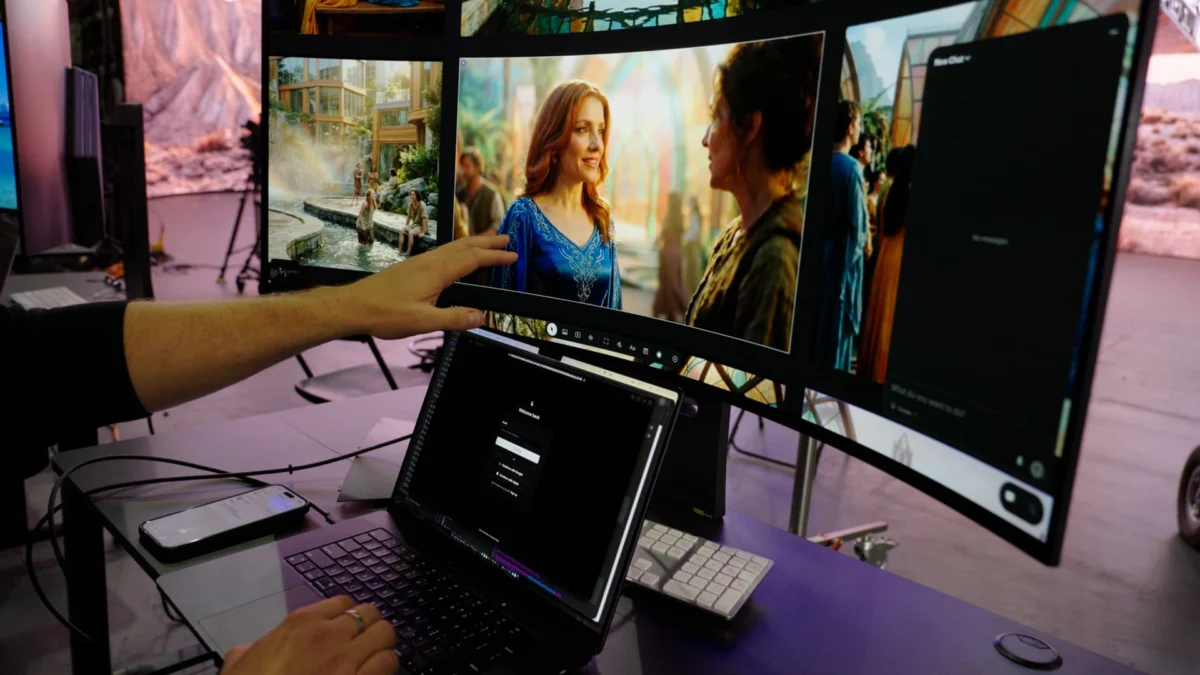
The infrastructure of Innovative Dreams is built upon a "hybrid" philosophy. Unlike purely digital animation or fully generative video, which can sometimes lack the nuance of human performance, the studio utilizes a "performance-first" approach. The facility features a massive LED wall—often referred to in the industry as a "Volume"—combined with advanced motion capture technology.
The workflow integrates a suite of sophisticated AI tools, including Luma’s generative engines, Google’s Nano Banana, and Bytedance’s SeeDream. These tools are used to augment the physical elements captured on set. For instance, an actor can perform on the soundstage in a basic costume, which is then digitally enhanced or entirely replaced in post-production using AI-driven "digital wardrobe" mapping. This allows the filmmaker to maintain the actor’s original performance, lens choice, and camera movement while digitally altering the surrounding world or the characters’ appearances with high fidelity.
According to Erwin, this method preserves the essential elements of filmmaking—acting and cinematography—while stripping away the prohibitive costs of location scouting, travel, and physical set construction. The AI acts as a bridge, allowing digital assets to react realistically to the lighting and movements of the physical actors on stage.
Case Study: "The Old Stories: Moses"
The efficiency of this new workflow is currently being demonstrated through the production of "The Old Stories: Moses," a three-part series starring Academy Award winner Ben Kingsley. The project, which is scheduled for a spring release, serves as a benchmark for the studio’s capabilities.
Under a traditional production model, a series of this scope—requiring approximately 40 distinct locations—would typically necessitate five to six weeks of principal photography, involving significant travel and set-building expenses. However, utilizing the Innovative Dreams soundstage and AI integration, the production team was able to complete the shoot in a single week. By projecting global locations onto the LED screens and using AI to refine the environmental details, the studio achieved a massive scale on a fraction of the traditional budget. This rapid turnaround highlights the potential for AI to drastically accelerate production cycles without sacrificing the "prestige" look required for modern streaming platforms.
Strategic Partnerships and Infrastructure
The computational demands of real-time AI video generation and virtual production are immense, requiring infrastructure that exceeds the capabilities of traditional post-production houses. To meet these needs, Innovative Dreams has entered into a strategic partnership with Amazon Web Services (AWS). As an investor and infrastructure provider, AWS supplies the cloud computing power necessary to run real-time hybrid production tools.

Samira Bakhtiar, General Manager of Media, Entertainment, Games, and Sports at AWS, emphasized that the goal is to empower filmmakers to collaborate at a scale and speed previously thought impossible. The involvement of AWS signals a broader trend of "Big Tech" companies becoming foundational pillars of the entertainment supply chain, providing the "pipes" through which the next generation of cinema will be built.
Furthermore, the partnership with Luma, a generative AI startup valued at over $4 billion, provides Innovative Dreams with access to cutting-edge "agent" tools. These tools allow for a collaborative workspace where multiple AI services can be managed simultaneously. Erwin’s team provides direct feedback to Luma, effectively shaping the development of AI tools to better suit the specific ergonomic and creative needs of professional directors and cinematographers.
The Economic Reality: Hollywood in Transition
The launch of Innovative Dreams occurs against a backdrop of significant economic distress in Los Angeles. Data indicates that Los Angeles County has lost more than 40,000 entertainment industry jobs since 2022. This decline is attributed to several factors: the aftermath of the COVID-19 pandemic, the 2023 writers and actors strikes, and a general "contraction" as studios pivot from a growth-at-all-costs streaming model to a focus on profitability.
Production activity in Los Angeles recently fell to its lowest level since 1995, as many projects have moved to regions with more aggressive tax incentives or lower labor costs. Entertainment attorney Jonathan Handel points out that the industry has been "battered by one shock after another," with overall spending and production volume down by 25% to 35% compared to pre-pandemic levels.
In this context, Erwin argues that AI-powered studios are not the cause of job losses, but rather a potential cure for the industry’s "unsustainable" trajectory. By lowering the "green light" threshold—the cost at which a project becomes financially viable—Innovative Dreams aims to bring productions back to Southern California. Erwin posits that by making it affordable to film locally, the studio can help stabilize the local workforce.
Labor Concerns and the Future of Craft
Despite the optimistic outlook from the studio’s leadership, the rise of AI in filmmaking remains a deeply polarizing issue. The 2023 strikes by the Writers Guild of America (WGA) and the Screen Actors Guild (SAG-AFTRA) were driven largely by fears that AI would be used to bypass human labor or exploit the intellectual property of creators.
The "hybrid" model proposed by Innovative Dreams raises specific questions regarding the future of craft departments, such as set design, makeup, and costuming. If environments and wardrobes can be "mapped" onto actors digitally using AI, the demand for physical set builders and costume designers may shift or diminish. Jonathan Handel notes that while "job augmentation" is possible, the potential for "job displacement" remains a source of significant anxiety.
There is also a concern regarding the "on-ramps" for new talent. Many entry-level positions in the film industry involve the physical labor of production—tasks that are most susceptible to being streamlined by AI. If these roles disappear, the industry may face a long-term talent vacuum. Erwin acknowledges these shifts but suggests that the most skilled workers will adapt, utilizing AI to enhance their own creative output rather than being replaced by it.
Analysis of Implications and Industry Outlook
The emergence of Innovative Dreams represents a broader trend toward the "democratization of scale." Historically, only major studios with nine-figure budgets could afford to create sprawling, multi-location epics. AI and virtual production are lowering that barrier to entry, potentially allowing independent creators to produce content with high production value.
However, the long-term impact on the Hollywood ecosystem remains to be seen. If the Innovative Dreams model becomes the industry standard, it could lead to:
- Centralization of Production: A move away from global location scouting toward centralized "super-studios" located in tech-heavy hubs.
- Shift in Skillsets: A requirement for traditional film crews to become proficient in digital asset management and AI prompting.
- Content Proliferation: A surge in high-quality niche content as the cost of "epic" storytelling drops.
As "The Old Stories: Moses" nears its debut, the industry will be watching closely to see if the quality of AI-augmented filmmaking can truly match the standards of traditional cinema. For Jon Erwin and his partners at AWS and Luma, the goal is clear: to prove that technology can be a lifeline for an industry in crisis, providing a new method to sustain the art of filmmaking in an increasingly expensive world. Whether this will lead to a revitalized Hollywood or a further disrupted workforce remains the central question of the AI era in entertainment.