
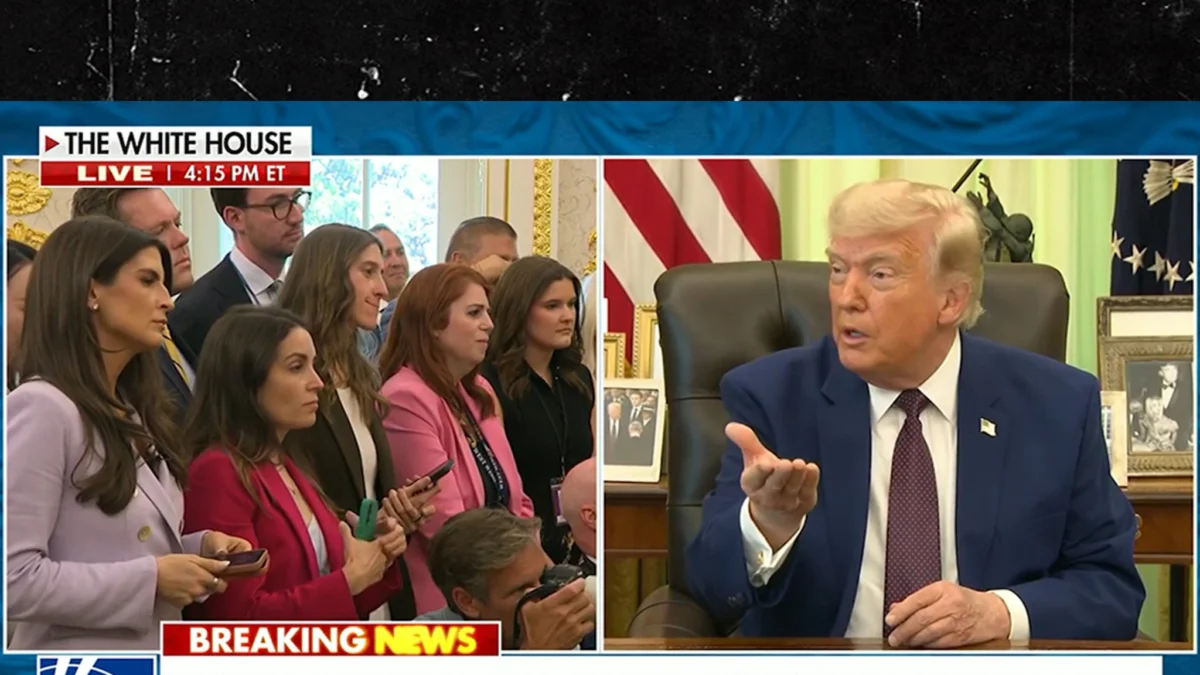
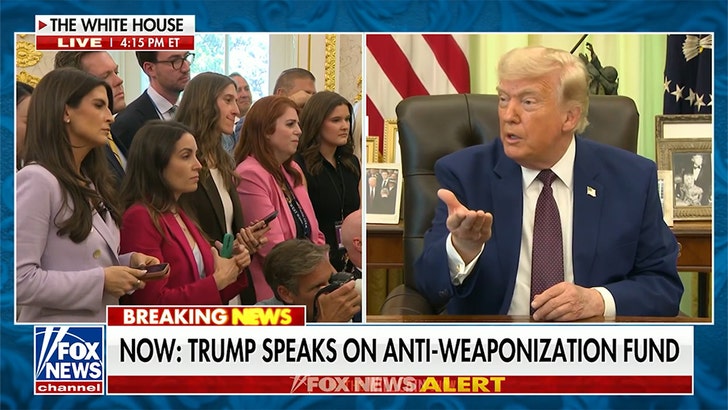
In a highly charged exchange in the Oval Office on June 3, 2026, President Donald Trump sharply rebuked CNN anchor Kaitlan Collins, diverting a policy discussion into a direct confrontation with the journalist. The incident, quickly dubbed a "media spectacle," saw the President accuse Collins of bias and animosity, culminating in the declaration, "You’re the story now!" The heated interaction arose during questioning about a controversial, now-scrapped, $1.8 billion "anti-weaponization" fund, a proposed compensation program for individuals claiming to be victims of politically motivated government investigations. The verbal clash rapidly overshadowed the substantive policy issue at hand, highlighting the persistent tension between the President and certain segments of the press.
The Scrapped "Anti-Weaponization" Fund: A Deep Dive
The proposed $1.8 billion anti-weaponization fund, which served as the initial subject of Collins’ inquiry, represented a significant and contentious policy initiative. Officially conceived as a mechanism to provide financial redress to individuals purportedly harmed by politically motivated government probes, the fund had been a focal point of debate within Washington for several weeks leading up to the Oval Office confrontation. Proponents of the fund, largely aligned with the President’s political base, argued that it was a necessary measure to correct perceived injustices and safeguard citizens from what they characterized as weaponized federal agencies. They cited numerous instances of high-profile investigations, particularly those targeting figures associated with the previous Trump administration or his political movement, as evidence of a systemic problem requiring immediate legislative remedy. The fund was envisioned as a direct response to these alleged abuses, offering substantial compensation to those who could demonstrate they had been unfairly targeted or financially burdened by such inquiries.
However, the proposal quickly encountered significant bipartisan criticism, leading to its eventual abandonment. Opponents from across the political spectrum raised profound concerns about its structure, intent, and potential for abuse. Critics argued that the fund risked politicizing the justice system by creating a mechanism for politically aligned individuals to claim damages without clear, impartial adjudication standards. There were widespread fears that it could be exploited for partisan purposes, potentially becoming a slush fund for political allies rather than a legitimate avenue for justice. Legal experts and civil liberties advocates expressed alarm that such a fund could undermine the independence of investigative bodies and establish a dangerous precedent, blurring the lines between legitimate oversight and political retribution. Questions were also raised regarding the criteria for eligibility, the evidentiary standards required to prove "politically motivated" targeting, and the process for disbursing taxpayer funds without robust oversight. The bipartisan outcry intensified as details emerged, with many lawmakers expressing discomfort at the prospect of allocating such a substantial sum to a program with ill-defined parameters and a high risk of partisan manipulation. This chorus of opposition ultimately proved insurmountable, leading to the fund being quietly withdrawn from legislative consideration shortly before the President’s encounter with Collins.
The Oval Office Confrontation: A Detailed Account
The setting for the contentious exchange was the venerable Oval Office, a space traditionally reserved for solemn policy discussions and diplomatic engagements. President Trump was addressing a pool of reporters, and the session, initially expected to focus on a range of domestic policy matters, quickly veered into familiar territory when Kaitlan Collins of CNN posed her question about the recently scrapped anti-weaponization fund.
Collins, known for her direct and persistent questioning style, pressed the President on the specifics of the fund’s failure, seeking clarity on why an initiative championed by his allies had collapsed under bipartisan pressure. Her question, delivered with journalistic precision, aimed to elicit a substantive explanation regarding the administration’s stance on the fund’s withdrawal and its implications for those it was intended to assist.
However, rather than engaging directly with the policy details, President Trump opted for a starkly different approach. According to accounts from other journalists present and the televised footage of the event, he characterized Collins’ inquiry as "batting practice," a metaphor suggesting he viewed her question not as a legitimate journalistic endeavor but as an opportunity for political counter-attack. The pivot was swift and personal. "You’re asking a question about something that’s already gone," the President retorted, his tone shifting from measured to confrontational. "Why are you always so negative? You have such hatred in your eyes when you look at me. It’s really sad to watch."
The accusation of "hatred in her eyes" immediately injected a deeply personal element into the exchange, shifting the focus from policy to personality. Collins, visibly maintaining her composure, attempted to redirect the conversation back to the fund. "Mr. President, I’m just asking about the policy," she interjected, her voice firm but even. "It was a major initiative, and it was scrapped. What happened?"
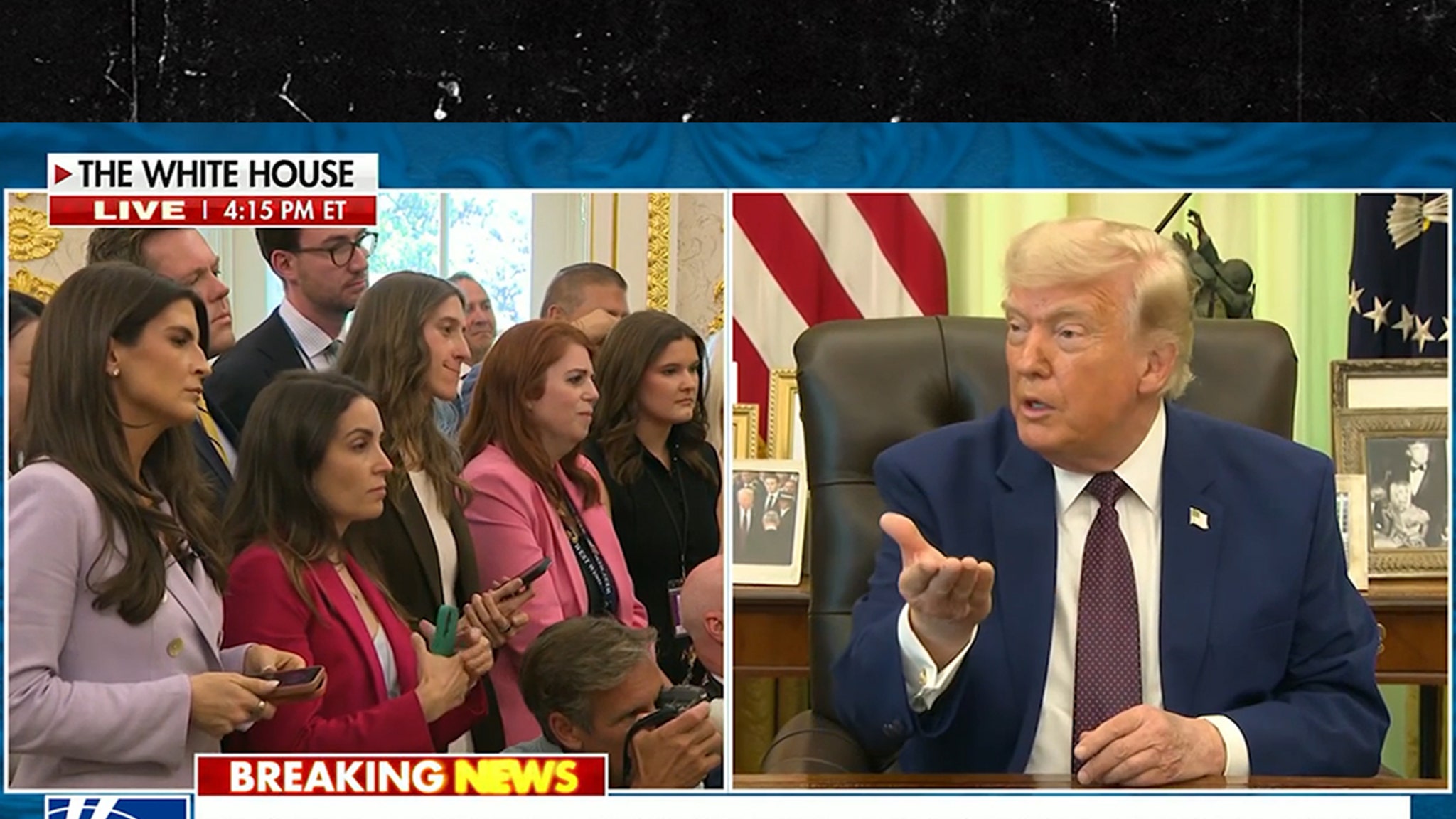
Trump, however, was undeterred in his offensive. He continued to lambast Collins and, by extension, her network, CNN. "Your reporting is always so unfair," he declared. "You’re always trying to create a narrative that isn’t true. CNN, frankly, is a disaster. And you know what? You’re the story now! You make yourself the story with these kinds of questions." This specific declaration, "You’re the story now!", quickly became the viral soundbite of the incident, emblematic of the President’s strategy of deflecting criticism by attacking the messenger.
Collins, undeterred by the personal attacks, made several more attempts to bring the discussion back to the proposed fund, reiterating the importance of transparency regarding a significant governmental initiative. Each effort was met with further broadsides from the President, who continued to question her motives and the journalistic integrity of her reporting. The exchange devolved into a familiar pattern of assertion, deflection, and personal attack, leaving the original policy question largely unanswered and overshadowed by the ensuing media confrontation. The incident, lasting several minutes, concluded with the President moving on to other reporters, but the spectacle of his clash with Collins had already captured the attention of the press corps and the public.
A History of Adversarial Media Relations
President Trump’s confrontational style with the media is not an isolated phenomenon but rather a defining characteristic of his political career, predating even his first term in office. From the outset of his political ascendancy, he cultivated a unique and often antagonistic relationship with news organizations, frequently labeling outlets critical of him as "fake news" and even "the enemy of the people." This rhetoric served multiple strategic purposes: it energized his base by framing mainstream media as biased adversaries, it provided a convenient deflection from challenging policy questions or controversies, and it sowed doubt about the veracity of unfavorable reporting.
His presidency saw an unprecedented level of direct engagement with journalists, often through freewheeling press conferences, rallies, and social media, where he would bypass traditional media filters. However, this direct engagement was frequently accompanied by public reprimands, personal insults, and challenges to the legitimacy of reporters and their questions. This approach fundamentally reshaped the dynamics of White House press briefings and presidential interactions, moving away from a traditional give-and-take toward more combative exchanges.
The President’s supporters often lauded this approach, viewing it as a refreshing challenge to perceived media liberal bias and an authentic expression of his disdain for what they considered unfair coverage. Critics, conversely, warned that such attacks on the press undermined democratic institutions, eroded public trust in factual reporting, and potentially incited hostility against journalists. This consistent pattern of media antagonism has become a hallmark of Trump’s political brand, creating a polarized environment where interactions between the President and certain journalists are almost invariably tinged with tension and potential for eruption. The latest incident with Kaitlan Collins is thus not an anomaly but a continuation of a well-established and deliberate strategy of media engagement.
The Enduring Feud: Trump vs. Collins
The exchange between President Trump and Kaitlan Collins on June 3, 2026, was not merely a singular event but another chapter in a long-running and often fiery feud that has characterized their interactions for years. Collins, a veteran White House correspondent, first gained prominence for her tenacious questioning during the Trump administration’s initial term. Her role often placed her in direct opposition to the President’s communication style, leading to numerous public clashes that garnered significant media attention.
Their adversarial relationship solidified through a series of memorable confrontations. During the initial administration, Collins was briefly banned from a White House press event after pressing President Trump on questions he deemed inappropriate. This incident, among others, cemented her reputation as a persistent interrogator unafraid to challenge presidential authority, while also positioning her as a frequent target of the President’s ire. Trump often singled her out in press conferences, dismissing her questions, questioning her journalistic integrity, and occasionally resorting to personal critiques. He frequently dismissed her inquiries as "fake news" or "rude," and would often pivot from her questions to broader attacks on CNN.
Collins, for her part, consistently maintained a professional demeanor, steadfastly attempting to steer conversations back to substantive policy issues despite the President’s deflections. Her persistence, viewed by supporters as a commitment to journalistic principles and by critics as an antagonistic posture, ensured that her interactions with Trump rarely unfolded without incident. These exchanges became a predictable feature of presidential press events, providing recurring examples of the broader struggle between the executive branch and a critical press. The "You’re the story now!" comment, therefore, encapsulates not just a moment of friction but the culmination of years of intense, public sparring between two figures who have become emblematic of the polarized media and political landscape. Each encounter has reinforced the narrative of an ongoing battle, with both individuals, wittingly or unwittingly, contributing to a dynamic that often sees the process of reporting become as newsworthy as the reported events themselves.
Reactions from the Political Spectrum
The Oval Office confrontation between President Trump and Kaitlan Collins elicited a predictably polarized array of reactions from across the political spectrum, underscoring the deep divisions in contemporary American public discourse.
From the President’s Supporters and Allies: Many within President Trump’s political base and his allied media outlets quickly rallied to his defense. They characterized his outburst as a justified response to what they perceive as biased and hostile questioning from a mainstream media consistently critical of his administration. Statements from supportive lawmakers and pundits often echoed the President’s sentiments, accusing Collins and CNN of pursuing a politically motivated agenda rather than objective journalism. They argued that the President was merely pushing back against a "gotcha" question designed to provoke rather than inform. Some social media commentators and conservative media personalities celebrated the "You’re the story now!" remark as a powerful rebuke of what they see as the media’s self-aggrandizing tendencies, asserting that journalists often seek to insert themselves into the narrative. They viewed the incident as a display of strength and authenticity from a leader unafraid to challenge perceived unfairness.
From Journalistic Organizations and Critics: Conversely, journalistic organizations, civil liberties advocates, and critics of the President vehemently condemned his behavior. Major news networks and press freedom groups issued statements defending Collins’ professionalism and her right to ask challenging questions of the President. They emphasized that a free and independent press is a cornerstone of democracy and that personal attacks on journalists undermine the vital role of accountability. Many pointed out that the President’s tactic of attacking the messenger serves to distract from substantive policy discussions and erode public trust in legitimate newsgathering. The Committee to Protect Journalists, for instance, reiterated its concern over rhetoric that delegitimizes the press, highlighting the potential for such language to create a hostile environment for reporters. Political analysts often described the incident as a deliberate strategy to control the narrative, deflect from uncomfortable truths, and energize a base that is inherently distrustful of traditional media.
From Political Opponents: Democratic lawmakers and other political opponents of President Trump used the incident to criticize what they described as his ongoing disdain for democratic norms and institutions, including the free press. They argued that such presidential behavior sets a dangerous precedent and diminishes the gravity of the Oval Office. They also highlighted the fact that the President’s outburst successfully diverted attention from the controversial fund itself, suggesting that the media confrontation served as a convenient political maneuver to avoid accountability for a failed policy initiative.
The incident, therefore, became less about the policy fund and more about the ongoing battle for narrative control, reflecting the entrenched positions and deep ideological divides that characterize the modern political landscape.
Implications for Press Freedom and Public Discourse
The contentious exchange between President Trump and Kaitlan Collins, culminating in the President’s declaration "You’re the story now!", carries significant implications for press freedom, the role of journalism in a democracy, and the broader landscape of public discourse.
Firstly, such presidential behavior, characterized by personal attacks and accusations of bias, directly challenges the foundational principle of a free and independent press. When a head of state, particularly one with a powerful platform, consistently frames critical reporting as politically motivated or driven by "hatred," it can erode public trust in journalistic institutions. This erosion of trust is perilous for a democracy, as a well-informed citizenry relies on credible, objective information to make sound decisions about their leaders and policies. The "story now" tactic implicitly suggests that the journalist’s motives or persona are more relevant than the substance of their questions, thereby attempting to delegitimize the very act of inquiry.
Secondly, the incident underscores the growing difficulty for journalists to hold powerful figures accountable in an era of hyper-partisanship and media polarization. When policy questions are consistently met with personal attacks, it creates a challenging environment where the pursuit of factual information can be overshadowed by spectacle. The focus shifts from the what and why of governance to the who and how of the interaction itself. This dynamic risks creating a feedback loop where confrontational exchanges become the primary news, further alienating segments of the public who may grow weary of the constant friction, or who may only consume news that reinforces their pre-existing biases.
Moreover, this type of interaction contributes to a broader climate of distrust and cynicism in public discourse. When political leaders consistently paint journalists as adversaries, it can foster an environment where misinformation and disinformation thrive, as citizens struggle to discern credible sources from partisan narratives. It encourages a "shoot the messenger" mentality, which can deter robust reporting on critical issues and discourage open, fact-based debate. The strategic use of such clashes by political figures also raises questions about their effectiveness: do they genuinely deflect from policy failures, or do they merely reinforce existing perceptions of the leader’s communication style?
Finally, the long-running feud between President Trump and Kaitlan Collins, exemplified by this latest incident, serves as a potent symbol of the contemporary challenges facing both political leaders and the media. It highlights the tension between a president’s desire to control his message and a journalist’s duty to scrutinize power. The repeated spectacle of these clashes has arguably normalized a degree of hostility in political communication that, while perhaps engaging to some audiences, ultimately detracts from the serious work of governing and informing the public. The incident serves as a stark reminder that in this new era of political communication, the messenger often finds themselves inextricably woven into the fabric of the story they are attempting to report.
The Broader Context: A New Era of Political Communication
The June 3, 2026, confrontation between President Trump and Kaitlan Collins is more than an isolated event; it is a microcosm of a new, often volatile, era of political communication. This era is characterized by an unprecedented level of direct engagement between political figures and the public, often bypassing traditional media gatekeepers, coupled with a heightened polarization of both news consumption and political identity.
In this landscape, the lines between policy debate and personal attack have frequently blurred. Political figures, particularly those with a populist appeal, have demonstrated an increasing willingness to challenge the legitimacy of institutions, including the press, when those institutions present unfavorable narratives. This strategy can be highly effective in mobilizing a dedicated base, which often views such confrontations as a leader fighting back against perceived unfairness from established elites. For these segments of the population, a president’s defiance of the media is not a detriment but a testament to his strength and authenticity.
Conversely, for those who value traditional journalistic norms and accountability, such exchanges represent a dangerous erosion of democratic principles. They see the President’s actions as a deliberate attempt to undermine the credibility of a vital check on power, creating a vacuum that can be filled by partisan propaganda. The constant cycle of accusation and counter-accusation contributes to a state of perpetual political combat, where every interaction is viewed through a highly partisan lens.
The scrapped anti-weaponization fund, which initially triggered the exchange, ultimately became an afterthought, proving the potency of the President’s deflection strategy. The policy’s fate, while significant, was overshadowed by the drama of the personal clash, demonstrating how effectively media confrontations can draw attention away from substantive issues. This phenomenon poses a profound challenge for the media, which must navigate how to cover both the policy and the spectacle without inadvertently amplifying the latter at the expense of the former.
As the political landscape continues to evolve, interactions like the one witnessed in the Oval Office are likely to remain a feature, not a bug, of modern political communication. They underscore the ongoing tension between a president’s strategic use of media and a free press’s imperative to hold power accountable, shaping not only how news is consumed but also how democracy itself functions in an increasingly fragmented and polarized world. The legacy of such encounters will likely be debated for years to come, reflecting on the profound shifts in the relationship between leaders, the media, and the public they both serve.