


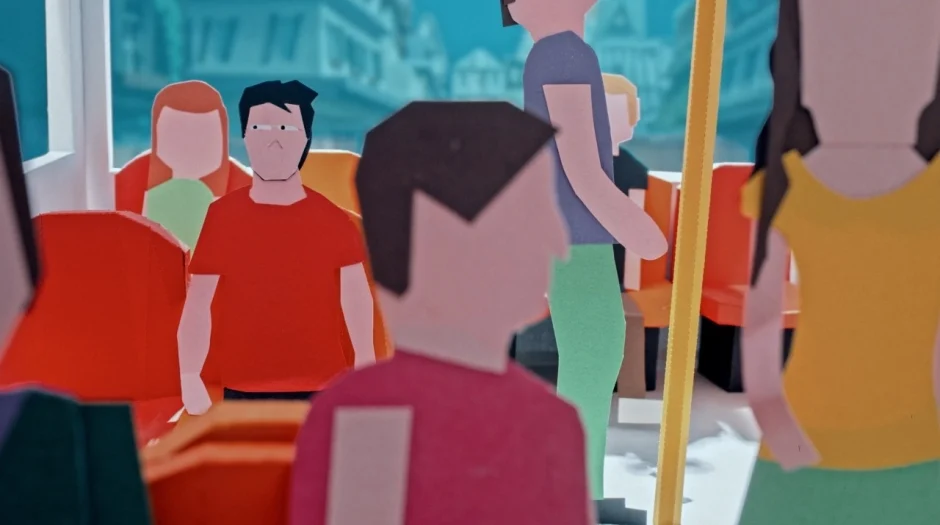
For over two decades, visionary director and producer Stefano Bertelli has sculpted compelling visual narratives, initially through dynamic live-action and animated music videos for a global roster of acclaimed artists, including Eminem, Motörhead, and Robbie Williams. His journey began with the vibrant independent music scene of his native Italy, a foundation that has propelled him to the forefront of innovative filmmaking. Bertelli’s creative evolution took a significant turn in 2014 with the experimental animated feature Acid Space, a bold foray into alternative production methods. This initial foray, though described by Bertelli himself as an "amateur feature made with friends," served as a pivotal catalyst, igniting his passion for paper stop-motion animation and setting the stage for his most ambitious project to date: the surreal and introspective feature film, Spacetime Chronicles.
"This feature represents my first true film, even though it’s technically my second," Bertelli shared, underscoring the profound artistic and technical growth that Spacetime Chronicles embodies. "It’s the first one I wrote, and it comes after reaching a more mature technical stage in my skills as a creative." This sentiment highlights a deliberate departure from his earlier work, positioning Spacetime Chronicles not just as another film, but as a deeply personal and meticulously crafted expression of his artistic maturity.

A Deep Dive into the Unconscious: The Narrative of Spacetime Chronicles
Produced through Bertelli’s own company, Seenfilm, Spacetime Chronicles unfolds as a surreal, dreamlike exploration of a man named Fred’s inner journey. The narrative eschews traditional linear storytelling, instead immersing the audience in a fluid state suspended between reality, dream, and limbo. From the disorienting sensation of a departing airplane to the claustrophobic confines of school corridors, and from visionary, otherworldly landscapes to cryptic dialogues with a feline embodiment of his unconscious—a cat representing Freud—Fred navigates a profound internal landscape. He confronts a spectrum of deeply human experiences: pervasive fears, latent desires, and the lingering echoes of unresolved memories.
The film employs a mosaic of symbolic episodes to depict this existential quest. These range from encounters with bullies and the anxieties of examinations to missed opportunities and fleeting, enigmatic interactions, such as a mysterious girl on a tram. Through these fragmented yet resonant vignettes, Spacetime Chronicles weaves a tapestry of existential doubt and the delicate nature of identity. At its philosophical core, the film articulates a quiet, profound realization: the essence of life lies not in the pursuit of a final destination, but in the richness and complexity of the journey itself, complete with its inherent uncertainties, cyclical repetitions, and ephemeral moments of profound beauty.
Festival Circuit and Future Releases: A Global Debut
Spacetime Chronicles has already begun its ascent on the international film festival circuit, garnering critical attention and audience engagement. Following its screening on April 18 at the Athens International Film and Video Festival, the film is slated for further exhibition at the prestigious Buenos Aires International Festival of Independent Cinema (BAFICI) on April 26. Additional screenings are planned for the Asolo Art Film Festival in Italy in June, followed by an anticipated Italian premiere in Milan during the same month. A wider, more extensive release is projected for the latter part of 2026, allowing the film to reach a broader global audience. The film’s trailer, offering a tantalizing glimpse into its unique visual style and thematic depth, has been released, generating significant anticipation.

The Genesis of an Unconventional Film: Embracing Ambiguity and the Inner World
Bertelli’s directorial philosophy for Spacetime Chronicles was rooted in a deliberate rejection of rigid structural constraints. "I had intended to make a film without imposing a rigid structure," he explained. The film’s opening sequences immediately establish this unconventional approach, depicting a man emerging from an abstract void, a state of pure emptiness, only to encounter a black hole. This visual metaphor directly represents the protagonist’s mind, a state of profound disorientation that can manifest in real life when an individual feels trapped in a personal stalemate—a condition further symbolized by an airplane depicted in free fall.
This emphasis on psychological depth and subjective experience is a recurring theme in Bertelli’s work. "I’ve always been drawn to a psychological and dreamlike approach to storytelling, focusing more on a character’s inner journey than on a traditional narrative," he stated. This commitment to exploring the internal landscape of his characters, rather than adhering to conventional plot-driven structures, is a hallmark of Spacetime Chronicles.
The production of Spacetime Chronicles mirrored its narrative’s unconventionality. The film’s production team was remarkably lean, consisting solely of Bertelli and Riccardo Orlandi. Crucially, the script was not fully completed before animation commenced. Instead, the narrative evolved organically throughout the production process, with script revisions and additions continuing right up until the film’s submission to festivals like Anima Brussels and BAFICI. This iterative approach allowed for a more fluid and responsive creative process, where the story could adapt and deepen as the visual elements took shape.

Bertelli recounts a particularly telling moment of this evolving creation: "I remember that even once the film was finished, I felt something was missing," he admitted. This feeling led to the eleventh-hour addition of the flight simulator scene, which appears near the film’s beginning. This seemingly late addition, however, proved instrumental in enhancing the narrative cohesion and deepening the audience’s understanding of Fred’s character, demonstrating the value of this flexible, emergent storytelling method.
The Intricate Art of Paper Stop-Motion: Crafting Fragility and Form
The most significant technical challenge in the creation of Spacetime Chronicles lay in its distinctive animation style. Bertelli and his team employed a unique approach to character and set design, utilizing "low poly paper craftsmanship." This involved constructing 3D paper models composed of numerous flat surfaces meticulously joined by folds and creases. While these geometric forms possess a striking aesthetic appeal, their animation presented considerable difficulties, particularly in maintaining the sharpness and integrity of their edges throughout the movement.
"We spent years experimenting with this style, even before the film, mainly through commissioned music videos and commercials," Bertelli explained. He elaborated on the collaborative efforts with Riccardo Orlandi, who was instrumental in the set and robotics mechanics. Together, they continuously refined their techniques. For the stop-motion animation, the team utilized a combination of stepper motors for precise, automated movements and traditional manual rigs for frame-by-frame animation.

The execution of slow-motion sequences presented its own set of unique challenges, particularly when elements had to defy gravity. In these instances, unconventional methods were employed. "We sometimes use small controlled explosive charges, triggered by sensors or simple buttons, to generate real physical reactions," Bertelli revealed. For particularly complex scenes, such as the airplane sequence, custom armatures were ingeniously engineered around the paper models. These armatures enabled the entire structure to rotate, allowing internal elements to move with a natural, chaotic fluidity, evoking an effect akin to a washing machine.
Despite the inherent engineering complexities and the delicate nature of the paper materials, Bertelli remained steadfast in his choice of medium. "Because it gives me unlimited possibilities to represent anything I imagine," he stated. He further elaborated on the symbolic resonance of paper: "Paper is fragile but also very flexible. It allows combining multiple techniques such as 2D, 3D, cut outs, rotoscope, and slow motion. Everything in the film was used with clear, narrative intention. It reflects human fragility, which is central to the film’s theme." This philosophical alignment between the medium and the message underscores the profound intentionality behind every creative decision.
The Personal Connection: Cherishing the Human Element in Animation
The process of animating the film’s protagonist, Fred, proved to be an intensely engaging and deeply rewarding experience for Bertelli. From capturing the nuances of his running gait and expressive close-ups to the subtle movements of his head and the vulnerability of crawling, each frame was imbued with care and artistic commitment. Bertelli confessed to developing a strong personal attachment to the character, to the extent that he meticulously preserves every paper cut-out used in Fred’s animated sequences.

"I became very attached to him," Bertelli admitted. This deep personal connection extends to his broader artistic philosophy. "I want to show that there are no real limits or excuses when it comes to creating. Difficulties are part of the process, and mistakes, every imperfection, are what make a story feel human. Especially in a time of major technological transformation, I think this perspective is even more important." This perspective resonates powerfully in an era increasingly dominated by digital and AI-generated content, emphasizing the enduring value of human craftsmanship, emotional authenticity, and the beauty found in imperfection.
The creation of Spacetime Chronicles represents a significant milestone in stop-motion animation, showcasing how a dedication to artistic vision, coupled with innovative technical execution, can result in a profoundly moving and visually distinctive cinematic experience. As the film continues its festival run, it promises to captivate audiences with its unique blend of psychological depth, surreal imagery, and the tangible artistry of paper stop-motion.