
The 79th edition of the Cannes Film Festival, concluded in May 2026, has been characterized by industry analysts as a transformative year for global cinema, moving away from high-octane spectacles toward what critics are calling "accumulative storytelling." While early reports from the Croisette initially suggested a subdued year in terms of immediate "masterpieces," the closing ceremonies revealed a slate of films that prioritized emotional depth, structural patience, and a "bodily impact" on the audience. This shift was evident in the selection of the Palme d’Or winner and the various sidebar honors, signaling a move toward cinema that functions through incremental dramatic resonance rather than sensory overload.
The Palme d’Or and the Debate Over Reactionary Narratives
The festival’s highest honor, the Palme d’Or, was awarded to Romanian director Cristian Mungiu for his multilingual drama, Fjord. The film serves as a rigorous, albeit controversial, exposé of the Norwegian child protective services system. This marks Mungiu’s second Palme d’Or, following his 2007 win for 4 Months, 3 Weeks and 2 Days. However, the victory was met with divided opinions among the international press. While the jury praised the film’s technical precision and its examination of the "nanny state," some critics argued the narrative leaned into a reactionary outlook, contrasting sharply with the more compassionate humanism found elsewhere in the competition.
Fjord centers on the escalating tensions between a state bureaucracy and a family, a theme Mungiu has explored previously in the context of institutional failure. Despite its "button-pushing" nature, the film solidified its place in the festival’s history, even as pundits debated whether the award was a recognition of craft or a validation of its specific political skepticism.
Ryusuke Hamaguchi and the Cinema of Connection
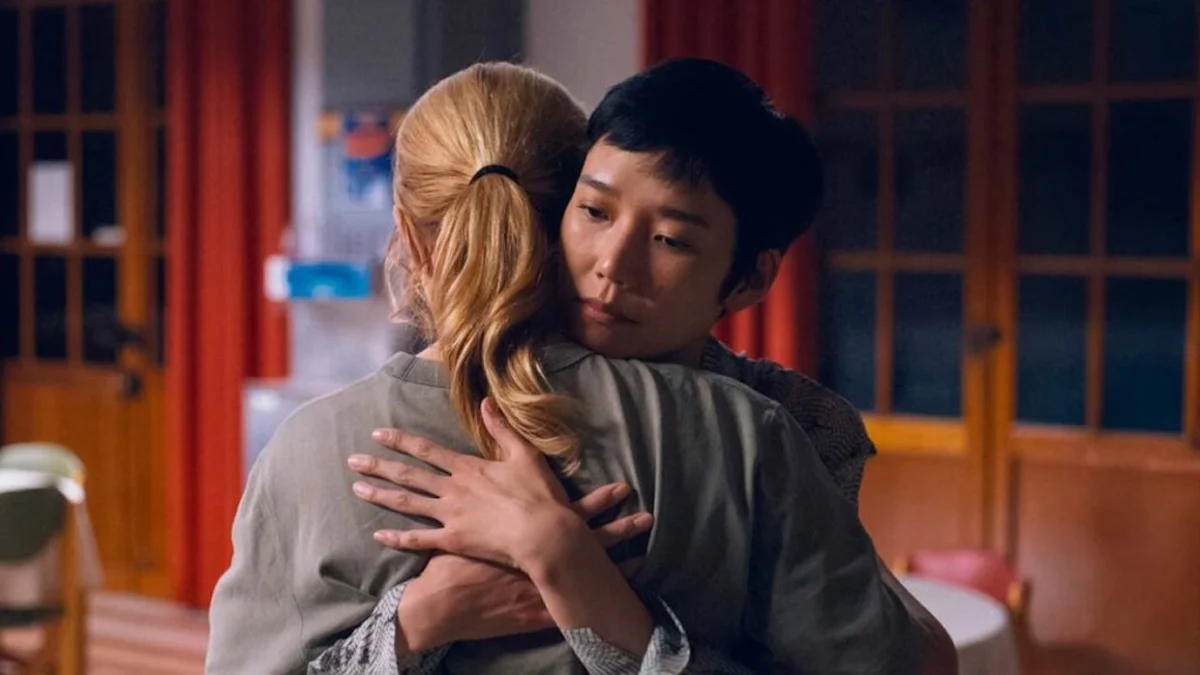
In stark contrast to Mungiu’s confrontational approach, Ryusuke Hamaguchi’s latest feature, All of a Sudden, emerged as a critical darling, despite missing out on the top prize. The film focuses on an extended dialogue between Mari, a Japanese playwright, and Marie-Lou, a French eldercare manager. Their meeting, initially between strangers, evolves into a profound friendship that addresses personal mortality and the perceived decline of the modern world.
The film did not leave empty-handed, as lead actresses Virginie Efira and Tao Okamoto received a joint Best Actress award. Their performances were lauded for capturing the "thrum of fast friendship" and the blurring lines between casual social interaction and existential analysis. The screenplay for All of a Sudden was notably inspired by the real-life correspondence between Japanese anthropologist Maho Isono and philosopher Makiko Miyano. Isono’s presence at the Lumière Theater premiere underscored the film’s roots in authentic human connection and the "compassionate scenario" of chance encounters becoming lifelines.
Valeska Grisebach and the Reimagined Western
Another major highlight of the 2026 competition was Valeska Grisebach’s The Dreamed Adventure. Despite being scheduled during the final afternoon of premieres—a slot often reserved for overlooked titles—the film quickly secured U.S. distribution following its screening. A three-hour epic set in the Eastern European borderlands, the film follows Veska (played by nonprofessional Yana Radeva), an archaeologist navigating a landscape dominated by post-Soviet "gangsterism" and antiquated gender dynamics.
Grisebach, known for her 2017 film Western, continued her deconstruction of genre tropes. The Dreamed Adventure simultaneously evokes and denies the conventions of the Western, focusing instead on "alfresco table talk" and village intrigue. In post-screening interviews, Grisebach emphasized that her years of research in the region were intended to address the core mechanics of power, asking "who is strong and who is weak" in a society clinging to the ghost of 1990s mafias.
Historical Re-evaluations: Fatherland and A Man of His Time
The 2026 festival also saw a resurgence of the period drama, though these works were noted for their contemporary relevance. Pawel Pawlikowski’s Fatherland was presented as a meticulously constructed road movie featuring Thomas Mann (Hanns Zischler) and his daughter Erika (Sandra Hüller) during their 1949 speaking tour across a divided Germany. Critics noted that the film’s exploration of postwar ruins and resurgent authoritarianism served as a chilling mirror to the geopolitical climate of 2026.

Similarly, Emmanuel Marre’s A Man of His Time utilized a 16mm aesthetic to document the moral decay of a municipal bureaucrat in Vichy France. Starring Swann Arlaud, the film is based on the letters of Marre’s own great-grandfather. By tracking a "paper-pushing shuffle toward fascism," Marre’s work was cited as a haunting study of how ordinary individuals become complicit in systemic genocide.
Breakthroughs in Sidebars: La Gradiva and Clarissa
The Critics’ Week section produced what many considered the festival’s most significant discovery: La Gradiva. The debut feature from Marine Atlan—who also served as co-writer and co-cinematographer—the film follows a group of French students on a trip to Pompeii. Atlan was praised for her "whisker-sensitive" portrayal of adolescent angst and autonomy. The film was immediately picked up for U.S. distribution by 1-2 Special, following a wave of positive reviews that challenged the traditional hierarchy of the Main Competition.
The Camera d’Or, awarded to the best first feature across all sections, went to Clarissa. Directed by Nigerian siblings Arie and Chuko Esiri, the film is a reimagining of Virginia Woolf’s Mrs. Dalloway. However, the directors infused the narrative with a sharp colonialist critique, drawing on the literary influence of Chinua Achebe. The win highlighted the festival’s ongoing commitment to diverse perspectives and the recontextualization of Western literary canons.
Market Trends and the Dominance of NEON
From a business perspective, the 2026 Cannes Film Festival was dominated by the distribution powerhouse NEON. The company entered the festival with an extensive slate of high-profile acquisitions, including:
- Hope: A South Korean monster movie directed by Na Hong-jin, featuring a "galloping hominid alien" inspired by Goya’s Saturn Devouring His Son.
- Paper Tiger: James Gray’s Queens-set family tragedy, which was described as a "pitch-perfect classical work," though it remained an underdog during the awards ceremony.
- Clarissa: The aforementioned Camera d’Or winner.
The presence of NEON and other major distributors signaled a robust market for international cinema, even as the "star power" of the red carpet was described by some pundits as more "muted" than in previous decades.
Aesthetic Innovation in Un Certain Regard and Directors’ Fortnight
In the Un Certain Regard sidebar, the top prize was awarded to Sandra Wollner’s Everytime. Shot by Gregory Oke (known for his work on Aftersun), the film is a "shattering study" of grief and recovery. Its sound design and intimate cinematography were cited as key elements in its success. The section opened with Jane Schoenbrun’s Teenage Sex and Death at Camp Miasma, a meta-horror exploration of parasocial desire starring Hannah Einbinder.
The Directors’ Fortnight (Quinzaine des Cinéastes) featured Dominga Sotomayor’s La Perra, a portrait of a Chilean islander dealing with childhood loss. However, the most discussed film in the sidebar was Arthur Harari’s The Unknown. Starring Léa Seydoux, the film utilizes a body-swap premise to explore trauma and "estrangement from self." Rather than adhering to genre tropes, Harari used the concept as a "floating signifier" for psychological displacement, resulting in one of the festival’s most "unclassifiable" and haunting experiences.
Political Statements and the Closing Ceremony
The festival concluded with a significant political gesture during the presentation of the Grand Prix. The award went to Russian exile Andrei Zvyagintsev for his film Minotaur. Filmed in Latvia, the movie is an adaptation of Claude Chabrol’s The Unfaithful Wife, set against the backdrop of Russian corruption. During his acceptance speech, Zvyagintsev addressed the Russian leadership directly, urging an end to the war in Ukraine.
As the curtains closed on Cannes 2026, the consensus among the film community was that of a year defined by "quiet revolutions." While the lack of a singular, consensus masterpiece may have led to "ho-hum" early reports, the depth of the 2026 selection suggested a healthy, evolving medium. Filmmakers like Hamaguchi, Grisebach, and Atlan demonstrated that the power of cinema often lies in the gradual accumulation of emotion and the "dramatic muscle memory" instilled in the viewer—a legacy that will likely be felt in the industry for years to come.