


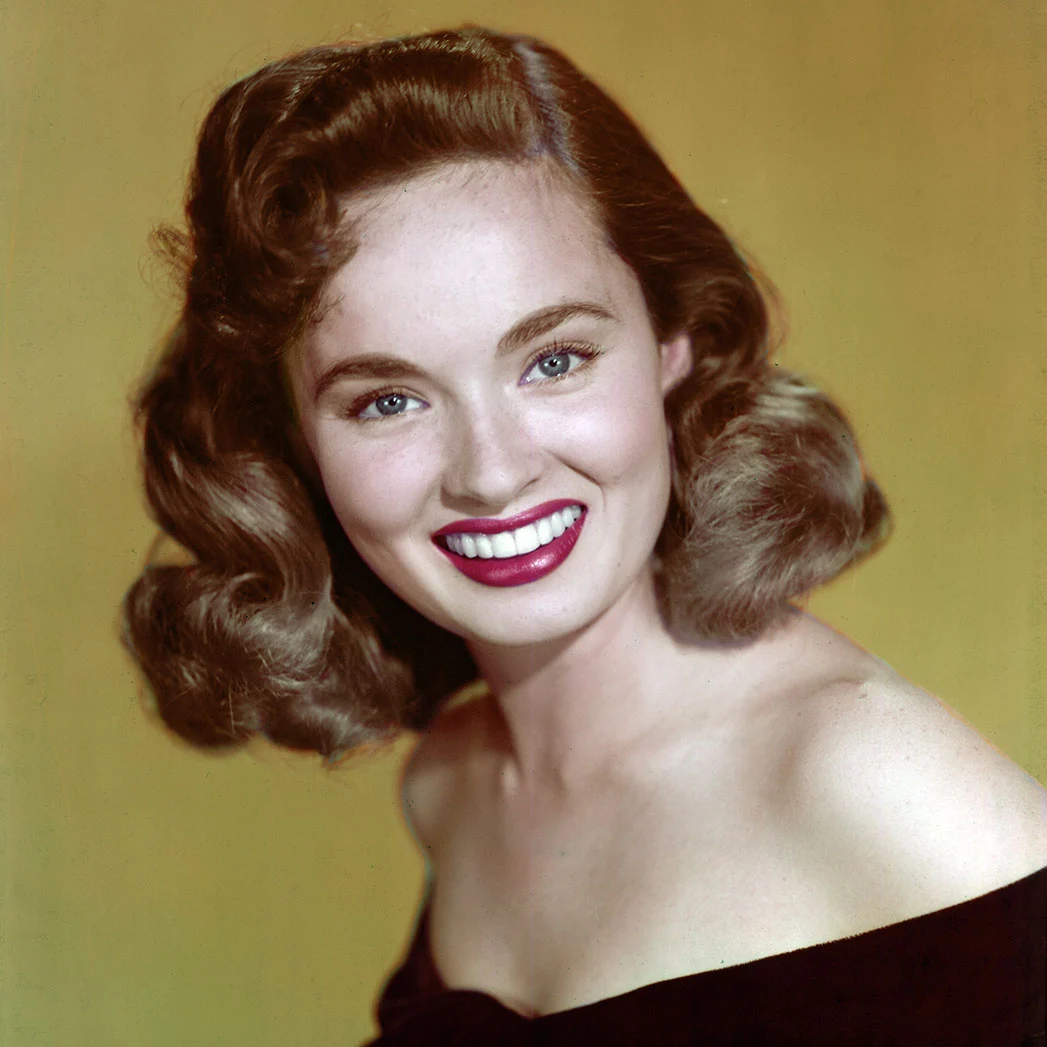
Ann Blyth, the esteemed actress and singer celebrated for her diverse roles spanning classic Hollywood melodramas, opulent musicals, and gritty dramas, has passed away at the age of 98. Blyth’s death on Wednesday, attributed to natural causes, was reported by KABC’s George Pennacchio, marking the end of a remarkable life that saw her rise from child radio performer to an Oscar-nominated screen legend. Her indelible portrayal of Veda Pierce, the manipulative and cruel daughter to Joan Crawford’s titular character in Michael Curtiz’s 1945 film noir masterpiece Mildred Pierce, remains one of the most iconic villainesses in cinematic history and earned her a Best Supporting Actress nomination.
Blyth’s career was characterized by an extraordinary versatility that allowed her to transition seamlessly between demanding dramatic roles and soaring musical performances. Beyond her groundbreaking dramatic turn as Veda, she captivated audiences with her operatic soprano voice in several major MGM musicals. She introduced the beloved classic "The Loveliest Night of the Year" while starring opposite Mario Lanza as his wife, Dorothy Caruso, in the 1951 biopic The Great Caruso. Her musical prowess further shone in leading roles in Rose Marie (1954), The Student Prince (1954), and Vincente Minnelli’s lavish Kismet (1955), cementing her status as a vibrant star of the genre.
A Multifaceted Talent: From Broadway to Hollywood’s Golden Age
Born Anne Marie Blythe on August 16, 1927, in Mount Kisco, New York, she spent her formative years on Manhattan’s Lower East Side. Her childhood was marked by resilience; her father left the family, leaving her mother to raise Ann and her older sister. From a remarkably young age, Blyth displayed prodigious talent, singing and reciting poetry on radio shows by age six and performing with the prestigious San Carlos Opera Company. Her entry into the professional acting world came through an extraordinary stroke of luck and talent. While still a student, she was approached in her school principal’s office by acclaimed writer Lillian Hellman and producer-director Herman Shumlin. They were seeking talent for the anti-Nazi Broadway drama Watch on the Rhine. Blyth, then just 13, secured the role of Paul Lukas’s daughter, appearing in the 1941-42 production, which ran for almost 400 performances. This early success not only showcased her acting capabilities but also connected her to significant cultural and political narratives of the era. Following the play’s successful Broadway run, she toured the country with the production and, as a unique honor, joined other cast members for dinner at the White House with President Franklin D. Roosevelt, a testament to the play’s national importance during World War II.
In 1943, Blyth’s burgeoning talent caught the eye of Hollywood. Universal Pictures signed her, reportedly in part to foster competition for their then-reigning musical star, Deanna Durbin, who was known for her frequent dissatisfactions with studio assignments. Blyth quickly proved her worth, being cast in four musicals released in 1944: Chip Off the Old Block, Babes on Swing Street, The Merry Monahans, and Bowery to Broadway. Three of these films saw her paired with her former teenage dancing partner, Donald O’Connor, highlighting her innate musicality and screen presence from the outset of her film career.
The Defining Role: Veda Pierce and the Oscar Nomination
The pivotal moment in Blyth’s career arrived with Mildred Pierce. This film, based on James M. Cain’s gritty 1941 novel, was a crucial project for Joan Crawford, whose career had been in disarray after her departure from MGM. Hundreds of teenage actresses auditioned for the complex role of Veda, a character infamous for her manipulative nature, avarice, and callous disregard for her mother’s sacrifices. Crawford, recognizing a unique spark in the then-16-year-old Blyth, took the extraordinary step of appearing opposite her in her screen test, a gesture virtually unheard of for a star of Crawford’s stature. Blyth herself recounted this experience to THR‘s Scott Feinberg in 2013: "I knew that other people wanted the part as well but I was the lucky one because Joan Crawford did the test with me, and it made a world of difference. People just didn’t do that, not people of her stature."
Crawford’s instincts proved prescient. The film was a critical and commercial triumph, marking a spectacular comeback for Crawford, who won the Best Actress Oscar for her portrayal of the self-sacrificing mother (famously accepting the award in bed while wearing pajamas). Blyth, in turn, received a nomination for Best Supporting Actress, a remarkable achievement for such a young actress in a role that demanded profound psychological depth and chilling malevolence. Her performance as Veda, a beautiful brat who would commit any act, even murder, for money, was universally lauded. The Hollywood Reporter wrote in its review: "This Blyth child is exquisite in her understanding of one of the most difficult roles ever written. Only the undeniable genius that has made Joan Crawford the great popular star she long since became enables her to keep Ann Blyth from running off with the film." Blyth’s portrayal elevated Veda beyond a simple villain; she became a complex, terrifying force, embodying the darkest aspects of ambition and ingratitude, a character that continues to resonate in discussions of film noir and mother-daughter dynamics.
Overcoming Adversity and Continued Cinematic Success

Just five days after completing filming on Mildred Pierce, Blyth faced a severe personal challenge. A sledding mishap near Lake Arrowhead, California, resulted in a broken back. Her experience, which she later detailed in a 1954 story titled "My Career Took a Toboggan Ride," was harrowing: "One minute we were sailing down the hard-packed icy hillside like snowbirds, then there was a crash and I fell on my back with a sickening thud. I didn’t cry out. The feeling was too big for that." The accident confined the petite 5-foot-2 actress to a body cast for seven months, followed by several more months in a wheelchair. Despite this immense physical setback, Blyth’s resilience was evident. She managed to attend the 1946 Academy Awards ceremony, where she was nominated, wearing a specially designed studio gown that cleverly concealed her back brace, demonstrating her determination to remain in the public eye even during recovery.
Once her back mended, Blyth continued to diversify her filmography. She initially returned to playing another "brat" in Swell Guy (1946). However, her burgeoning maturity as an actress led her to resist typecasting. Her refusal to play another "bad girl" role in the film Abandoned led to an unpaid suspension, a common tactic by studios to control their stars, but one that highlighted Blyth’s growing agency in her career choices. She went on to deliver compelling performances in a variety of genres. She portrayed Burt Lancaster’s wife in the intense 1947 prison drama Brute Force, showcasing her ability to handle grittier, more realistic narratives. In 1948, she charmed audiences as an attractive creature from the sea brought home by William Powell in the fantasy film Mr. Peabody and the Mermaid.
Her return to musicals at MGM marked another significant phase, where her operatic training truly shone. Following The Great Caruso, a massive success that capitalized on the popularity of operatic stars, Blyth starred in Rose Marie (1954), a lavish remake of the popular operetta, and The Student Prince (1954), another classic musical. Her final MGM musical was Vincente Minnelli’s Kismet (1955), a vibrant adaptation of the Broadway hit. Beyond these, her film credits during this period include a range of titles such as Killer McCoy (1947), Another Part of the Forest (1948), Top O’ the Morning (1949), Once More, My Darling (1949), The Golden Horde (1951), I’ll Never Forget You (1951), One Minute to Zero (1952), The World in His Arms (1952), All the Brothers Were Valiant (1953), The King’s Thief (1955), and Slander (1957). These roles showcased her as a reliable and adaptable leading lady, capable of handling romance, adventure, and drama.
Transition to Television and a Lasting Legacy
After departing MGM, Blyth signed with Warner Bros., where she starred in two notable 1957 biopics. In Sidney Sheldon’s The Buster Keaton Story, she reunited with her former dancing partner Donald O’Connor. Her final feature film role was as the alcoholic 1930s torch singer in The Helen Morgan Story (1957), opposite Paul Newman. This poignant role allowed her to demonstrate her dramatic depth once more, capturing the tragic life of a real-life performer. Although she was considered for the lead in The Three Faces of Eve (1957), a role that ultimately earned Joanne Woodward a Best Actress Oscar, Blyth made a conscious decision to step away from the demanding world of feature films.
Despite her departure from major motion pictures, Blyth remained active and visible. She developed a successful nightclub act in Las Vegas, performed in local theater productions, and became a familiar face on television. Her television appearances spanned several decades and genres, introducing her to new generations of viewers. She guested on popular shows such as Wagon Train, The Name of the Game, Quincy M.E., and Murder, She Wrote. One particularly memorable TV role was in The Twilight Zone, where she played a Hollywood star who mysteriously doesn’t age, a meta-commentary on the eternal youth demanded by the industry. In the 1970s, Blyth embraced a different kind of public persona, becoming known to a new generation of TV audiences as a mom in a beloved series of commercials for Hostess Cupcakes, cheerfully pitching iconic American snacks like Twinkies, Crumb Cakes, and Ding Dongs. This unexpected turn demonstrated her enduring appeal and willingness to adapt to the changing media landscape.
A Life Dedicated to Family
In 1953, Ann Blyth married Los Angeles obstetrician James McNulty, the brother of singer Dennis Day. Their marriage was a testament to stability and partnership in an industry often characterized by fleeting relationships. They built a family together, raising five children: Timothy, Maureen, Kathleen, Terence, and Eileen. Their enduring union lasted until McNulty’s passing in 2007 at the age of 89, spanning over five decades. Blyth often spoke about her decision to prioritize her family, a choice that shaped the latter part of her career and allowed her to enjoy a rich personal life away from the relentless demands of Hollywood stardom.
Ann Blyth’s career, marked by its extraordinary range and quiet strength, leaves behind a multifaceted legacy. From the manipulative child villainess of Mildred Pierce to the radiant operatic soprano in The Great Caruso, and from the dramatic actress in film noir to the beloved face of television commercials, she carved out a unique and enduring place in entertainment history. Her ability to command both the screen and the stage, coupled with her graceful navigation of Hollywood’s tumultuous landscape, solidified her status as a true star of the Golden Age, admired for her talent, versatility, and enduring commitment to her craft and her family. Her passing marks the loss of a captivating performer who enriched the lives of millions through her unforgettable contributions to film, television, and music.