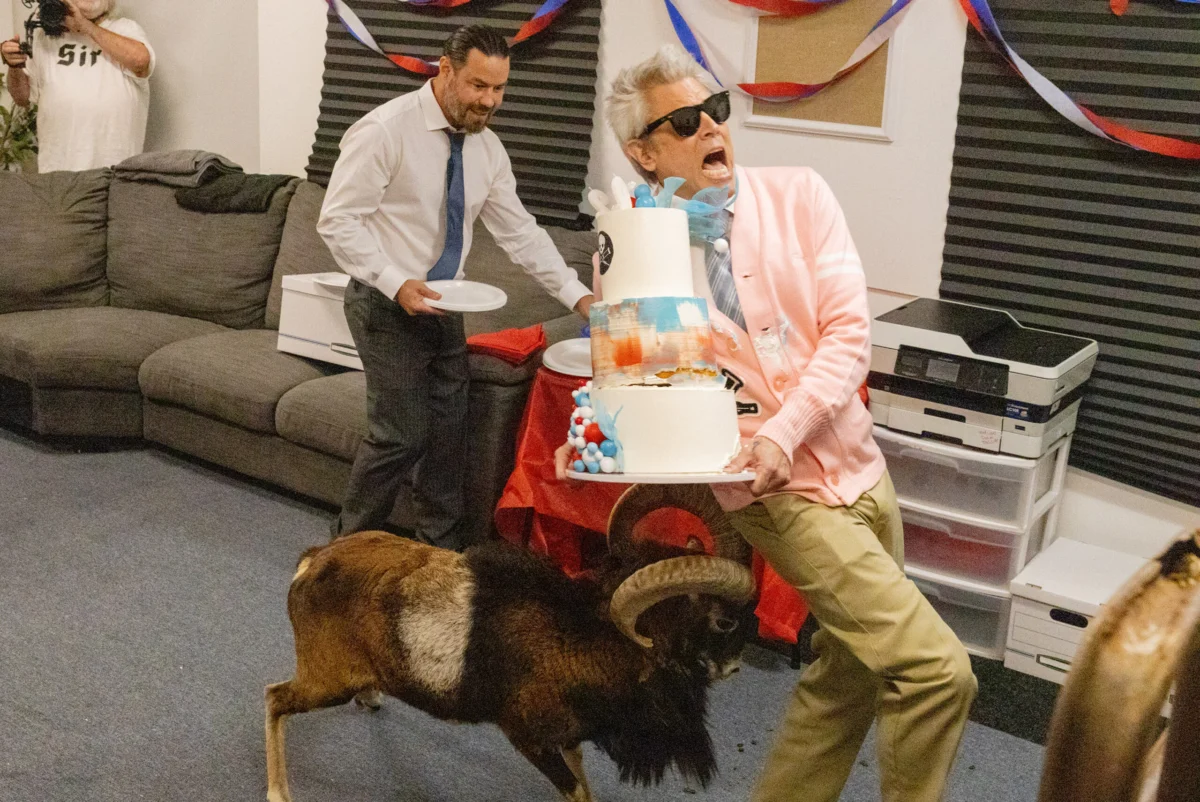
The release of Jackass: Best and Last (2026) marks a definitive conclusion to a media property that has spanned over a quarter of a century, transitioning from a niche subculture experiment into a multi-million-dollar cinematic staple. Director Jeff Tremaine, who has steered the franchise since its inception in the late 1990s, recently reflected on the emotional weight of concluding the series. Speaking during a press circuit for the final installment, Tremaine noted that the process of editing the film—which involved revisiting decades of archival footage—provided a rare moment of introspection for a crew typically known for their relentless pursuit of the next physical stunt.
Tremaine observed that the longevity of the franchise was never a calculated objective. The original premise was built on a foundation of volatility, with the creators expecting immediate cancellation or legal intervention. However, the endurance of the central cast and the evolving appetite of the global audience allowed Jackass to defy the standard lifecycle of reality-based entertainment. This final chapter, according to Tremaine, serves as both a retrospective of their collective history and a final demonstration of the "sophomoric brilliance" that defined their careers.
From Skate Magazine to Global Phenomenon: A Chronological Overview
The origins of Jackass are rooted in the DIY skate culture of the late 1990s, specifically within the pages and videos of Big Brother magazine. Tremaine, serving as the magazine’s editor, became a central figure in curating a roster of personalities whose primary appeal was not necessarily their athletic prowess, but their willingness to engage in transgressive, often dangerous, public performances.
The chronology of the franchise can be divided into four distinct eras:
- The Big Brother/MTV Era (1998–2002): This period was defined by raw, low-resolution video footage. The pivotal moment occurred when Johnny Knoxville filmed himself being shot while wearing a bulletproof vest. This footage caught the attention of major networks, leading to the 2000 premiere of Jackass on MTV. Despite internal corporate concerns regarding liability, the show became an overnight cultural sensation.
- The Transition to Cinema (2002–2006): Following the television show’s conclusion, the crew transitioned to feature films. Jackass: The Movie (2002) was produced on a modest $5 million budget and grossed nearly $80 million worldwide, proving the brand’s viability in a theatrical format. This era was characterized by increased production values and the formalization of the "stunt-comedy" genre.
- The Technical Evolution (2010–2022): With Jackass 3D, the franchise embraced high-definition and slow-motion cinematography. The use of Phantom cameras allowed Tremaine to capture physical impact with a level of detail that bordered on the clinical, yet remained comedic. This era also saw the franchise’s first significant critical re-evaluation.
- The Legacy Era (2022–2026): Jackass Forever and the subsequent Jackass: Best and Last focused on the aging process of the original cast while introducing a new generation of performers. These films leaned heavily into themes of nostalgia and the enduring nature of male friendship.
The Art of Curated Chaos: Tremaine’s Directorial Philosophy
Despite his public persona as a "knucklehead" among a group of pranksters, Tremaine’s background is rooted in fine arts and design. He holds an undergraduate degree in the field, and his early career was spent as a graphic designer and art director. This aesthetic sensibility is the "hidden hand" behind the franchise’s visual identity. Tremaine’s approach to directing is less about scripted dialogue and more about "curating personalities."
In his recent reflections, Tremaine emphasized that his primary role is to create an environment where spontaneity can occur within a controlled production framework. He highlighted the importance of casting, noting that specific individuals like Chris Pontius act as a "safety net" for the comedy. If a stunt fails to deliver the expected physical payoff, Tremaine relies on the organic reactions and wit of the cast to elevate the scene from a failure to a comedic highlight. This methodology—identifying the "magic" in the mundane or the disastrous—is what Tremaine considers the core of his artistic voice.
Navigating Studio Systems and Regulatory Constraints
As the franchise grew, so did the logistical and regulatory hurdles. In the early days, the crew operated with a "guerrilla" mindset, often filming without permits and engaging in spontaneous public disruptions, such as the infamous staged kidnapping of actor Brad Pitt. However, as Jackass became a flagship property for Paramount Pictures, the production evolved into what Tremaine describes as a "slow-moving, deliberate machine."
One of the most significant challenges Tremaine faced throughout his career was the negotiation with the Motion Picture Association of America (MPAA). The franchise’s reliance on male nudity and graphic physical humor frequently led to conflicts over ratings. Tremaine recounted an instance during the production of Jackass 3D where a slow-motion sequence involving Chris Pontius required precise editing to meet studio requirements. The director was forced to compromise by using "black bars" and specific timing to ensure the film maintained its R-rating while preserving the comedic intent. Tremaine noted that while these restrictions were often frustrating, they frequently forced him to find more creative, and sometimes funnier, ways to present the material.
The Shift in Critical Consensus: From Scorn to MoMA
Perhaps the most surprising aspect of the Jackass trajectory is its eventual acceptance by the high-art community and mainstream film critics. For the first decade of its existence, the series was largely dismissed by critics as a low-point in Western culture, often cited as evidence of a "dumbing down" of the American public.
This perception began to shift significantly in 2010 when Jackass 3D premiered at the Museum of Modern Art (MoMA) in New York City. The event signaled a transition where the franchise’s slapstick was viewed through the lens of performance art and avant-garde filmmaking. Critics began to draw parallels between Tremaine’s work and the silent-era physical comedy of Buster Keaton or Charlie Chaplin.
Tremaine admits to a level of discomfort with this intellectualization. "We’re magnifying stupid," he stated, maintaining that the goal was always the immediate visceral reaction rather than a deep psychological message. Nevertheless, by the release of Jackass Forever in 2022, the series was receiving overwhelmingly positive reviews, with critics praising its "unfiltered joy" and its portrayal of healthy, supportive male relationships—a stark contrast to the "toxic masculinity" often associated with male-centric media.
Quantitative Impact and Market Performance
The financial success of the Jackass franchise is a testament to its broad and enduring appeal. The series has consistently delivered high returns on investment, making it one of Paramount’s most profitable assets.
- Jackass: The Movie (2002): Budget: $5M | Global Box Office: $79.5M
- Jackass Number Two (2006): Budget: $11.5M | Global Box Office: $84.6M
- Jackass 3D (2010): Budget: $20M | Global Box Office: $171.7M
- Jackass Forever (2022): Budget: $10M | Global Box Office: $80.3M
Collectively, the films have grossed over $500 million globally, not including home media sales, television syndication, or merchandise. Beyond the box office, the Jackass "aesthetic"—characterized by handheld cameras, first-person reactions, and low-budget stunts—is credited with laying the groundwork for the modern digital creator economy. Platforms like YouTube and TikTok are populated by creators who utilize the very format Tremaine and his team pioneered in the late 90s.
Broader Impact and Implications for the Future of Comedy
As the series concludes with Jackass: Best and Last, the industry is left to assess its broader impact. The franchise has been lauded for its accidental subversion of social norms. While the stunts are often crude, the underlying camaraderie among the cast has been cited as a rare example of non-competitive, affectionate male bonding. Furthermore, the show’s refusal to engage in punch-down humor—focusing instead on self-inflicted harm or shared experiences—has allowed it to age more gracefully than many of its contemporaries in the "shock comedy" genre.
Tremaine’s own career has branched out into unexpected areas, including his direction of a highly-regarded safety PSA for American Airlines. He finds irony in the fact that a man who built a career on "safety third" was eventually commissioned by the world’s largest airline to teach passengers about safety protocols. This diversification suggests that Tremaine’s "voice"—one of clarity, rhythm, and visual storytelling—is applicable far beyond the world of stunts.
As Jeff Tremaine approaches 60, he remains steadfast in his creative identity. While he expresses a desire to evolve, he acknowledges that his fundamental interests—music, art, and the humor found in the absurd—remain unchanged. The conclusion of Jackass: Best and Last represents the end of a specific chapter in cinematic history, but the influence of Tremaine’s "curated chaos" is likely to persist in the DNA of comedy and digital media for decades to come. The franchise proved that with the right eye, even the most "sophomoric" moments can be elevated to something enduring, profitable, and, in its own peculiar way, profound.