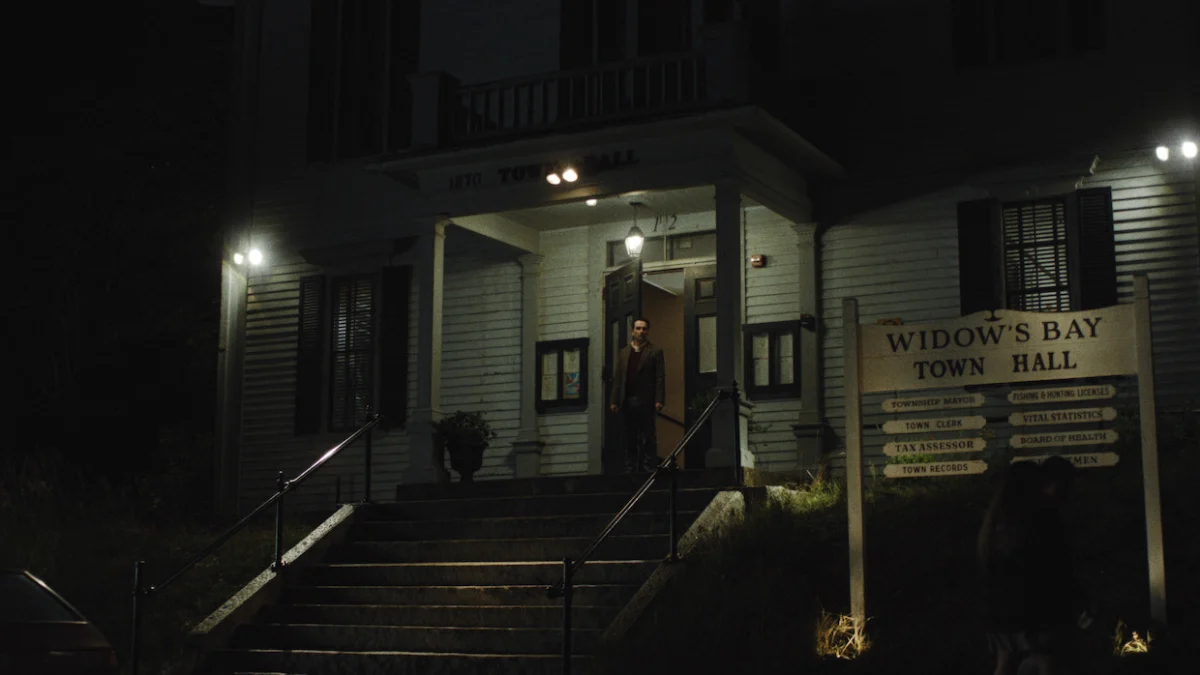
The television landscape is currently witnessing a significant paradigm shift as the boundaries between traditional genres continue to dissolve. Apple TV+’s latest offering, Widow’s Bay, stands at the forefront of this evolution, representing a sophisticated synthesis of macabre horror and sharp-witted comedy. Created and executive produced by Katie Dippold, a veteran of the comedy circuit with credits spanning Mad TV and Parks and Recreation, the series marks a pivotal moment in the "comedy-to-horror" pipeline that has redefined contemporary cinema and television over the last decade.
Starring Emmy winner Matthew Rhys as Tom Loftis, the relentlessly optimistic mayor of a cursed New England island, Widow’s Bay explores the friction between municipal ambition and supernatural reality. The series arrives at a time when industry experts are closely monitoring how genre-blending projects perform both in viewership metrics and during the prestigious awards season, where the show is slated to compete in the comedy categories.
The Narrative Architecture of Widow’s Bay
The premise of Widow’s Bay centers on the eponymous island, a picturesque but deeply troubled locale characterized by a history of maritime tragedy and ancient curses. Matthew Rhys’s character, Tom Loftis, serves as the narrative’s emotional anchor. In a departure from his more brooding roles in The Americans and Perry Mason, Rhys portrays a "lovably rascally" leader whose primary goal is to rebrand the haunted island as a premiere vacation destination.
Loftis faces constant opposition from Wyck, played by character actor and Emmy nominee Stephen Root. Wyck functions as the town’s resident "crankpot," a fervent believer in the island’s malevolence who serves as a foil to the mayor’s skepticism. The supernatural threats lurking beneath the island’s quirky surface are diverse and visceral, ranging from an ominous, sentient fog and a killer clown to a haunted inn and a sea hag with unconventional methods of dispatching victims.
Despite these high-stakes horrors, the series maintains its comedic identity through the characters’ grounded reactions to the absurd. For instance, a central set piece involves the mayor attempting to debunk the haunting of a local hotel by staying overnight, only to be confronted by a terrifying reality that the local innkeeper was too sensible to witness. This juxtaposition of the mundane and the monstrous defines the series’ unique tone.
Chronology of Development: From Spec Script to Streaming Tentpole
The journey of Widow’s Bay from concept to screen spans nearly two decades, reflecting the long-term creative evolution of its creator. Katie Dippold first conceived the idea as a spec script for the NBC sitcom Parks and Recreation roughly 18 years ago. During her tenure as a writer for the acclaimed mockumentary, Dippold explored the potential of placing high-stakes supernatural events within the framework of small-town bureaucracy.
While the project remained in development, Dippold’s career trajectory provided her with the necessary experience to handle large-scale genre productions. Her credits include co-writing the 2016 female-led Ghostbusters and penning the script for Disney’s 2023 Haunted Mansion, directed by Justin Simien. These projects allowed her to refine the balance between humor and horror, a skill set she ultimately brought to the production of Widow’s Bay.
The series’ final form was heavily influenced by a collaborative environment. Dippold credits the input of her production design team and various directors for expanding the scope of her original vision. The transition from features back to television granted her the creative agency to oversee every aspect of the production, ensuring that the visual brooding matched the sharpness of the dialogue.
The Comedy-to-Horror Pipeline: A Statistical and Cultural Trend
Widow’s Bay is the latest example of a broader industry trend where creators with backgrounds in sketch comedy and improv transition into the horror genre. This movement reached a fever pitch in 2017 with Jordan Peele’s Get Out. Peele, formerly of the comedy duo Key & Peele, earned an Academy Award for Best Original Screenplay for his debut, which grossed over $255 million worldwide on a $4.5 million budget.
Following Peele’s success, other comedy veterans have found similar acclaim. Zach Cregger, a founding member of the comedy troupe The Whitest Kids U’ Know, directed the 2022 breakout hit Barbarian, which earned $45 million against a $4.5 million budget and currently holds a 92% rating on Rotten Tomatoes. This year, the horror film Weapons—Cregger’s follow-up—saw Amy Madigan win Best Supporting Actress, further cementing the legitimacy of comedy-born horror.
Dippold posits that the correlation between these two genres lies in the mechanics of "anticipation and payoff." Both comedy and horror rely on the careful construction of tension followed by a sudden release—either a laugh or a scream. By leveraging her background at the Upright Citizens Brigade (UCB), Dippold utilizes these shared rhythmic structures to keep the audience in a state of perpetual uncertainty.

Visual Language and Technical Collaboration
The aesthetic of Widow’s Bay is defined by its brooding, atmospheric cinematography, a result of Dippold’s collaboration with executive producer Hiro Murai. Murai, an Emmy-winning director known for his surrealist work on Atlanta and the visceral tension of The Bear and Station Eleven, directed five of the season’s ten episodes.
The visual inspiration for the series dates back to Dippold’s adolescence in the 1980s, specifically a "lawless" haunted house attraction in Long Branch, New Jersey. This nostalgia for tactile, visceral scares—where actors were permitted to physically interact with visitors—informed the show’s practical effects and set design. The goal was to capture the specific sensation of being genuinely terrified while simultaneously enjoying the experience.
The production design team worked to create a New England setting that felt authentic and lived-in, avoiding the "clean" look often associated with modern sitcoms. By utilizing low-key lighting and a muted color palette, the show maintains a visual gravity that allows the horror elements to be taken seriously, even when the dialogue is overtly comedic.
Casting Strategy: The Importance of Dramatic Gravitas
A critical component of Widow’s Bay’s success is its unconventional casting strategy. While the supporting cast features a "who’s who" of comedic talent—including Jeff Hiller (Somebody Somewhere), Tim Baltz (The Righteous Gemstones), and Toby Huss (Halt and Catch Fire)—the central roles are occupied by actors primarily known for their work in heavy dramas.
In addition to Matthew Rhys and Stephen Root, the cast includes Kate O’Flynn as Patricia, the mayor’s mousy assistant; Kevin Carroll (The Leftovers) as Sheriff Bechir Clemmons; and Dale Dickey (Winter’s Bone) as the no-nonsense Rosemary. Dippold purposefully avoided casting recognizable comedy stars in the lead roles to prevent the show from feeling like a parody.
This approach was inspired by the 1982 film Tootsie. Director Sydney Pollack famously noted that despite the film’s humor, the atmosphere on set was that of a drama. By having actors like Rhys "play the truth of the scene" rather than "reaching for the joke," the series achieves a level of sincerity that enhances both the scares and the humor. Dippold cites horror legends Stephen King and John Carpenter as influences, but admits that the dramatic commitment of Dustin Hoffman in Tootsie is the "secret" blueprint for the performances in Widow’s Bay.
Awards Season Implications and Industry Impact
As the television industry enters the Emmy cycle, Widow’s Bay presents a unique challenge for voters. Apple TV+ has officially submitted the series in the comedy categories. Historically, the Television Academy has been hesitant to recognize genre-heavy shows as comedies, with rare exceptions like FX’s What We Do in the Shadows and Netflix’s Wednesday.
The "Drama" categories have traditionally been more inclusive of genre fiction, nominating and awarding shows like Game of Thrones, The Mandalorian, Stranger Things, and The Last of Us. However, for a show like Widow’s Bay, the comedic elements are not incidental; they are the primary vehicle for the narrative. If the series manages to secure nominations in the comedy categories, it could signal a widening of the Academy’s definition of what constitutes a comedy series in the streaming era.
The implications for Apple TV+ are equally significant. As the platform continues to build its library of "prestige" content, projects like Widow’s Bay demonstrate a willingness to take risks on high-concept, expensive genre blends. The success of the series would likely encourage further investment in creators who can navigate the complex tonal requirements of "horror-comedy," a subgenre that is increasingly proving to be a reliable draw for both critical acclaim and subscriber engagement.
Conclusion: A New Standard for Genre Blending
Widow’s Bay represents more than just a seasonal horror offering; it is a meticulously crafted exploration of human optimism in the face of the inexplicable. By grounding its supernatural elements in the bureaucratic frustrations of a small-town mayor and the dramatic commitment of a world-class cast, the series transcends the limitations of its individual genres.
As Katie Dippold and her team wait for the response from both the public and the Academy, the series stands as a testament to the enduring power of the "comedy-to-horror" pipeline. It suggests that in the hands of skilled practitioners, the line between a scream and a laugh is not just thin—it is nonexistent. Widow’s Bay serves as a reminder that the most effective way to confront the dark is often with a sense of humor, provided that humor is played with the absolute conviction of a drama.