

Jehane Noujaim and Vikram Gandhi’s four-hour HBO docuseries, The Man Will Burn, offers an expansive, yet ultimately perplexing, look into the inner workings of the iconic Burning Man Festival. Granted extensive multi-year access to the event’s participants, its intricate bureaucracy, and the very landscape it transforms annually, the series presents a visually engaging but structurally inconsistent narrative. It grapples with an abundance of material, often without the necessary clarity or rigorous focus to transcend its inherent complexities. The result is a production that, while providing glimpses into the community, infrastructure, and internal political conflicts of Burning Man, often feels more like a well-produced advertisement than a deep, investigative dive, leaving viewers with an engaging puzzlement rather than profound insight.
The Genesis of Black Rock City: A Counterculture Phenomenon
To understand the contemporary challenges and internal debates depicted in The Man Will Burn, one must first appreciate the origins and philosophical underpinnings of Burning Man. The festival emerged from humble beginnings on Baker Beach in San Francisco in 1986, when Larry Harvey and Jerry James burned an 8-foot wooden effigy of a man. This act, initially a spontaneous expression of radical self-expression and community, quickly grew, drawing increasing numbers of participants. By 1990, facing increased scrutiny from park police, the event relocated to the vast, open expanse of Nevada’s Black Rock Desert, giving birth to Black Rock City – a temporary metropolis that rises from the playa each year.
The move to the desert was pivotal, allowing the event to scale and develop its distinct ethos. Central to this ethos are the Ten Principles, articulated by Larry Harvey in 2004, which serve as guiding ideals for participants: Radical Inclusion, Gifting, Decommodification, Radical Self-Reliance, Radical Self-Expression, Communal Effort, Civic Responsibility, Leaving No Trace, Participation, and Immediacy. These principles aim to foster a unique, participant-driven culture free from commercialism, encouraging creativity, collaboration, and a profound connection to the moment and one another. From its anarchic roots within the Cacophony Society, a playful subversion group from the Bay Area, Burning Man transitioned into a more formalized, albeit still counter-cultural, organization with the founding of Black Rock City LLC in 1999, which then became the non-profit Burning Man Project (BMP). This shift marked a critical juncture, professionalizing the event’s logistics and governance while striving to preserve its anti-establishment spirit.
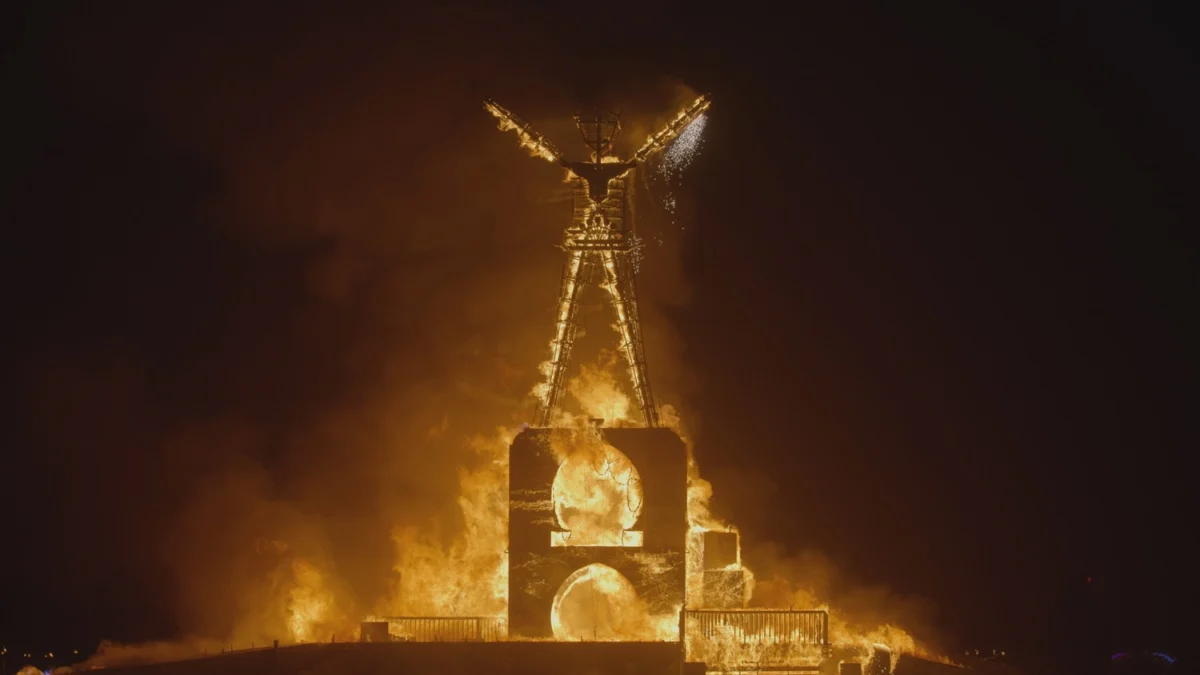
Over the decades, Burning Man has evolved from a gathering of a few dozen friends into a global phenomenon attracting over 80,000 "burners" annually. This exponential growth has brought both unprecedented artistic expression and significant logistical and philosophical challenges. The festival has become renowned for its monumental art installations, themed camps, mutant vehicles, and a vibrant culture of gifting and performance, all culminating in the ceremonial burning of "The Man" and "The Temple." However, this expansion has also led to increased scrutiny regarding its accessibility, environmental impact, and the perceived infiltration of wealth and corporate influence, questions that The Man Will Burn touches upon but rarely fully interrogates.
A Festival at a Crossroads: Navigating Crisis and Identity
The Man Will Burn primarily focuses on a tumultuous period in Burning Man’s recent history, specifically from the lead-up to the 2021 festival through the rain-soaked 2023 event. The central drama unfolds around the decision regarding the 2021 festival amidst the ongoing global COVID-19 pandemic. The documentary captures the intense internal debate within the Burning Man Project’s leadership and community: should the event be canceled for a second consecutive year, allowing for widespread vaccination and better mitigation strategies for a triumphant return in 2022? Or was it imperative to proceed in 2021 to uphold the brand’s values, satisfy its devoted participants, and ensure the organization’s economic solvency?
This internal struggle is personified through key figures like CEO Marian Goodell, a long-time leader and custodian of Burning Man’s core principles, and board member Kimbal Musk, a prominent investor and brother of Elon Musk. Musk, whose presence in the docuseries exudes an air of entitlement, strongly advocates for the festival’s return, driven by a perception of brand necessity and economic continuity. His perspective highlights a growing tension between the festival’s founding ideals of decommodification and radical self-reliance, and its increasing reliance on, and influence from, affluent individuals and corporate-style governance. Ultimately, the decision was made to cancel the 2021 event, a move that, much to Musk’s chagrin, underscored the deep divisions within the organization.
The cancellation, while disappointing to many, including first-time hopefuls like Lindsay, an online professor from Pasadena, and Ray, a Black veteran from rural North Carolina, also inadvertently sparked the "renegade burn" of 2021. This unofficial gathering, facilitated by those unable to forgo their annual pilgrimage, offered a fascinating, albeit chaotic, testament to the enduring spirit of Burning Man outside of its formal organizational structure. The docuseries uses Lindsay and Ray as empathetic entry points for viewers, illustrating the diverse motivations—from cultural immersion and artistic expression to spiritual awakening and community seeking—that draw individuals from all walks of life to the playa. While the series successfully portrays their individual journeys and the allure of "burning," it refrains from delving deeply into the broader implications of the renegade event for the official organization or the future governance of the festival space.
Navigating Controversy and Growth: The 2023 Deluge and Beyond
Following the 2021 cancellation and the subsequent return in 2022, the 2023 festival presented an entirely new set of challenges: an unprecedented deluge of rain. The docuseries dedicates significant screen time to this event, capturing the stunning visual paradox of a flooded desert landscape. Participants found themselves stranded, with muddy conditions making travel impossible and raising concerns about sanitation and safety. The media, often characterized by burners as sensationalistic and voyeuristic, quickly reported on the "destruction and devastation." However, The Man Will Burn presents a largely reassuring counter-narrative, with participants and organizers reiterating that "everything was perfectly fine" and "we’re all okay." While the cinematography captures the beauty of the flooded playa, the docuseries’ unwavering adherence to this official line, even amidst photographic evidence of significant disruption, raises questions about its critical distance.
The portrayal of the 2023 event serves as a microcosm for the docuseries’ broader approach. It acknowledges external criticism and challenges but often frames them within a narrative of resilience and community, rather than probing deeper into the underlying issues. For instance, the original article points out that the docuseries touches upon the inherent "whiteness and privilege" of Burning Man. Despite its principle of Radical Inclusion, the high cost of tickets (often hundreds of dollars), travel, and necessary gear creates a significant barrier to entry, limiting participation largely to those with disposable income. While the series introduces a Black veteran as a first-time attendee, it stops short of a comprehensive analysis of the festival’s demographic homogeneity or concerted efforts towards greater diversity and accessibility, leaving this crucial social critique largely superficial.
Similarly, the docuseries tiptoes around the long-standing "town-and-gown" conflicts between Burning Man and the local communities and law enforcement in Gerlach, Nevada. The annual influx of tens of thousands of participants places immense strain on local resources, infrastructure, and services. Issues such as traffic congestion, waste management, and the economic benefits (or burdens) for local businesses are complex and often contentious. The series alludes to these tensions but quickly moves on, never establishing a detailed history of these concerns or exploring their potential for exacerbation. This pattern of introducing potentially thorny issues—such as the festival’s financial woes, land acquisition aspirations for a "philosophical center," or a burgeoning coup among board members—only to abandon them for superficially happy resolutions, undermines the docuseries’ ability to offer a truly comprehensive or critical perspective.
The Docuseries’ Unflinching Access, Limited Scrutiny
One of the most striking aspects of The Man Will Burn is its unparalleled access to Burning Man’s leadership, internal discussions, and intimate moments on the playa. The directors, Jehane Noujaim and Vikram Gandhi, capitalize on this access to deliver a visually rich tapestry of the festival. Drone-heavy cinematography captures the sprawling artistry, eclectic participants, dazzling pyrotechnics, and the sheer scale of Black Rock City, effectively conveying the event’s unique aesthetic and energetic atmosphere. However, this proficiency in visual storytelling does not translate into a comparable depth of critical inquiry.
The primary critique leveled against the docuseries is its perceived lack of rigor and critical distance. Unlike Noujaim’s previous, critically acclaimed work, such as The Vow, which meticulously dissected the NXIVM cult with a clear investigative intent, The Man Will Burn appears to pull its punches. The close involvement between the filmmakers and the Burning Man Project (BMP) seems to have fostered an amiable, perhaps even complicit, spirit of accommodation rather than journalistic interrogation. This leads to a narrative where conflicts, even profound ones between disparate ideologies, are presented as benign disagreements, with all parties ultimately striving for what they believe is "best for Burning Man." The viewer is left to wonder what true criticisms or frustrations might lie beneath the surface, particularly concerning the influence of Silicon Valley billionaires like Kimbal Musk on an organization ostensibly dedicated to decommodification. The docuseries’ reluctance to dig deeper, to ask uncomfortable questions, or to challenge official narratives results in a sanitized portrayal that borders on promotional material.
The series features an assortment of veteran burners, artists, and logistical organizers who steer the narrative, often reciting what feels like "party lines" about the festival’s idealism. While their passion is evident, the documentary does not provide sufficient counterpoints or critical analysis to balance these perspectives. Consequently, Burning Man, as depicted, becomes almost indistinguishable from the idealized, self-serving narratives often found in documentaries about cults, albeit without the explicit intent of critical exposure. This is a significant missed opportunity, as a deeper exploration of the tensions between idealism and pragmatism, counter-culture roots and mainstream commercialization, or individual freedom and collective responsibility could have elevated the docuseries from engaging surface-level observation to profound cultural commentary.
Future Horizons for Burning Man: Challenges and Implications
As The Man Will Burn concludes its narrative arc in 2023, it leaves many critical questions about Burning Man’s future unanswered. The series hints at ongoing financial issues and broader aspirations for the festival, including land acquisition and the establishment of a "philosophical center," but these threads are left dangling. The financial sustainability of such a massive, non-commercial event, particularly in the face of unforeseen circumstances like pandemics and extreme weather, remains a significant challenge. The economic impact of cancellations on the organization, its contractors, and the surrounding local economy is substantial, underscoring the precarious balance between idealism and financial reality.
Moreover, the tension between Burning Man’s core principles and the realities of its growth continues to be a central debate. How does an event committed to decommodification manage the influx of wealth and the commercialization inherent in large-scale operations? How does it maintain radical self-reliance when it increasingly relies on complex logistical infrastructure and corporate sponsorships (even if indirect)? The perceived exclusivity, fueled by rising ticket prices and the cost of participation, directly challenges the principle of Radical Inclusion. Efforts to address diversity, equity, and inclusion within the Burning Man community are ongoing but face systemic barriers that the docuseries largely sidesteps.
The environmental footprint of Black Rock City, despite the principle of Leaving No Trace, is another critical concern. Managing waste for 80,000+ people in a delicate desert ecosystem, minimizing carbon emissions from travel and generators, and mitigating the impact of large-scale art installations are complex environmental challenges that require continuous innovation and vigilance. While the docuseries visually captures the "Leave No Trace" efforts, it does not delve into the deeper ecological implications or the sustainability strategies for the future.
Ultimately, The Man Will Burn is a testament to the power of access and the allure of its subject, yet it falters in its critical ambition. It serves as a beautifully shot, well-sourced, albeit largely uncritical, commercial for an event that arguably needs no further advertising. While it offers a valuable, if sanitized, introduction to the world of Burning Man, it shies away from the harder questions and deeper conflicts that define its ongoing evolution. In its attempt to be both comprehensive and inoffensive, the docuseries occupies an unsatisfying middle ground—neither a tight, sensational exposé nor a rich, complex investigation. It is a series that, much like the paradox of Burning Man itself, is visually captivating but intellectually constrained, leaving viewers with a sense of wonder mixed with a longing for greater depth and critical engagement.