
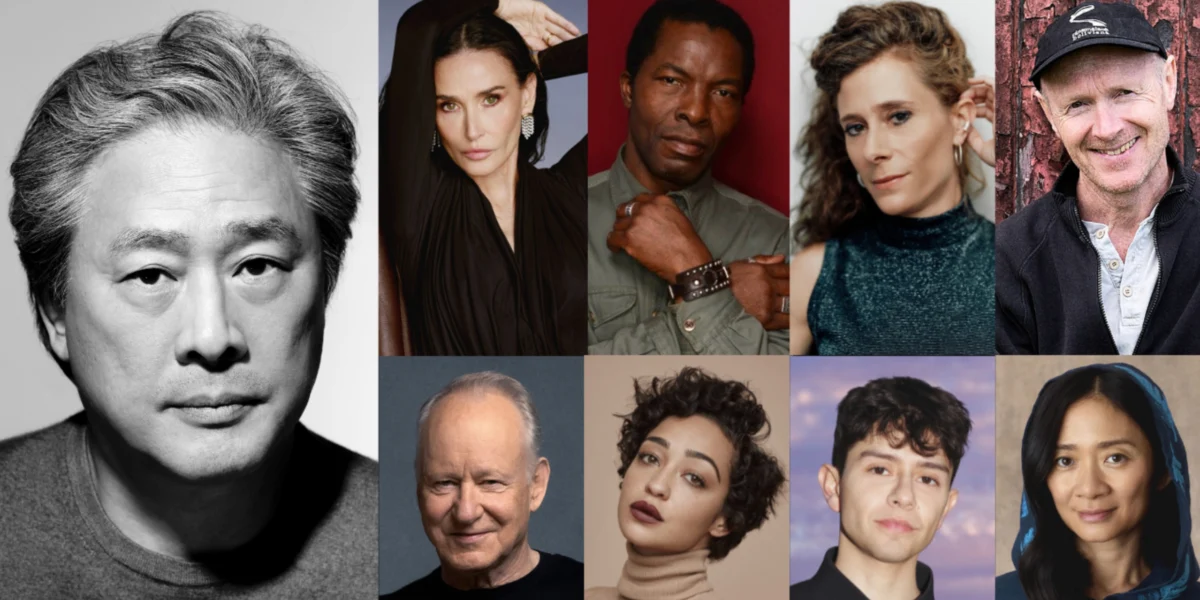
The 79th edition of the prestigious Cannes Film Festival, set to unfold from May 12th to May 23rd, 2026, has officially unveiled the distinguished jury that will preside over the Official Competition. At the helm of this esteemed panel is acclaimed South Korean director, screenwriter, and producer Park Chan-wook, a filmmaker whose visceral and audacious cinematic vision has consistently captivated global audiences and garnered significant accolades on the Croisette. He will be joined by a diverse and accomplished ensemble of international cinematic talent, representing a broad spectrum of artistic expertise and global perspectives.
This year’s jury is a testament to the festival’s enduring commitment to celebrating diverse voices and groundbreaking filmmaking. The lineup includes celebrated American actress and producer Demi Moore, whose illustrious career spans iconic roles and recent critical triumphs; Irish-Ethiopian actress and producer Ruth Negga, recognized for her powerful performances and significant contributions to both film and television; Belgian director and screenwriter Laura Wandel, whose poignant explorations of youth and societal pressures have earned her international acclaim; Chinese director and screenwriter Chloë Zhao, an Academy Award-winning auteur known for her empathetic storytelling and unique visual style; Chilean director and screenwriter Diego Céspedes, a rising star in Latin American cinema celebrated for his politically charged and deeply personal narratives; Ivorian-American actor Isaach De Bankolé, a formidable presence in international cinema with a career marked by collaborations with visionary directors; Scottish screenwriter Paul Laverty, a long-standing collaborator with Ken Loach, whose socially conscious narratives have twice earned the Palme d’Or; and Swedish actor Stellan Skarsgård, a veteran performer renowned for his versatility across blockbusters and independent cinema.
Together, this jury of nine luminaries will bear the significant responsibility of deliberating over the 22 films vying for the festival’s highest honor, the Palme d’Or. This coveted award, a benchmark of cinematic achievement, was last bestowed in 2025 upon Jafar Panahi’s "It Was Just an Accident," a film presented by the jury chaired by Juliette Binoche. The culmination of their deliberations will be revealed on Saturday, May 23rd, during the Closing Ceremony, a grand event that will be broadcast live by France Télévisions in France and by Brut internationally, marking the official conclusion of this year’s cinematic marathon.
The President: Park Chan-wook’s Enduring Cannes Legacy
The selection of Park Chan-wook as Jury President is a fitting tribute to his profound and lasting impact on the art of filmmaking, particularly within the context of the Cannes Film Festival. His directorial oeuvre is characterized by a fearless exploration of complex themes, a distinctive visual flair, and a mastery of genre that often pushes boundaries. Described as visceral, subversive, and baroque, Park’s cinema is defined by its boldness, evident in its storytelling, its stylistic innovation, and its moral ambiguities. He possesses a rare ability to immerse audiences in dark, unsettling worlds, crafting journeys that are simultaneously terrifying, exhilarating, and erotic, often within a single film.
Park’s relationship with Cannes dates back to 2004, when his seminal thriller "Oldboy" earned him the Grand Prix. This marked the beginning of a highly successful tenure at the festival, with nearly every subsequent submission to the Official Competition finding favor with the juries. His filmography at Cannes includes "Thirst," which garnered the Jury Prize in 2009, and "The Handmaiden" (2016). Most recently, his critically acclaimed "Decision to Leave" earned him the Best Director Award in 2022, further solidifying his status as a filmmaker deeply respected by the festival’s esteemed panels. Park’s celebrated "Vengeance Trilogy" – "Sympathy for Mister Vengeance," "Oldboy," and "Lady Vengeance" – has become a cornerstone of contemporary Korean cinema, renowned for its unflinching examination of revenge. His work also frequently pays homage to the master of suspense, Alfred Hitchcock, an influence subtly woven into films like "Stoker" (2013) and his more recent work, including "No Other Choice" (2025). Park Chan-wook’s cinematic DNA embodies the spirit of modern Korean filmmaking: unconstrained by convention, audience-aware, ambitious, and provocatively sophisticated without sacrificing intellectual depth.
A Jury of Global Acclaim and Diverse Expertise
The assembled jury members bring with them a wealth of experience and a diverse range of artistic perspectives, promising a rich and insightful deliberation process.
Demi Moore: A Hollywood Icon and Contemporary Force
Academy Award-nominated actress and producer Demi Moore has recently captivated audiences with her performance in Coralie Fargeat’s "The Substance," which earned the Best Screenplay Award at the 2024 Cannes Film Festival. Her role in the film garnered her prestigious Golden Globe, SAG, and Critics Choice awards, alongside BAFTA and Academy Award nominations. Moore is currently a prominent figure in television, having returned for the second season of Paramount+’s "Landman," which has already been renewed for a third. Her upcoming projects include Neon’s "I Love Boosters," directed by Boots Riley, which has garnered early critical praise, and Roger Ross Williams’ "Strange Arrivals," where she will star alongside Colman Domingo. Her television work also includes a significant role in the second season of "Feud: Capote vs. The Swans." Moore’s enduring legacy in Hollywood is built upon iconic performances in films such as "Ghost," "A Few Good Men," "Indecent Proposal," and "G.I. Jane." Her inclusion on the jury signifies a bridge between established Hollywood glamour and the cutting edge of international cinema.
Ruth Negga: A Nuanced Performer with Global Roots
Ruth Negga, an Irish-Ethiopian actress and producer, earned an Academy Award nomination for her transformative performance in Jeff Nichols’ "Loving," which premiered in Competition at the 2016 Cannes Film Festival. Her career, shaped by her upbringing in Ethiopia, Ireland, and England, has seen her excel in both theatre and film. Negga’s theatrical achievements include a Laurence Olivier Award nomination for her role in "Duck" and originating the titular role in a production of "Hamlet" in Dublin and New York. She also received a Tony nomination for her performance in "Macbeth." Her cinematic work includes a notable role in Rebecca Hall’s "Passing," which earned her a Golden Globe nomination and an Independent Spirit Award. On television, Negga received an Emmy Award nomination for her role in "Presumed Innocent" and starred as a co-executive producer in the acclaimed series "Preacher," among numerous other projects that have garnered her Emmy, BAFTA, and Irish Film & Television Awards. Negga’s presence brings a depth of performance and a perspective informed by a rich cultural heritage.
Laura Wandel: A Rising Belgian Director with Emotional Resonance
Belgian director and screenwriter Laura Wandel, a graduate of the Institut des Arts de Diffusion (IAD), has rapidly emerged as a significant voice in contemporary cinema. Her directorial journey began with the short film "O Negative" in 2010, followed by "Foreign Bodies," which screened in the short film competition at Cannes in 2014. Wandel returned to the festival in 2021 with her debut feature film, "Playground," which captivated audiences in the Un Certain Regard section and won the FIPRESCI Award. The film also received an Oscar shortlist for Best International Feature Film and secured seven Magritte du Cinéma Awards. Her directorial approach is characterized by a realistic and immersive style, as seen in her subsequent work, "Adam’s Sake" (2025), developed at La Résidence of the Festival de Cannes and selected to open the Semaine de la Critique. Wandel’s inclusion highlights Cannes’ dedication to nurturing emerging directorial talent with a strong artistic vision.
Chloë Zhao: An Oscar-Winning Visionary Shaping Modern Cinema
Beijing-born writer, director, editor, and producer Chloë Zhao has etched her name in the annals of world cinema with her distinctive narrative style and profound humanism. Her debut feature, "Songs My Brothers Taught Me" (2015), garnered attention at festivals like Sundance and Cannes, followed by the widely acclaimed "The Rider" two years later. Zhao achieved global recognition with the Searchlight film "Nomadland" (2021), earning two Academy Awards for Best Picture and Best Director. She also directed Marvel Studios’ "Eternals." In 2025, "Hamnet" garnered numerous awards, including Best Motion Picture – Drama at the Golden Globes and Outstanding British Film at the BAFTAs, making Zhao only the second woman to be nominated twice for the Academy Award for Best Director. She further expanded her influence by launching the production companies Book of Shadows in 2023 and Kodansha Studios in 2025. Zhao’s presence on the jury brings an unparalleled understanding of both independent and blockbuster filmmaking, along with a proven track record of critical and commercial success.
Diego Céspedes: A Latin American Luminary of Desire and Identity
Diego Céspedes, a Chilean director and screenwriter, is recognized as one of the most distinctive emerging voices in Latin American cinema. His debut feature, "The Mysterious Gaze of the Flamingo," developed at La Cinef, earned him the Un Certain Regard Prize at the 2025 Festival de Cannes. Céspedes’ work masterfully crafts intimate and politically resonant stories that delve into themes of desire, identity, and chosen families. His earlier short films, "The Summer of the Electric Lion" (2018), which won the Cinéfondation First Prize at Cannes, and "The Melting Creatures" (2022), which premiered at the Semaine de la Critique, have screened at major international festivals including San Sebastián, Sundance, and Toronto. Céspedes’ films are celebrated for their ability to blend the fantastical with the everyday, exploring marginal spaces and emotional communities through a singular visual language. He is currently developing his second feature film, "The Case of a Boy Who Lost His Heart." His inclusion underscores Cannes’ commitment to championing groundbreaking talent from diverse global regions.
Isaach De Bankolé: An International Actor of Captivating Presence
Ivorian-American actor Isaach De Bankolé is a globally recognized performer whose career has spanned decades and continents. He is slated to appear in Denis Villeneuve’s highly anticipated "Dune: Part Three." De Bankolé began his career in France, earning the César Award for Most Promising Actor for his role in "Black Mic-Mac" (1987). His extensive collaborations with director Claire Denis include "Chocolat" (Competition, Festival de Cannes 1988), "No Fear, No Die" (1992), "White Material" (2010), and the recent "The Fence." His work in theatre includes collaborations with Patrice Chéreau. De Bankolé’s artistic partnership with director Jim Jarmusch has yielded memorable performances in "Night on Earth" (1991), "Ghost Dog: The Way of the Samurai" (Competition, Festival de Cannes 1999), "Coffee and Cigarettes" (2003), and "The Limits of Control" (2009). He has also appeared in major blockbusters such as "Casino Royale" and "Miami Vice," and in Ryan Coogler’s "Black Panther" films (2018 & 2022). His recent appearances include "Muganga: The One Who Treats" and Brady Corbet’s "The Brutalist." De Bankolé’s commanding presence and diverse filmography make him a significant addition to the jury.
Paul Laverty: A Socially Conscious Screenwriter with Palme d’Or Pedigree
Scottish screenwriter Paul Laverty has been a pivotal collaborator with director Ken Loach and producer Rebecca O’Brien for three decades, contributing to two Palme d’Or winners: "The Wind that Shakes the Barley" (2006) and "I, Daniel Blake" (2016). His writing has also been recognized with best screenplay awards at prestigious festivals, including Cannes for "Sweet Sixteen" (2002), the Venice International Film Festival for "It’s a Free World!" (2007), and the San Sebastián Film Festival for "Yuli" (2018). Laverty has penned 14 films for Loach, 11 of which have been selected for the Official Competition at Cannes, including "My Name Is Joe," "Looking for Eric," "The Angels’ Share," and "The Old Oak." He also maintains a close creative partnership with Spanish director Icíar Bollaín, with whom he made "Even the Rain," winner of the Panorama Audience Award in Berlin and shortlisted for an Academy Award for Best Foreign Language Film (2012), as well as "El olivo" (2016) and "Yuli" (2018). Laverty’s dedication to crafting narratives that illuminate social issues and champion the human spirit brings a powerful ethical dimension to the jury.
Stellan Skarsgård: A Versatile Actor of International Renown
Stellan Skarsgård, a highly esteemed Swedish actor, is a recipient of a Golden Globe Award and has been nominated for BAFTA and Academy Awards. Renowned for his remarkable versatility, Skarsgård seamlessly transitions between television, independent dramas, historical epics, and major fantasy blockbusters. He recently starred in Joachim Trier’s "Sentimental Value," which won the Grand Prix at the 2025 Festival de Cannes, earning Skarsgård a nomination for his performance. He first gained international recognition for his role in "Breaking the Waves" (Grand Prix, 1996 Festival de Cannes). His extensive filmography includes critically acclaimed performances in "Good Will Hunting," "Pirates of the Caribbean," "Mamma Mia!," "Melancholia" (Competition, 2011 Festival de Cannes), and major franchises such as the Marvel Cinematic Universe’s "Thor" and "The Avengers." His television work includes the highly regarded HBO series "Chernobyl." Skarsgård’s continued presence in high-profile projects like "Dune – Part Two" and the Star Wars series "Andor" solidifies his position as a respected and influential figure in contemporary entertainment.
The Path to the Palme d’Or: A Festival Chronology
The Cannes Film Festival, established in 1946, has evolved into the world’s most prestigious cinematic gathering, attracting filmmakers, industry professionals, and cinephiles from across the globe. The festival’s primary objective is to showcase and award outstanding cinematic achievements, fostering cultural exchange and promoting the art of filmmaking. The Official Competition, at the heart of the festival, features a curated selection of films vying for the coveted Palme d’Or and other jury prizes.
The journey for the 2026 jury begins with the official announcement of the festival dates and the jury composition. This is typically followed by the unveiling of the Official Selection, a highly anticipated moment that sets the stage for the films that will compete. The festival itself then commences with an Opening Ceremony, followed by a rigorous schedule of film screenings, press conferences, and industry events. Throughout the festival, the jury engages in private deliberations, meticulously evaluating each film based on artistic merit, narrative innovation, and thematic depth. The pinnacle of the festival is the Closing Ceremony, where the jury’s decisions are formally announced, culminating in the awarding of the Palme d’Or and other prestigious accolades. The broadcast of this ceremony ensures that the festival’s impact extends far beyond the Croisette, reaching a global audience eager to celebrate cinematic excellence.
Broader Implications and Future Trends
The composition of the 2026 Cannes Film Festival jury speaks volumes about the evolving landscape of global cinema. The inclusion of directors like Chloë Zhao and Laura Wandel, alongside established figures, signals a continued emphasis on emerging talent and diverse storytelling. The presence of actors and screenwriters from various international backgrounds underscores the festival’s commitment to a truly global perspective.
The careful selection of a jury that reflects a wide array of cinematic styles and cultural influences suggests a desire to honor films that are both artistically ambitious and universally resonant. Park Chan-wook’s leadership, known for his bold and often challenging filmmaking, could indicate a leaning towards films that push creative boundaries. The jury’s diverse backgrounds are likely to foster nuanced discussions, ensuring that the final decisions represent a broad consensus on cinematic achievement. The festival’s sustained focus on recognizing filmmakers who address complex social and political issues, as evidenced by the inclusion of Paul Laverty, highlights its role as a platform for films that provoke thought and inspire dialogue.
The 2026 Cannes Film Festival, under the guidance of this distinguished jury, promises to be another landmark event, celebrating the enduring power of cinema to connect, challenge, and inspire audiences worldwide. The anticipation for the films that will grace the competition and the ultimate decision of this esteemed panel is already palpable within the global film community.