


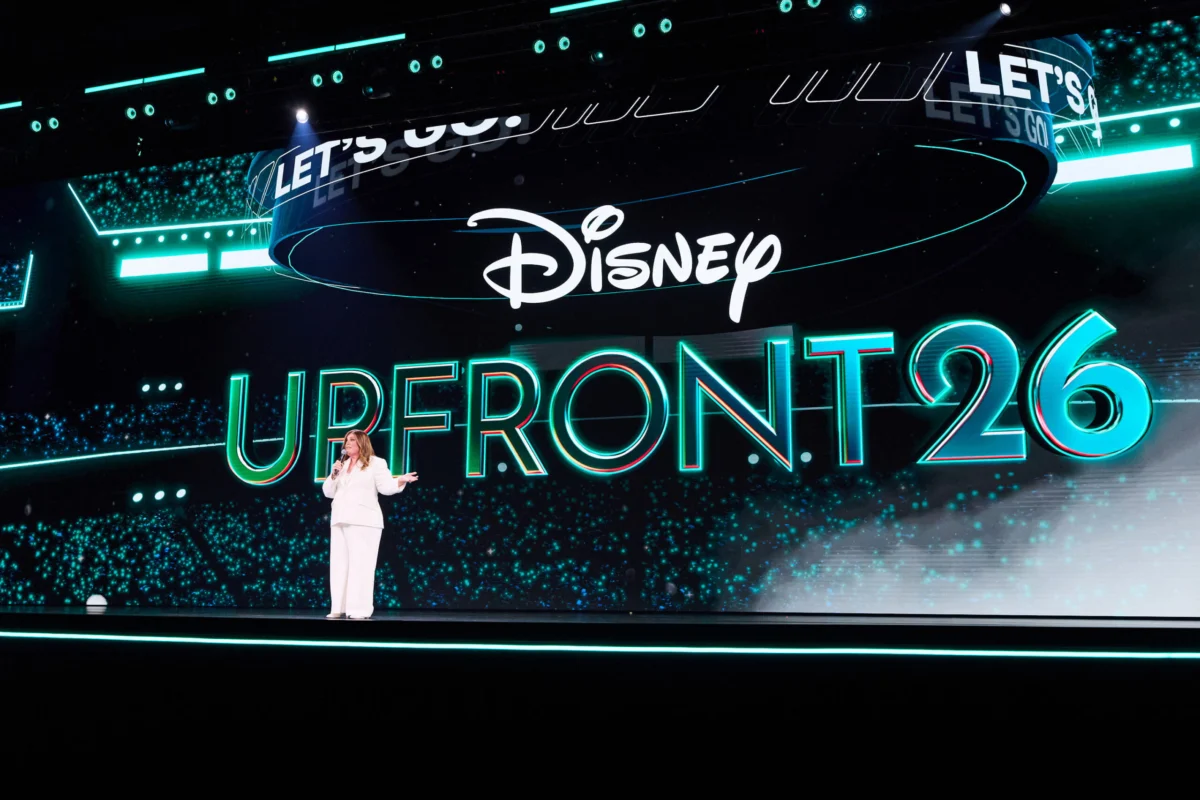
The landscape of modern media advertising is undergoing a seismic shift, characterized by the convergence of traditional linear broadcasting, high-growth streaming platforms, and data-driven targeting. At the epicenter of this transformation for The Walt Disney Company is Rita Ferro, the President of Global Advertising, whose leadership has become synonymous with the company’s "One Disney" initiative. During the recent Disney Upfront 2026 presentation held at the North Javits Center in New York City, Ferro’s influence was underscored by an unconventional introduction from actor Paul Anthony Kelly, who recently portrayed John F. Kennedy Jr. in the FX series "Love Story." Kelly’s endorsement—noting that Disney’s "unrivaled fandom" is driven largely by Ferro’s operational vision—served as a prelude to a high-stakes pitch to advertisers at a time when the industry is grappling with the decline of cable television and the rising costs of premium sports rights.
Ferro, a 29-year veteran of the company, now manages the advertising revenue for a portfolio that includes Disney Entertainment, ESPN, and ABC News. Her rise to the global presidency in 2023 follows a career path that mirrors the evolution of the media industry itself. From her early days at MTV Latin America to her leadership roles within Disney Interactive and ESPN International, Ferro has navigated the transition from an era of "unpolished" cable growth to a sophisticated digital-first environment. Today, her mandate is clear: monetize the vast Disney ecosystem by bridging the gap between content creation and consumer data, ensuring that every touchpoint—from a theme park visit to a Super Bowl broadcast—provides value to brand partners.
A Career Defined by Innovation and Adaptability
Rita Ferro’s journey to the top of the advertising world is rooted in a background of resilience and cultural fluency. Born and raised in Miami to Cuban immigrants who fled just before the Cuban Revolution, Ferro originally intended to pursue a career in creative copywriting. However, a realization during her studies at Florida International University led her toward the business and fundraising side of production. Her professional debut in the early 1990s at MTV Latin America provided a foundational experience in building an industry from the ground up. In 1993, cable television in Latin America lacked a blueprint, requiring Ferro to thrive in an environment that was often unsophisticated but highly dynamic.
Since joining Disney, Ferro has occupied pivotal roles across various divisions, including the now-defunct Disney Interactive, where she focused on mobile games and social media distribution. This diverse background has proven serendipitous. As the media industry shifts toward interactive and digital-first advertising, Ferro’s familiarity with gaming and social platforms has allowed Disney to stay ahead of competitors. Her colleagues, including ESPN Chairman Jimmy Pitaro, emphasize that Ferro remains "in the field," maintaining a hands-on approach to client relationships despite her executive status. This visibility is crucial as Disney negotiates complex multi-year commitments with global brands.
The One Disney Strategy and CEO Transition
The 2026 Upfront presentation arrived during a critical juncture for Disney. In March 2026, Josh D’Amaro officially succeeded Bob Iger as CEO, marking a new chapter focused on integration and technological immersion. D’Amaro’s "One Disney" strategy aims to dissolve the silos between the company’s various divisions—Studios, Parks, and Media—to create a more personalized consumer experience. For Ferro, this strategy translates into a more holistic advertising offering. Instead of merely selling commercial spots on a linear network, Disney now offers "corporate alliance" packages that can include park activations, movie studio partnerships, and targeted streaming ads.
This integrated approach is designed to maximize the "lifetime value" of the consumer, a metric frequently cited by Disney CFO Hugh Johnston. By tracking how a fan interacts with the brand across multiple platforms, Disney can provide advertisers with a level of granular targeting that was previously the sole domain of tech giants like Google and Meta. The goal is to move beyond traditional media sales into a role that resembles a strategic business consultancy for brand partners.
The Dominance of Live Sports and the Super Bowl Milestone
As traditional scripted television faces audience fragmentation, live sports have emerged as the final frontier of mass-reach advertising. Disney has doubled down on this sector, securing long-term media rights deals that are among the most expensive in history. The NFL’s 11-year, $111 billion deal and the NBA’s $77 billion agreement have placed immense pressure on ad sales teams to deliver high returns on investment.
A landmark moment for Ferro’s team in 2026 is the return of the Super Bowl to Disney’s broadcast network, ABC, for the first time in two decades. The game will also be simulcast on ESPN, marking the first time the sports-centric network has aired the championship. Industry reports suggest that 30-second commercial spots for the event are fetching upwards of $10 million, reflecting the premium that advertisers place on live, "unskippable" content. The launch of the ESPN direct-to-consumer (DTC) streaming app in late 2025 has further expanded this inventory, allowing Disney to offer advertisers a mix of broad broadcast reach and targeted digital impressions.
Technological Moats: The In-House Ad Tech Stack
One of the most significant shifts under Ferro’s leadership has been the internal development of Disney’s advertising technology. Recognizing that relying on third-party platforms would limit the company’s control over its data, Ferro spearheaded the buildout of a proprietary tech stack. This includes the "Disney Audience Graph," a first-party data repository that provides insights into viewership habits across Disney+, Hulu, and ESPN+.
By utilizing "clean room" technology—which allows advertisers to match their own customer data with Disney’s viewership data in a privacy-compliant manner—Ferro has positioned Disney as a direct competitor to major social media platforms. Kevin Krim, CEO of the ad data firm EDO, noted that Disney was an early and aggressive investor in this space while other media companies hesitated. This technological foresight has allowed Disney to report double-digit ad revenue growth for Disney+ even as competitors struggle with subscriber plateaus.
Financial Performance and the Pivot to Profitability
The financial implications of Ferro’s strategy are evident in Disney’s recent quarterly reports. While traditional linear affiliate fees have seen a steady decline due to cord-cutting, the entertainment segment’s streaming revenue has begun to offset these losses. The addition of an ad-supported tier to Disney+ in late 2022 was a turning point, providing a lower-cost entry point for consumers while creating a high-margin revenue stream for the company.
In May 2026, Disney reported that its streaming business had reached a state of consistent profitability, a goal that had been a central focus of the previous Iger administration. Ferro’s ability to monetize the streaming audience through sophisticated ad placements has been a primary driver of this success. By integrating Hulu into the Disney+ app—a process completed in 2025 after Disney took full control of the service from Comcast—the company has created a "one-stop shop" for advertisers, offering everything from prestige drama to live sports and family-friendly animation.
International Expansion: The Next Frontier
Looking ahead, Ferro has identified international growth as the next major priority for Disney’s advertising business. While the U.S. market is mature, international territories offer significant opportunities for scaling the ad-supported streaming model. CEO Josh D’Amaro has emphasized the importance of local content investments to drive subscriber growth in Europe, Asia, and Latin America.
Ferro’s upcoming participation in VivaTech in Paris—often referred to as the "CES of Europe"—underscores her commitment to understanding the nuances of global markets. Her strategy involves adapting the successful U.S. ad tech model to meet the regulatory and cultural requirements of international regions. This expansion is not merely about increasing volume but about creating a "vibrant" ecosystem where brand partnerships can thrive on a global scale.
Conclusion and Industry Implications
The trajectory of Rita Ferro’s career and the current state of Disney’s advertising business serve as a microcosm of the broader media industry’s evolution. As the lines between content, technology, and commerce continue to blur, the role of the advertising executive has transformed from a seller of time to a curator of experiences. Through the "One Disney" lens, Ferro has demonstrated that the company’s greatest asset is not just its library of intellectual property, but the "unrivaled fandom" that connects its audience across digital and physical worlds.
As Disney prepares for a future dominated by streaming and high-stakes sports broadcasting, the technological and strategic foundations laid by Ferro will be critical to maintaining the company’s competitive edge. By prioritizing in-house data, embracing the high costs of live events, and expanding its global footprint, Disney is attempting to prove that a legacy media giant can indeed operate with the agility and precision of a modern tech firm. For Ferro, the mission remains constant: leveraging the power of storytelling to drive business results in an increasingly complex global marketplace.