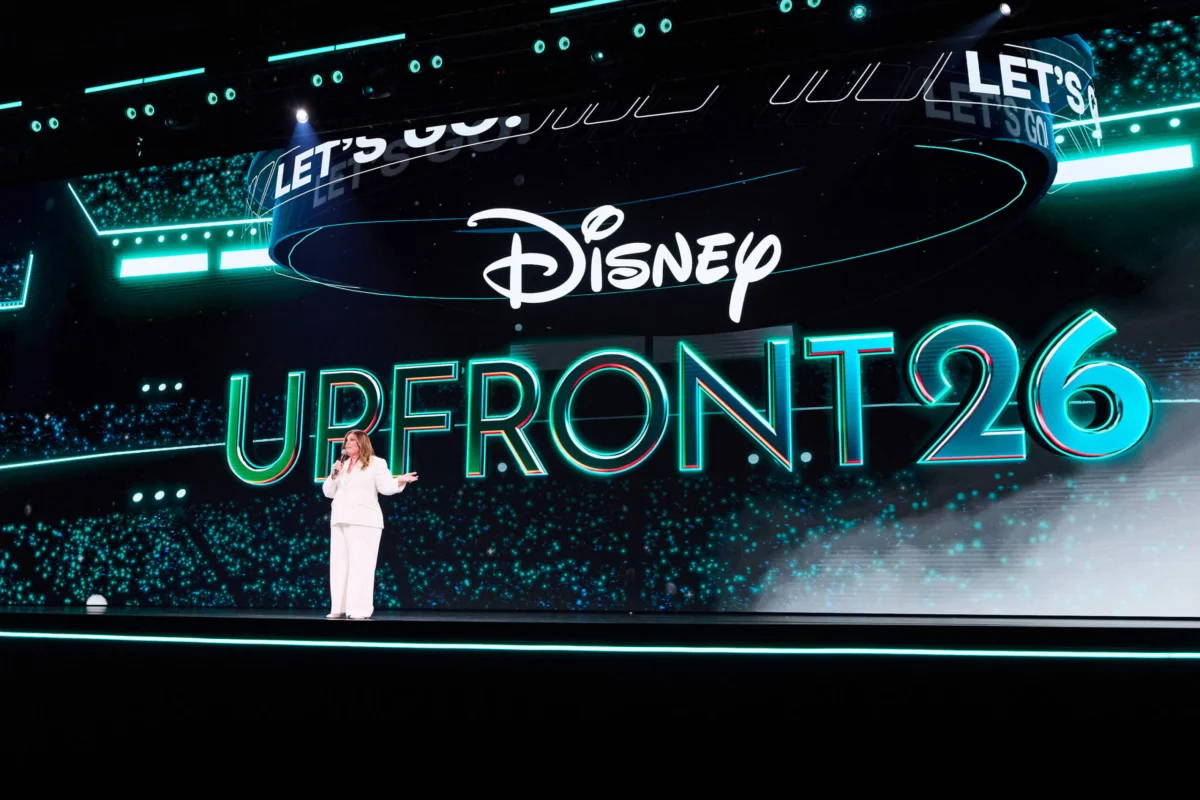
As the media landscape undergoes a seismic shift from traditional linear broadcasting to a data-driven, multi-platform ecosystem, Rita Ferro, Disney’s President of Global Advertising, has emerged as a pivotal figure in navigating this transition. At the company’s 2026 upfront presentation, an annual event where networks pitch their upcoming slates to advertisers, Ferro’s influence was underscored not just by the stars on stage, but by the strategic integration of Disney’s vast portfolio. Introduced by actor Paul Anthony Kelly, who recently portrayed John F. Kennedy Jr. in the FX series Love Story, Ferro was characterized as the architect of the "Disney difference"—a philosophy rooted in unrivaled fandom and corporate synergy. This moment served as more than a high-profile introduction; it represented the culmination of a 29-year career at the Walt Disney Company, positioning Ferro at the intersection of entertainment, technology, and global commerce.
The Strategic Vision of One Disney under Josh D’Amaro
The backdrop of Ferro’s current mandate is a significant reorganization within the Walt Disney Company. Following the second tenure of Bob Iger, which focused on stabilizing the company’s streaming assets and theatrical output, newly installed CEO Josh D’Amaro has ushered in the "One Disney" era. This strategy seeks to dissolve the traditional silos between Disney’s various divisions, including its movie studios, theme parks, and media networks. On his first day as CEO in March 2026, D’Amaro articulated a goal of delivering a "connected, personalized, and immersive experience" to consumers.
For the advertising division, this means moving beyond the traditional role of media sales. Ferro’s team is now tasked with creating holistic brand partnerships that span the entire Disney ecosystem. A single campaign might involve a movie studio tie-in, a custom activation at a Disney theme park, and targeted ad placements across Disney+, Hulu, and ESPN. This "one-stop shopping" approach, as described by Debra OConnell, Chairman of Disney Entertainment Television, is designed to maximize the lifetime value of the consumer. By leveraging the company’s diverse touchpoints, Disney aims to offer advertisers a level of engagement that social media platforms or pure-play streaming services struggle to replicate.
A Chronology of Leadership: From MTV Latin America to Global President
Rita Ferro’s path to the top of the advertising world is a narrative of adaptability and pioneering spirit. The daughter of Cuban immigrants, Ferro was raised in Miami and originally sought a career in the creative arts as a copywriter. However, her professional trajectory shifted toward the business side of media during the early days of the cable industry. Her first significant role was at MTV Latin America in 1993, a period she describes as "unsophisticated and unpolished," where there was no established blueprint for success.
Her expertise in the Latin American market and her bilingual capabilities eventually led her to Disney, where she initially worked with ESPN International. Over nearly three decades, Ferro has navigated various corners of the Disney empire, including Disney Media Network’s Kids and Family and the now-defunct Disney Interactive. The latter, which focused on mobile games and digital products, provided Ferro with an early understanding of the digital disruption that would eventually redefine the entire industry.
In 2018, Ferro was named President of Advertising Sales for the U.S., and by 2023, her responsibilities expanded to the global stage. Today, she reports to a triumvirate of Disney’s top leaders: ESPN Chairman Jimmy Pitaro, Disney Entertainment Co-Chairman Alan Bergman, and Debra OConnell. This reporting structure reflects the integrated nature of Disney’s modern advertising business, which encompasses entertainment, news, and sports across linear, digital, and streaming platforms.
The Technological Armament: Ad Tech and the Audience Graph
A central pillar of Ferro’s strategy has been the internal development of a robust advertising technology stack. As the industry moves away from third-party cookies and toward first-party data, Disney has invested heavily in its own proprietary tools. This effort began in earnest around 2021 with the launch of the Disney Tech and Data showcase at the Consumer Electronics Show (CES).
Key to this technological evolution is the "Disney Audience Graph," a first-party data platform that provides granular insights into viewership habits across all Disney properties. By controlling its own ad tech, Disney can offer advertisers highly targeted segments and more accurate measurement of campaign outcomes. Industry analysts, such as Kevin Krim, CEO of EDO, have noted that Disney was an early and aggressive mover in this space, allowing it to compete directly with tech giants like Google and Meta.
The importance of this tech-driven approach was highlighted by CFO Hugh Johnston during a recent investor conference. Johnston emphasized that Disney’s redesigned ad tech stack allows the company to target audiences much more effectively than in previous years. This capability is particularly crucial for the ad-supported tiers of Disney+ and Hulu. While Hulu has long been an ad-supported powerhouse, the 2022 launch of an ad-supported tier for Disney+ has opened new revenue streams, showing double-digit growth in the most recent fiscal quarters.
Sports as the Ultimate Aggregator: The NFL and NBA Factors
In an era of fragmented audiences, live sports remain the last bastion of massive, simultaneous viewership. For Rita Ferro, the sports portfolio—primarily driven by ESPN—is a critical component of Disney’s value proposition. The costs of maintaining these rights are historic: the NFL is currently in the middle of an 11-year, $111 billion deal, while the NBA recently secured an 11-year, $77 billion agreement.
The monetization of these expensive rights falls squarely on Ferro’s shoulders. The 2026 season marks a milestone for Disney, as the Super Bowl returns to ABC for the first time in two decades and will air on ESPN for the first time ever. With 30-second commercial spots reportedly commanding $10 million, the event represents a massive influx of ad revenue. Beyond the Super Bowl, the launch of the ESPN direct-to-consumer (DTC) app in August 2025 has provided a new platform for advertisers to reach sports fans who have abandoned traditional cable packages.
Jimmy Pitaro, Chairman of ESPN, has lauded Ferro’s ability to "monetize not just through affiliate fees but through ad sales and sponsorships," noting that her presence "in the field" with clients is a key differentiator. This boots-on-the-ground approach ensures that Disney remains responsive to the shifting demands of major advertisers who are increasingly looking for ROI-driven data in their sports spending.
Scaling the International Frontier
As the domestic U.S. market reaches a point of maturity, Disney is looking toward international expansion to drive its next phase of growth. This represents a return to Ferro’s roots in international media. CEO Josh D’Amaro has identified international growth for Disney+ as a top priority, focusing on scaling the ad-supported model in markets outside North America.
Ferro’s strategy involves tailoring ad experiences to local markets while maintaining the global standard of Disney’s tech stack. This summer, Ferro is scheduled to attend VivaTech in Paris—often referred to as the "CES of Europe"—to meet with international partners and explore the nuances of the European market. The goal is to replicate the domestic success of Disney’s ad-supported streaming model globally, tapping into diverse consumer bases in Europe, Asia, and Latin America.
Broader Implications and the Future of Media Advertising
The work being led by Rita Ferro at Disney serves as a case study for the broader media industry. The decline of traditional cable TV subscribers and the push for streaming profitability have forced legacy media companies to reinvent themselves as tech-centric entities. Disney’s ability to offset declines in linear affiliate fees with streaming ad revenue—as seen in its Q2 2026 earnings report—suggests that the transition is beginning to bear fruit.
However, challenges remain. The competition for consumer attention is no longer just between networks; it involves social media giants like TikTok and YouTube, which have mastered the art of short-form, algorithmically driven content. Disney’s response is to double down on "unrivaled fandom" and high-quality intellectual property. By leveraging franchises like Marvel, Star Wars, and Pixar, and combining them with the reach of live sports and news, Ferro is betting that advertisers will continue to pay a premium for the "Disney difference."
As Disney moves forward under the "One Disney" banner, the integration of data, technology, and storytelling will remain the cornerstone of its advertising business. For Rita Ferro, the mission is clear: to ensure that as the way people consume stories changes, the way those stories are monetized evolves at an even faster pace. With a focus on global scaling and technological autonomy, Disney is positioning itself not just as a content creator, but as a dominant force in the future of global digital advertising.