


Master filmmaker Asghar Farhadi’s latest cinematic offering, "Parallel Tales," delves into the intricate and often surprising ways in which human lives intersect, exploring the potent influence of fiction on reality. The film, which boasts a stellar cast including Isabelle Huppert, Virginie Efira, Vincent Cassel, Pierre Niney, and Adam Bessa, with a screenplay co-written by Farhadi and Massoumeh Lahidji, presents a narrative that is as ambitious in its scope as it is intricate in its execution. Clocking in at a substantial 139 minutes, "Parallel Tales" initially appears to be a contemplation on the power of storytelling and its capacity to reshape perceptions and guide individuals through life’s complexities. However, the film’s trajectory soon veers into a more unsettling exploration of how fabricated narratives can lead to unforeseen and potentially disastrous consequences.
The genesis of "Parallel Tales" can be traced to a fundamental human fascination with the stories we tell ourselves and others, and how these narratives shape our understanding of the world and our place within it. From impactful cinematic experiences that alter perspectives to literary works that catalyze significant life decisions, fiction has consistently served as a profound source of inspiration and guidance. Farhadi, renowned for his masterful ability to dissect complex human relationships and societal dynamics, turns this notion on its head, posing the provocative question: what happens when the consumption of a fabricated story yields not enlightenment, but disruption? This central thematic inquiry forms the bedrock of "Parallel Tales," a film that, while initially promising a unique blend of observational drama and fictionalized extrapolation, ultimately struggles to maintain its narrative momentum, occasionally succumbing to a sense of repetition that tests the patience of its audience.
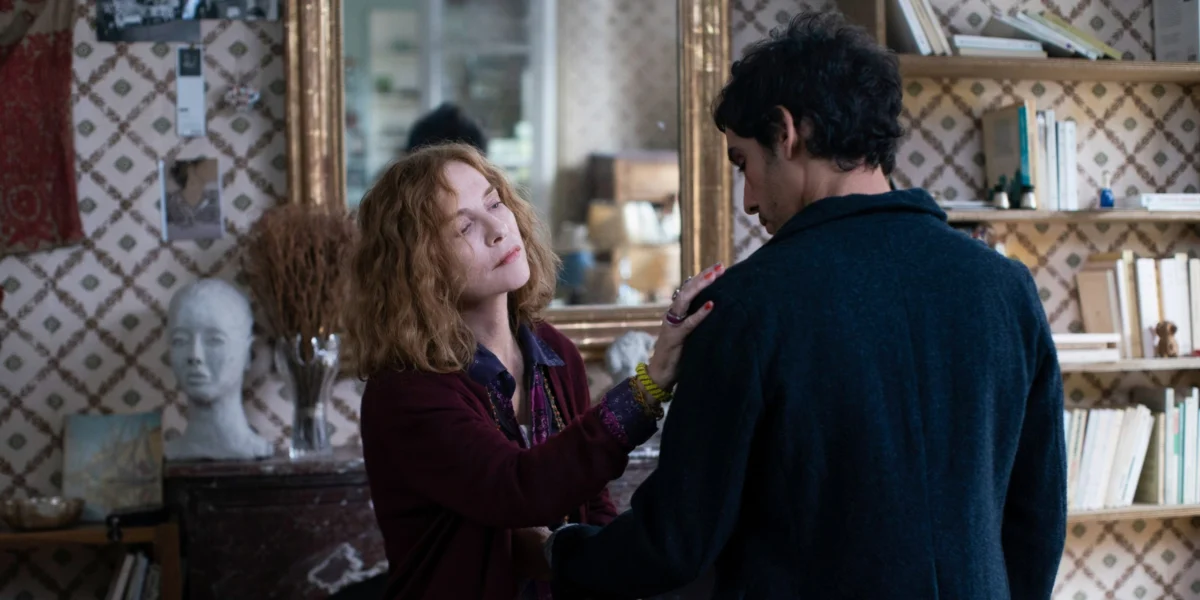
At the heart of the film’s initial narrative is Sylvie, portrayed by the inimitable Isabelle Huppert. Sylvie is presented as a reclusive and eccentric author, a hermit of sorts within her opulent yet cluttered Parisian apartment. Her days are largely dedicated to observing the lives of her neighbors across the street through the lens of a telescope, an activity that serves as both a personal pastime and a source of creative fuel for her upcoming novel. With a keen, albeit sometimes misconstrued, eye, Sylvie constructs elaborate narratives based on her limited observations. She projects her imagined storylines onto the seemingly mundane routines of those she watches, transforming their reality into the dramatic fodder for her literary endeavors.
One such observation focuses on a trio of individuals working in an apartment across the way, ostensibly engaged in the delicate craft of Foley artistry – the creation and dubbing of sound effects for film. Sylvie’s fertile imagination, however, imbues their professional collaboration with a steamy, illicit affair. In her fictionalized account, she renames the woman, Anna (played by Virginie Efira), transforming her from blonde to brunette, and casts her in a clandestine relationship with Christophe (Pierre Niney), the husband of Anna. Their supposed trysts are then further complicated by the presence of an older man, Pierre (Vincent Cassel), creating a torrid ménage à trois that fuels Sylvie’s literary ambitions.
These imagined sequences, visually distinct with a pervasive moody blue filter and narrated by Sylvie herself, lean into the melodramatic and romanticized elements of her fictional world. The contrast between Sylvie’s elaborate fantasies and the actual reality of the Foley artists’ work becomes a central point of dramatic and comedic tension. In Sylvie’s narrative, Anna is tasked with creating the sound of intimate moments, such as the squeaky protests of an old spring mattress during a sexual encounter. The humor and irony are amplified when the audience later witnesses the actual footage the Foley artists are working on: it is revealed to be entirely innocuous footage of animals, with the sounds of flapping wings and hooves splashing in puddles being meticulously recreated using everyday household objects. While not a primary focus, these scenes offer a fascinating glimpse into the craft of filmmaking and serve as a delightful treat for cinephiles, highlighting the chasm between perception and reality.
The film’s narrative structure undergoes a significant shift approximately halfway through its runtime. The fantastical sequences, so central to the film’s initial engagement, are brought to an abrupt end, coinciding with a point where Sylvie’s own writing process is interrupted. This transition unfortunately marks a reduction in the screen time of Isabelle Huppert, a presence that undeniably commands attention. Farhadi, however, crafts Huppert’s portrayal of Sylvie as a wonderfully peculiar, almost campy character. Her eccentricities – shuffling around her cluttered apartment, seemingly unfazed by broken glass and scurrying mice, and lighting a cigarette with an unconventional flair – contribute to a memorable and compelling screen presence. Her image through the telescope is so striking it is poised to become an enduring meme within film circles. While Huppert’s performance is a standout, its suitability as a precursor to the film’s subsequent direction is a question that rests with Farhadi’s directorial vision.
Following a brief intervention by Sylvie’s editor, who makes a single, albeit impactful, appearance played by the legendary Catherine Deneuve, Sylvie abandons her book. The manuscript, however, does not vanish entirely. It falls into the hands of Nita, the woman who served as the real-life inspiration for Sylvie’s fictional character Anna. This turn of events is orchestrated by a new character, Adam (Adam Bessa), whose introduction into Sylvie’s life is as unexpected as it is disorienting. Adam enters the orbit of Sylvie’s niece (India Hair) after intervening in a would-be robbery on the Paris Métro. Seeking a place to live, he is inadvertently granted residency in Sylvie’s apartment, a development that, while subtly handled, introduces a sense of foreboding. The screenplay, which at times can be overly explanatory, here opts for a more understated approach, leaving the audience to piece together the implications of this new lodger.
Adam is portrayed as a character of stark contrasts, his unassuming and soft-spoken demeanor masking a more unsettling propensity for unsettling women. Bessa effectively navigates this duality, but the film struggles to imbue Adam’s character with the intended mysterious allure. Instead, he often feels like an obstacle the narrative must awkwardly circumvent rather than an integral element of the unfolding drama. This observation extends to the film’s broader plotting, which, in its latter half, becomes increasingly repetitive. The narrative revisits established points and ideas with a frequency that stretches the film’s already considerable runtime beyond its narrative necessity. The inclusion of a minor character, a cleaning lady, who receives a third scene dedicated to discussing her back pain, exemplifies this tendency towards narrative redundancy, signaling that the film’s conclusion is long overdue.
"Parallel Tales" can, in many respects, be understood as a film divided into two distinct narrative halves, a structural division that is perhaps alluded to in its title. The initial half, rich with Sylvie’s imaginative flights and Isabelle Huppert’s captivating performance, offers a compelling and engaging viewing experience. However, the second half proves to be an arduous and, at times, interminable affair, desperately missing the vibrant presence of Huppert. The dramatic arcs and character developments in this latter portion seem to lack the space or the impetus to fully engage, and the absence of Sylvie’s unique perspective leaves a noticeable void.
Given Asghar Farhadi’s illustrious filmography, which is replete with meticulously crafted and tightly structured human dramas, the faltering narrative drive of "Parallel Tales" is particularly disappointing. Farhadi has consistently demonstrated an exceptional ability to weave complex emotional tapestries and build suspense through nuanced character interactions. In "Parallel Tales," however, the film appears to deviate from this established strength, unraveling into a monotonous and ultimately underwhelming misfire. The initial promise of a thought-provoking exploration of fiction’s impact on reality is, unfortunately, overshadowed by a narrative that loses its way, failing to sustain the compelling momentum established in its early stages. The film’s ambitious premise, while intriguing, ultimately buckles under the weight of its own narrative sprawl, leaving the audience with a sense of unfulfilled potential and a lingering question about the choices made in its latter half. The ensemble cast, despite their individual talents, are unable to salvage a story that, much like Sylvie’s fictional creations, loses its coherence and impact as it progresses.