The landscape of independent cinema often offers a poignant lens through which to explore universal human experiences, and Lauren Meyering’s feature directorial debut, "Horsegirls," emerges as a compelling testament to this. Clocking in at a thoughtful 101 minutes, the film, co-written by Meyering and Mackenzie Breeden, delves into the profound journey of Margarita, a 22-year-old autistic woman, as she navigates the seismic shift in her life following her mother Sandy’s uncertain health diagnosis. This narrative, inspired by the life of Breeden and featuring her in a poignant final scene, offers a deeply empathetic portrayal of familial love, burgeoning independence, and the unexpected avenues through which dreams can take flight.
The Core Narrative: A Mother’s Fear, A Daughter’s Growth
At its heart, "Horsegirls" is a story of two women bound by an unbreakable, yet evolving, maternal bond. The film opens a window into the intimate world of Margarita (Lillian Carrier) and her mother, Sandy (Gretchen Mol). Their days are interwoven with the mundane joys and quiet routines that define close familial relationships: karaoke nights filled with shared laughter, intimate dinners at their cherished local eatery, and even the shared experience of accompanying Sandy to her chemotherapy sessions. In these moments, Margarita’s presence is not merely that of a daughter, but of an integral part of a supportive community, extending her warmth and interaction to fellow patients as if they were an extension of her own family.
However, the undercurrent of Sandy’s deteriorating health casts a long shadow. A scene that encapsulates the film’s emotional depth features Margarita’s direct, almost disarming question to her mother: "Do you fear dying?" Sandy’s response, however, is not about the cessation of her own existence, but the chilling prospect of leaving Margarita behind. Her fear stems from a world that often marginalizes those who deviate from perceived norms, a world where individuals can be "made to feel small simply for being themselves." This fear, a pervasive theme of overprotective love, is handled by Meyering with a delicate, yet unflinching, gaze. Sandy’s desire for Margarita’s happiness is intertwined with a deep-seated anxiety that her daughter might be underestimated, patronized, or even exploited in her absence.
Margarita, however, is on the cusp of her own burgeoning autonomy. While Sandy grapples with the fear of vulnerability for her daughter, Margarita is brimming with an eager anticipation to explore the world and demonstrate her capabilities. The film masterfully portrays the slow, organic collision of these two perspectives, ultimately forging a mother-daughter relationship that places Margarita’s agency at its absolute center. This narrative arc is amplified by the authentic voice of Lillian Carrier, an actor on the autism spectrum, whose portrayal imbues Margarita with a nuanced authenticity rarely seen on screen.
A World of Hidden Passions: The Emergence of Hobby Horsing
The narrative takes a significant turn as Margarita begins to forge her own path towards independence, a concept she defines with a unique perspective that diverges from her mother’s focus on traditional markers like securing employment. Sandy’s emphasis on Margarita finding a job is rooted in her desire for her daughter to embrace adult responsibilities and financial security. Yet, Margarita’s vision of independence is intrinsically linked to creative expression and self-discovery.
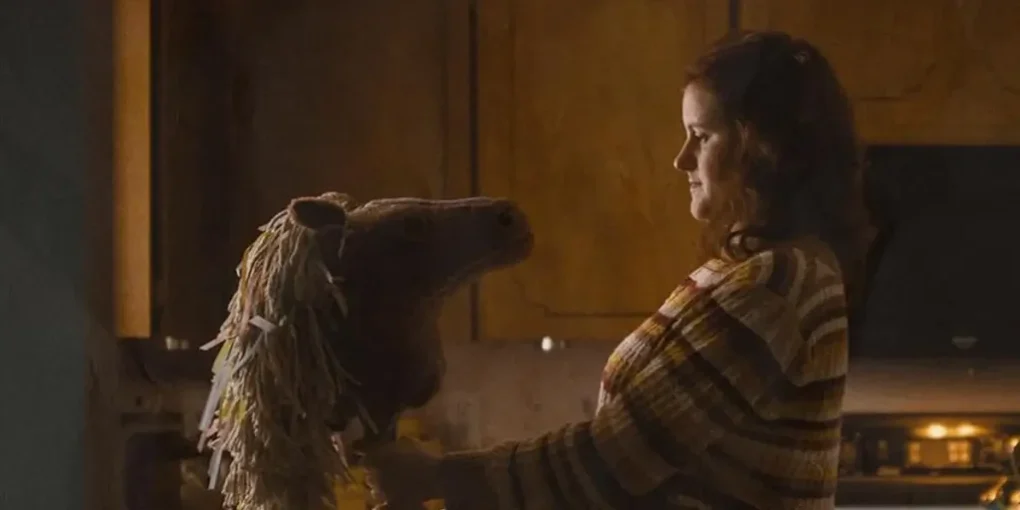
This divergence becomes evident during a quiet evening bike ride, accompanied by her beloved stuffed horse, Cheeseburger. Margarita stumbles upon a rehearsal for hobby horsing. This unique subculture, a vibrant and physically demanding activity, involves participants—predominantly young women—mimicking equestrian sports using hobby horses, essentially faux horse heads mounted on sticks. The practice is a captivating blend of choreographed gymnastics, athletic prowess, and artistic expression. For Margarita, who harbors a lifelong, unfulfilled dream of riding a real horse, this discovery presents an unparalleled opportunity. It becomes a pathway not only to assert her independence but also to find a profound sense of belonging.
Driven by this newfound passion, Margarita is determined to participate. The practicalities of this endeavor quickly emerge. To afford the weekly rehearsal fees mandated by the Coach (Jerod Haynes), Margarita takes on a part-time job at a local Halloween store. This employment, while fulfilling a practical need, also serves as a clandestine element of her burgeoning independence, as she must often sneak away from her duties to attend the hobby horsing sessions and master the intricate routines.
Hobby Horsing as a Metaphor for Self-Discovery and Community
"Horsegirls" transcends its coming-of-age premise by framing independence as a powerful form of uninhibited creative expression. Director Lauren Meyering skillfully captures the sheer exhilaration of discovering one’s passion and the boundless possibilities that such a discovery can unlock. Hobby horsing, in this context, becomes more than just a sport; it is the vehicle through which Margarita fulfills her equestrian aspirations and satisfies an innate human desire for connection.
Margarita is meticulously crafted as a character of depth and complexity. The film’s success in presenting her as such is significantly attributed to Lillian Carrier’s enchanting performance. Carrier’s portrayal is not merely integral to the rehearsal group’s functioning—she plays a crucial role in bringing the group’s participant numbers up to championship eligibility—but is the very bedrock of the film’s authenticity. Her presence on screen is natural, her sense of humor endearing, and her performance radiates an assurance that commands attention. She centers Margarita’s multifaceted personality, contributing significantly to the diversification of on-screen portrayals of autistic characters, which have historically been limited. The writing further supports this by resisting the temptation to define Margarita by a single trait or circumstance, allowing her unique and layered personality to shine through organically. A particularly memorable recurring element of the film involves Margarita’s explanation of her name’s origin: her parents, she humorously recounts, were celebrating with margaritas on the night of her conception.
Sandy’s Arc: A Mother’s Evolving Acceptance
While Sandy’s character could easily have fallen into the archetypal cinematic mother figure—either a saint or a villain—the film imbues her with a compelling nuance. Although she occasionally leans into predictable tropes, particularly in her initial resistance to Margarita’s hobby horsing, her perspective is rendered with a grounded realism. Gretchen Mol delivers a performance characterized by charisma and a profound ability to convey Sandy’s all-encompassing fear of leaving her daughter vulnerable. The chemistry between Mol and Carrier is palpable, lending the film a lived-in authenticity that resonates deeply with audiences. Their individual journeys converge in moments of poignant emotional resonance, as Margarita steps towards a new chapter while Sandy’s future becomes increasingly uncertain.
Sandy’s character arc is dynamic. Initially, she seeks tangible reassurances that Margarita will be well-provided for, such as securing a job and demonstrating self-sufficiency in daily tasks like preparing her own meals. However, as the narrative progresses, she begins to confront and ultimately accept the uncontrollable aspects of life, a testament to her own personal growth amidst her illness. This emotional tension builds toward a final scene that is both effectively bittersweet and deeply satisfying.
A Tapestry of Supporting Characters and Thematic Resonance
The supporting cast of "Horsegirls" enriches the narrative tapestry, with Jerod Haynes delivering a standout performance as the hobby-horsing Coach. Haynes and Carrier share a particularly resonant scene that explores the essence of belonging and the universal human drive to "embody who they think they’re supposed to be." Margarita’s amusingly pragmatic observation about the perceived exhaustion of such a pursuit highlights her inherent sincerity and contributes to some of the film’s most charming interactions. These charming encounters extend to Margarita’s work at the Halloween store, where she interacts with her manager, Hank (Iqbal Theba), and her co-worker, Felix (Matthew Schwab). Tony Hale makes a brief but impactful appearance as Margarita’s Uncle Patrick, offering a source of comfort and imbuing his scenes with an immediate warmth.
Visual Storytelling and the Essence of Community
Lauren Meyering’s directorial approach imbues "Horsegirls" with a majestic and graceful quality, a visual echo of the elegance and power of horses. Even though the characters engage with faux stick horses, Meyering’s camerawork renders these props visually dynamic, imbuing them with significant symbolic weight. They represent not only a creative outlet but also a vital means of connection and self-expression. Through her compassionate direction, Meyering elicits the inherent humanity in each character, presenting a well-rounded portrait defined by moments of profound kindness and humility. This palpable sense of community is central to the film’s emotional impact, particularly in its concluding acts, transforming "Horsegirls" into a truly wondrous viewing experience.
The climax of the film, centered around a hobby horsing competition, is not about achieving perfect execution. When Margarita stumbles, the moment is immediately transformed into one of uplift. While the film subtly acknowledges that the other girls in the group are not necessarily Margarita’s closest friends, they demonstrate a remarkable capacity for inclusion. They seamlessly integrate her stumble into the team’s choreography, offering support and lifting her spirits. The competition becomes a vibrant tableau of community: the familiar faces who provide transportation and greet her upon arrival; the genuine friend she encounters backstage; and the pure, unadulterated joy she experiences upon making her first jump into this new, empowering world.
Broader Implications and Cultural Significance
"Horsegirls" shines as an endearing narrative that celebrates the unique, everyday passions that provide individuals with a vital sense of belonging. In an era where authentic representation is increasingly paramount, the film’s commitment to portraying an autistic protagonist with such depth and agency is a significant contribution to the cinematic landscape. The casting of Lillian Carrier, an autistic actress, lends an unparalleled layer of authenticity and advocacy to the film, challenging conventional casting practices and offering a powerful counter-narrative to limited on-screen portrayals.
The film’s success in weaving together themes of familial love, the challenges of caregiving, and the universal pursuit of identity and belonging positions it as a significant work of independent cinema. Its exploration of hobby horsing as a legitimate and empowering form of athletic and creative expression also serves to destigmatize and elevate niche interests, highlighting their potential to foster community and personal growth. The 101-minute runtime is expertly utilized, allowing for a measured development of characters and plotlines, culminating in a narrative that is both emotionally resonant and intellectually stimulating. The collaborative writing process between Lauren Meyering and Mackenzie Breeden, drawing from real-life experiences, ensures that the emotional core of the story remains grounded and relatable, even as it explores the extraordinary journey of its protagonist. The supporting cast, including notable performances from Jerod Haynes, Iqbal Theba, Matthew Schwab, and Tony Hale, further bolsters the film’s rich characterizations, each actor contributing to the film’s overall warmth and authenticity. The underlying message of embracing individuality and finding joy in personal passions is a timely and important one, making "Horsegirls" a film that is likely to leave a lasting impression on audiences.