


July 17, 2026 – Christopher Nolan’s highly anticipated thirteenth feature film, The Odyssey, has premiered globally, marking a significant milestone in cinematic history with its ambition to be the first feature-length motion picture filmed entirely with IMAX cameras and IMAX-sized film. The film, which adapts Homer’s timeless epic, arrives in theaters worldwide, available across every cinematic format, including traditional 35mm and 70mm prints, alongside digital and expansive IMAX presentations, underscoring Nolan’s commitment to a universal yet maximally immersive theatrical experience. Early critical assessments hail The Odyssey as a monumental achievement in grand-scale storytelling, pushing the boundaries of what modern cinema can achieve in terms of visual spectacle and technical innovation.
A New Pinnacle in Cinematic Technology
The realization of The Odyssey represents the culmination of a vision Nolan began articulating nearly two decades ago with The Dark Knight in 2008, when he first integrated IMAX photography into narrative filmmaking. Over the intervening eighteen years, Nolan has steadily increased his reliance on the format, with films like Dunkirk and Oppenheimer utilizing extensive IMAX sequences to enhance immersion and historical authenticity. The Odyssey transcends these previous efforts by committing to IMAX as the sole capture medium, necessitating the development and deployment of the largest film cameras ever constructed for narrative production. This technical feat, years in the making, aimed to deliver unparalleled resolution, dynamic range, and a truly panoramic visual scope, translating the vastness of the Mediterranean and the mythological landscapes of Homer’s epic directly onto the colossal screens of IMAX theaters.
The film’s technical prowess extends beyond its camera choice. Nolan’s renowned dedication to practical effects and on-location shooting is reportedly taken to new extremes. Production teams traversed various Greek islands and coastal regions to capture authentic seascapes, ancient ruins, and natural phenomena. Reports from the set indicated the construction of historically inspired, seaworthy longships, which were then utilized in open water for complex action sequences, foregoing green screens and digital augmentation wherever possible. This commitment to tangible realism aimed to ground the fantastical elements of the story – the monsters, the gods, the magic – within a believable, tactile world, a hallmark of Nolan’s filmography, which has consistently prioritized grounded narratives even within speculative or historical contexts, as seen in Interstellar and Oppenheimer.

Thematic Resonance: A Continuation of Oppenheimer‘s Legacy
Beyond its technical grandeur, The Odyssey delves into profound thematic territory, which, according to some early analyses, directly extends the philosophical inquiries posed in Nolan’s previous Oscar-winning feature, Oppenheimer. While Oppenheimer explored the destructive consequences of scientific innovation and individual moral responsibility on a global scale, The Odyssey reportedly examines similar themes through the lens of ancient mythology. The narrative centers on Odysseus’s arduous decade-long journey home after the Trojan War, a voyage fraught with divine intervention, monstrous encounters, and the unraveling of human civilization in his absence.
One prominent critical perspective posits that Nolan’s adaptation connects the internal turmoil of J. Robert Oppenheimer with the external trials of Odysseus. Both figures are presented as men who, through their actions – one initiating atomic warfare, the other engaging in a protracted, devastating conflict – bring about immense destruction and destabilization, subsequently grappling with the profound moral and societal repercussions. The Odyssey is described as a literal journey through metaphorical hell, including a descent into the underworld, where Odysseus confronts the chaos unleashed by his decisions and the erosion of fundamental human values. The film frequently references "Zeus’s law," interpreted as a moral code akin to the Golden Rule, juxtaposed against the growing darkness and self-interest that permeate the world, mirroring contemporary global conflicts and a perceived decline in ethical conduct. This thematic through-line suggests Nolan is not merely retelling an ancient tale but using it as a mirror to reflect on humanity’s recurring patterns of conflict, accountability, and the struggle for redemption in a world grappling with the aftermath of its own destructive choices.
Navigating Homer’s Epic: Modern Interpretations and Narrative Choices
Nolan’s The Odyssey is the latest in a long line of adaptations of Homer’s epic, which has inspired countless stage plays, films, television series, and literary reinterpretations throughout history. While deeply rooted in the original source material, Nolan’s rendition takes significant artistic liberties, modernizing elements for a contemporary audience. The dialogue, for instance, has been updated, and the casting reflects a diverse array of ethnicities, departing from historical accuracy in favor of universal representation. Notably, some historical details, such as the design of Odysseus’s ships, are reimagined, reportedly featuring Viking longship aesthetics rather than more historically authentic ancient Greek vessels, signaling an emphasis on artistic vision over strict archaeological precision. These choices reinforce the notion that the film serves as Nolan’s personal interpretation of an enduring fable, rather than a documentary recreation.

The narrative structure reportedly balances faithfulness to the core journey with distinct Nolan-esque flourishes. While the broad strokes of Odysseus’s encounters with sirens, cyclops, and other mythical beings remain, the film reportedly dedicates less screen time to the overt depiction of Greek gods and fantastical elements, instead focusing on the human tragedy and the psychological toll of Odysseus’s journey. This approach aligns with Nolan’s characteristic inclination towards grounded storytelling, even in fantastical settings. A particularly highlighted narrative enhancement is the expanded subplot involving Elliot Page as Sinon, and Odysseus’s consequential encounter with him in the underworld, which is described as one of the most invigorating and emotionally resonant sequences in the film. Similarly, Tom Holland’s portrayal of Telemachus, Odysseus’s son, reportedly offers a powerful exploration of a son reckoning with his legendary father’s complex legacy.
Performances and Practicality: A Cast Embarks on a Real Journey
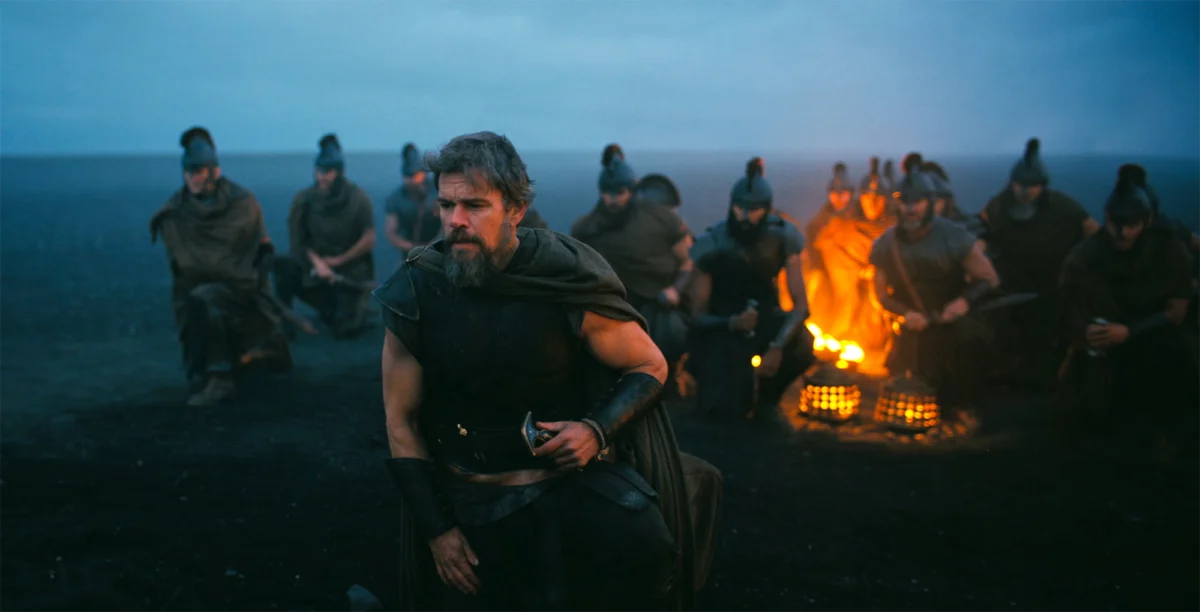
The ensemble cast assembled for The Odyssey features a blend of established Nolan collaborators and new faces. Matt Damon takes on the titular role of Odysseus, portraying the weary, calculating, and ultimately repentant hero. Anne Hathaway, another frequent Nolan collaborator, plays Penelope, Odysseus’s steadfast wife, though some early critiques suggest her portrayal sometimes leans towards overt distress rather than nuanced resilience. Tom Holland as Telemachus is lauded for his depth, while Himesh Patel, as Odysseus’s second-in-command Eurylochus, is singled out for a standout performance, depicting a character traditionally seen as foolish or cowardly with newfound wisdom and humility. John Leguizamo portrays Eumaeus, the loyal swineherd, identified as the emotional core of the story. Samantha Morton’s portrayal of the sorceress Circe also garners positive mentions.
The physicality of the production is reflected in the performances. Actors reportedly endured the rigors of filming on real ships in open seas, contending with genuine waves, sea sickness, and the general weariness inherent in such conditions. Nolan’s commitment to capturing these authentic experiences on IMAX cameras aims to immerse the audience fully, allowing them to "taste the salt in the air" and feel the "full weight of Odysseus" as bonds collapse and humanity unravels. This dedication to practical effects and authentic environments is presented not merely for realism, but for what Nolan terms "cinematic glory," intending to create a visceral, lived-in experience that transcends typical film sets. However, this pursuit of grandeur also presents certain challenges. Some critics have noted that while the sweeping wide shots and sea sequences are breathtaking, the use of large IMAX cameras for intimate close-ups and dialogue scenes can occasionally feel cumbersome, leading to a slight disconnect in emotional impact compared to the epic scope of the broader journey.
Critical Reception and Industry Impact

Initial critical reception, while overwhelmingly positive regarding the film’s technical achievements and thematic ambition, also points to specific areas for discussion. The film’s overall rating hovers around an "8.5 out of 10" in some early reviews, positioning it as a strong entry in Nolan’s filmography, though perhaps not surpassing his most universally acclaimed works like Oppenheimer or The Prestige. The film is praised for its "exhilarating experience" and its ability to be "everything cinema should be and can be."
However, the three-hour runtime and the sheer "heaviness" of its themes, particularly the exploration of humanity’s darkness and the unraveling of civilization, are noted as potentially exhausting for viewers. A specific point of contention arises in Nolan’s long-standing criticism regarding the clarity of his action sequences. The grand finale showdown in the Ithaca palace is described as "dark and confusing," making it difficult to discern the action, potentially detracting from the narrative’s climax despite the film’s R-rating and depiction of violence. This issue, which some critics trace back to The Dark Knight, reportedly resurfaces here, highlighting a perceived limitation in Nolan’s directorial approach when choreographing intricate combat. Films like Oppenheimer and The Prestige, which rely less on physical action, are often cited as Nolan’s most "flawless" precisely because this perceived weakness does not impede their narrative.
Despite these reservations, The Odyssey is widely regarded as an "extraordinary cinematic achievement." Its release is expected to further solidify Christopher Nolan’s reputation as a visionary filmmaker who consistently pushes the technological and artistic boundaries of the medium. The film’s ambitious use of IMAX is likely to set new industry standards and inspire future productions to explore similar avenues of immersive storytelling. More broadly, The Odyssey serves as a powerful reminder of the enduring importance of storytelling itself. By revitalizing a millennia-old fable with modern cinematic artistry, Nolan reinforces the idea that narratives, especially tragic ones, continue to hold vital messages for contemporary society, prompting reflection on current global challenges and the timeless struggle between chaos and order, destruction and redemption. The film’s global premiere positions it as a major cultural event, inviting audiences to reflect on ancient wisdom through the unparalleled spectacle of modern cinema.