

Apolinariya Degtyareva, a rising filmmaker from Yakutsk in the Sakha Republic, has emerged as a distinctive voice in contemporary cinema with her debut feature film, "Fear." Though formally educated in linguistics and Japanese, Degtyareva, who has been active in filmmaking since 2012, has carved out a niche for herself through powerful storytelling and a keen understanding of psychological depth. Her early work, the short film "Inner Voice," garnered significant acclaim. This poignant piece, performed entirely by deaf actors and centered on the experiences of the deaf community, secured the Grand Prix at the republican festival "Cinema Without Barriers" and subsequently earned a spot in the main competition of the international festival of the same name in Moscow. This success foreshadowed her ability to translate complex human experiences into compelling cinematic narratives. "Fear," known in its native Russian as "Presence," represents the culmination of an idea Degtyareva had nurtured since 2014. The script underwent an extensive eight-year revision process before finally being brought to the screen in August 2023, with Dmitry Davydov serving as a key coproducer. The film’s journey from conception to its premiere highlights Degtyareva’s persistent vision and dedication to her craft.
A Chamber Drama Unfolding in Isolation
"Fear" is meticulously crafted as a chamber horror drama, primarily unfolding within a confined setting and anchored by the compelling performance of a single lead actress. Anastasia Alekseeva, a performer from the Olonkho Theatre, delivers her first leading role in a feature film with remarkable intensity. The production itself embraced its limitations, with filming concentrated within a modest three-room apartment. This intimate setting, however, necessitated the daily presence of up to twenty crew members, including cameras, lighting, and other essential equipment. This demanding yet tightly focused environment proved instrumental in shaping the film’s claustrophobic atmosphere and its psychological intensity. The film’s premiere took place in 2025 at the Mayak Film Festival, where it was selected for the main competition from an impressive pool of over six hundred submissions, ultimately ranking among the festival’s ten competing titles. The screening in Bishkek offered an early opportunity for international audiences to engage with Degtyareva’s unique cinematic vision.
The narrative of "Fear" centers on a young woman grappling with severe anxiety. Residing in a small city apartment with her husband, she has become increasingly reclusive, having not left her home for approximately a month. This self-imposed confinement is exacerbated by the pervasive COVID-19 news cycle, but also by a more profound, initially undefined fear that permeates her existence. Her interactions with the external world are largely mediated through digital platforms, where she spends her days scrolling through content, ordering necessities, and recording voice messages for her husband, who is ostensibly away on a business trip. As the story progresses, the apartment itself begins to exhibit unsettling phenomena. A window inexplicably opens, a child’s voice is faintly heard through the ventilation system, and an palpable sense of an unseen presence within the house intensifies.
Psychological Terrors and Sakha Cultural Threads
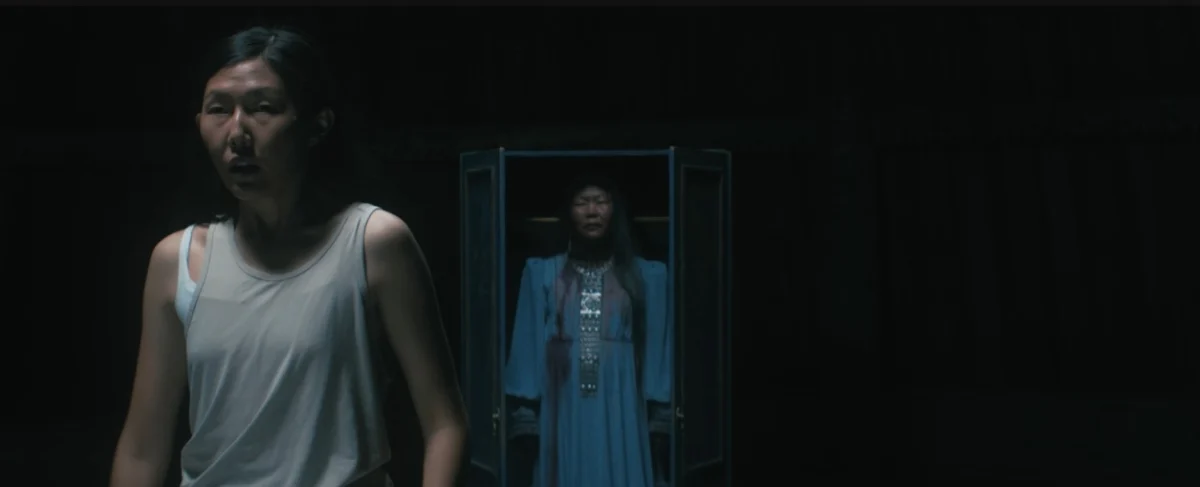
The heroine’s nights are plagued by vivid nightmares featuring her recently deceased mother, depicted in traditional Sakha attire. These dream sequences are set in a stark, ritualistic expanse reminiscent of a vast yurt, dominated by a solitary, enigmatic old wardrobe. As the protagonist’s isolation within the apartment deepens, the film skillfully blurs the lines between the paranormal, the psychological, and the repercussions of a truth she has actively avoided confronting. The narrative pivots dramatically in its final act, transforming from a seemingly straightforward ghost story into something entirely unexpected, revealing the deeper thematic concerns at play.
One of the most compelling aspects of "Fear" is its sophisticated use of the COVID-19 pandemic. The global health crisis is not merely a passive backdrop but an active element that shapes both the emotional landscape and the narrative trajectory. The pervasive atmosphere of the pandemic amplifies the protagonist’s sense of isolation, suspicion, and helplessness. Degtyareva effectively illustrates how fear can manifest as a self-perpetuating, closed system. Initially, the heroine’s entrapment is external, driven by news reports and the fear of contagion. However, as the film unfolds, it becomes increasingly evident that her true prison is internal. The horror therefore stems less from the potential presence of a supernatural entity and more from the unbearable weight of denial and suppressed psychological distress. In the context of a cinematic landscape that saw a surge in single-location, limited-cast films during and in the immediate aftermath of the pandemic, "Fear" attempts to imbue this familiar setting with a renewed sense of urgency and thematic depth.
The film intentionally eschews the perspective of a spectral entity, instead focusing on the subjective experience of a woman who believes herself to be haunted. The apartment transforms into a tangible manifestation of her internal state, a mental landscape where every repetitive action, every unanswered message to her absent husband, and every furtive glance into a darkened corner contributes to the growing impression of a woman unraveling within the confines of her own illusions.
Strengths and Limitations in Cinematic Execution
While the conceptual framework of "Fear" is strong, the execution of its genre elements is not consistently as impactful. Degtyareva appears more invested in exploring the underlying meaning of fear than in generating pure terror, a choice that lends thematic richness but at times detracts from the potential for a purely visceral horror experience. The narrative twist at the film’s conclusion, while intended to be surprising, can feel both convoluted and predictable. The tension, though present, fluctuates, and the film’s reliance on music to sustain it is not always successful. Similarly, a number of recurring shots and gestures, while effectively underscoring the monotony of confinement, can inadvertently lengthen the perception of the film’s already concise running time.
Visually, however, "Fear" achieves moments of profound impact. The sequences captured through the lens of surveillance cameras, particularly those filmed at night, stand out as some of the film’s most effective and unsettling. Anastasia Alekseeva’s long, dark hair and her deliberate physical movements evoke a clear stylistic lineage to classic Japanese horror cinema, most notably "Ring." This visual resonance is hardly surprising, given Degtyareva’s academic background as a specialist in Japanese studies. The nocturnal imagery of the protagonist navigating her apartment is among the film’s strongest contributions, even when the surrounding horror mechanisms falter.
The integration of Sakha cultural elements is also a significant, though not always perfectly realized, aspect of the film. Recurring motifs such as the Sakha wedding, the mother in traditional attire, and the mysterious wardrobe all signal a deliberate attempt to weave a narrative deeply rooted in this cultural heritage. While these elements do not consistently resonate with the same power, the endeavor to connect domestic horror with Sakha identity imbues "Fear" with a distinct character, setting it apart from more generic apartment haunting narratives.
A Performance-Driven Narrative
The most crucial element of "Fear" is undoubtedly Anastasia Alekseeva’s performance. Given the film’s profound reliance on her presence, any deficiency in the central acting would have jeopardized the entire construction. Fortunately, Alekseeva inhabits the role with unwavering commitment and a palpable emotional intensity. Her facial expressions, body language, and subtle micro-expressions become the primary conduits through which the story is conveyed, especially considering that the heroine spends a significant portion of the film in solitary confinement.
"Fear" stands as a flawed yet undeniably bold directorial debut. Its pacing can be deliberately slow, its genre mechanics are not always perfectly aligned, and some of its symbolic gestures may feel heavy-handed. Conversely, the film possesses a powerful central concept, an outstanding lead performance, and a commendable willingness to employ the horror genre as a vehicle to explore anxieties far more profound and terrifying than the supernatural. While Degtyareva may not yet command absolute control over every facet of her material, she demonstrates a clear understanding of how genre conventions can be elevated to achieve deeper thematic resonance. The film’s reception at festivals and its subsequent availability have positioned Degtyareva as a filmmaker to watch, one whose unique perspective and thematic ambition promise further compelling works in the future. The film’s exploration of isolation, amplified by the global pandemic and grounded in specific cultural contexts, offers a timely and resonant commentary on the human condition.