


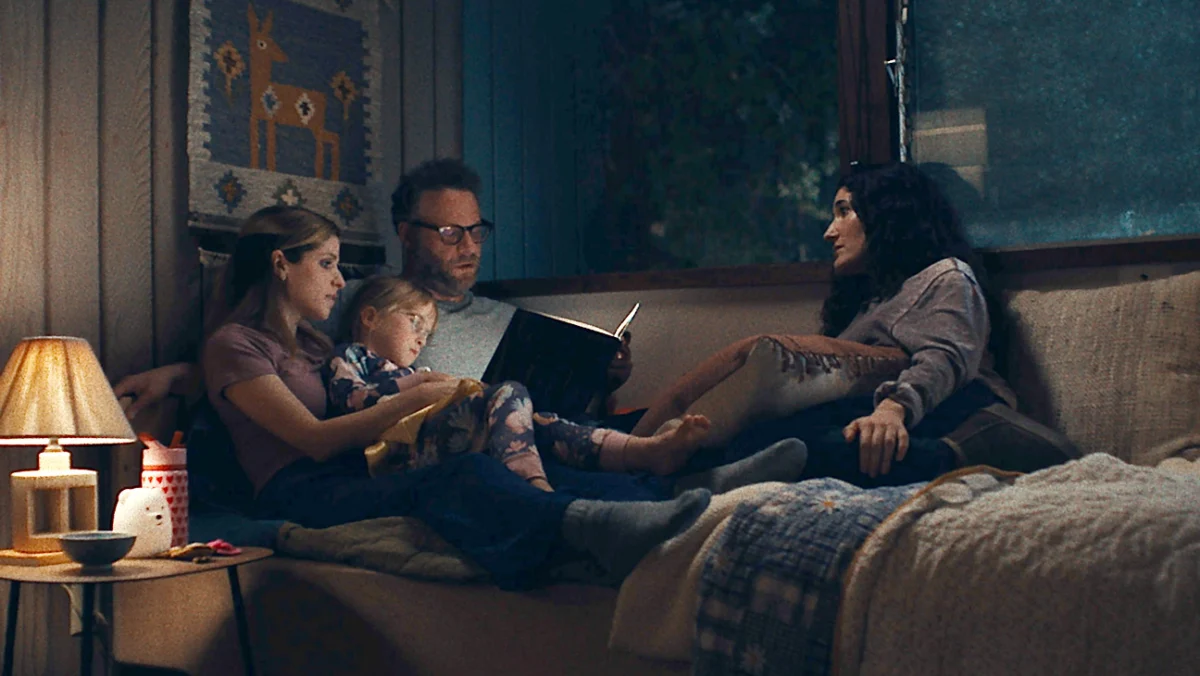
Premiering at the Toronto International Film Festival (TIFF) as part of the prestigious Gala Presentations, the film marks the sophomore directorial effort of Lauren Miller Rogen. The feature, clocking in at 97 minutes, serves as a poignant, humorous, and deeply resonant examination of a couple navigating the decision to either remain child-free or embrace the responsibilities of raising the next generation. Starring Anna Kendrick and Seth Rogen, the film arrives as a significant contribution to the current cinematic discourse on family planning and the pressures of domestic societal expectations.
A Portrait of Contemporary Domesticity
The narrative centers on Annie (Kendrick) and Aaron (Rogen), a Los Angeles-based couple whose 17-year union is defined by stability, mutual support, and a lack of children. The inciting incident occurs during a Fourth of July social gathering, where the couple finds themselves observing the disparate parenting styles of their peers. This observation triggers an internal shift for Annie, leading her to question whether their contentment is a genuine choice or a path of least resistance.
The film’s screenplay, also penned by Miller Rogen, draws heavily from autobiographical inspirations, blending the levity of comedic tropes with the gravitas of mortality. As the couple navigates their professional lives and their social circle—which includes an expectant friend (Issa Rae) and a recently separated peer (Kate Berlant)—they are forced to confront the reality that they have reached a juncture where the "to be or not to be" question of parenthood can no longer be deferred.
Production Context and Creative Direction
Following her 2018 directorial debut Like Father, Miller Rogen has cultivated a reputation for grounding high-concept premises in authentic, relatable human stakes. Babies represents a maturation of this style, balancing the inherent chaos of child-rearing—frequently represented by a plot-heavy subplot involving a stubborn toddler and a series of "poop jokes"—with the somber realities of aging.
The production boasts an ensemble cast that anchors the film’s tonal shifts. Beyond the leads, the inclusion of Sharon Stone, David Strathairn, and Dan Stevens adds layers of depth to the narrative. Strathairn’s portrayal of Annie’s father, who is struggling to navigate the dating world while coping with the decline of his wife due to Alzheimer’s, provides the film with its emotional core. This subplot serves as a catalyst for Annie’s anxiety: she begins to wonder if her potential future child would be subjected to the same sorrowful caregiving duties she is currently managing.
Sociological Trends and Data Context
The thematic urgency of Babies is supported by broader demographic shifts in the United States and globally. According to data from the U.S. Census Bureau and the Pew Research Center, the percentage of adults without children has been steadily climbing over the last two decades. Economic instability, the rising cost of childcare, and a cultural shift toward prioritizing individual autonomy have led many couples to delay or permanently forgo parenthood.
In the film, these macroeconomic pressures are translated into personal dialogue. When Annie and Aaron act as makeshift guardians for a friend’s daughter, they experience firsthand the logistical and emotional toll of parenting. The film does not shy away from the "terrible twos" or the exhaustion of domestic management, positioning these realities as essential components of the decision-making process. By integrating these real-world pressures, Babies transcends the standard rom-com format, acting as a mirror for the contemporary "DINK" (Double Income, No Kids) demographic.
Critical Reception and Festival Impact
The Toronto International Film Festival, which has long served as a launchpad for critically acclaimed dramedies, proved to be a fitting venue for the film’s debut. Early responses to the gala screening highlighted the "crowd-tickler" nature of the film, noting that Miller Rogen’s ability to oscillate between slapstick humor and existential dread is the film’s primary strength.
Anna Kendrick’s performance has been widely cited as the film’s anchor. Her portrayal of Annie is characterized by a "richly conveyed" journey of self-discovery, particularly during a sequence at a baby shower where the protagonist vocalizes the often-unspoken frustrations of childless women in social settings. This scene, and others like it, serve as the film’s intellectual backbone, challenging the audience to consider why society frequently insists that child-free couples are "missing out" on a fundamental human experience.
The Balancing Act: Humor and Pathos
Miller Rogen’s directorial approach is defined by a delicate equilibrium. The screenplay utilizes humor not merely for entertainment, but as a mechanism for character development. For instance, a sequence involving a Los Angeles County Museum of Art (LACMA) installation becomes a pivot point for a discussion on bodily shame and the constraints of societal etiquette.
By juxtaposing such moments with the stark reality of Alzheimer’s disease, the film asserts that life is a series of trade-offs. The "weightier questions" surrounding human existence are not answered with definitive solutions, but rather explored through the lens of individual choice. This refusal to offer a didactic conclusion is perhaps the film’s most mature attribute.
Future Implications and Theatrical Release
As the film prepares for a wide release via Roadside Attractions and Vertical, its marketability lies in its broad appeal. It occupies a space between the "indie darling" and the "mainstream hit," appealing to audiences who enjoy character-driven stories with high production values.
The film’s implications for the cultural zeitgeist are significant. By portraying the choice of parenthood as a complex negotiation rather than an inevitable life stage, Babies contributes to a growing body of work that validates the child-free lifestyle. Conversely, it also honors the sanctity and profound beauty of the parental bond through the experiences of secondary characters, thereby avoiding a polarizing perspective.
Analysis of Narrative Structure
The narrative follows a non-linear emotional arc. It begins with the external pressures of societal expectation, moves through the internal exploration of personal desires, and concludes with a synthesis of these experiences. The "inner monologues" performed by Kendrick, while numerous, serve the purpose of grounding the audience in the protagonist’s psyche, making her ultimate conclusions feel earned rather than forced.
The collaboration between Miller Rogen and her lead actors, particularly the "warm, easy chemistry" between Kendrick and Rogen, suggests a high level of trust on set. This chemistry is essential; without a believable foundation for their 17-year marriage, the audience might struggle to care about their eventual decision. Instead, the film succeeds in making the viewer feel like a third participant in their long-running dialogue.
Final Assessment
Babies is a sophisticated, timely, and emotionally intelligent film. It manages to address the "thorny question" of the title with humor, empathy, and a rigorous commitment to the truth of its characters’ lives. In a marketplace often saturated with sequels and high-octane blockbusters, the film stands out as a character study that dares to ask what it means to lead a meaningful life.
Whether or not the characters decide to pursue parenthood is secondary to the process of their arrival at that decision. By highlighting the necessity of open communication, the importance of social support systems, and the courage required to define one’s own path, Babies offers a poignant reflection on the human condition. It is a film that acknowledges the absurdity of life while simultaneously celebrating the connections that make that absurdity endurable. As it heads to theaters next year, it is poised to resonate with audiences who find themselves at similar crossroads, providing both comfort and clarity in an increasingly complex world.