The landscape of contemporary television is increasingly defined by the ambitious expansion of established intellectual properties, as creators move beyond the constraints of original source material to build sprawling narrative universes. From the dystopian corridors of Gilead to the haunted streets of Derry and the corporate-dominated frontiers of a future Earth, high-profile showrunners are reimagining the relationship between classic literature, cinema, and long-form television. This shift represents a fundamental change in the industry’s approach to adaptation, moving away from literal translations toward "additive" storytelling that seeks to answer lingering questions and explore the thematic depths of iconic worlds.
The Evolution of Gilead: Bridging The Handmaid’s Tale and The Testaments
When Margaret Atwood’s The Handmaid’s Tale was first adapted for Hulu in 2017, it arrived at a moment of intense cultural and political scrutiny. The series, led by showrunner Bruce Miller and starring Elisabeth Moss, became a global phenomenon, securing its place in history as the first streaming production to win the Emmy Award for Outstanding Drama Series. Over its subsequent seasons, the show collected a total of 15 Emmy Awards and 76 nominations, underscoring the appetite for Atwood’s cautionary tale.
However, the creative journey of the series underwent a significant transformation when Atwood decided to return to her fictional world. Miller, who had initially found the original 1985 novel’s ambiguous ending somewhat unsatisfying, discovered that Atwood was working on a sequel titled The Testaments. Published in 2019, the sequel is set 15 years after the events of the first book. This literary development provided Miller with a unique opportunity to align the television narrative with Atwood’s expanded vision.
A critical turning point in this collaboration was Atwood’s directive regarding the character of Aunt Lydia, portrayed by Emmy winner Ann Dowd. Atwood specifically instructed Miller to ensure the character’s survival in the television series, as she plays a central, more complex role in The Testaments. This coordination between author and showrunner allowed the television series to serve as a bridge, filling in the historical gaps between the two novels.
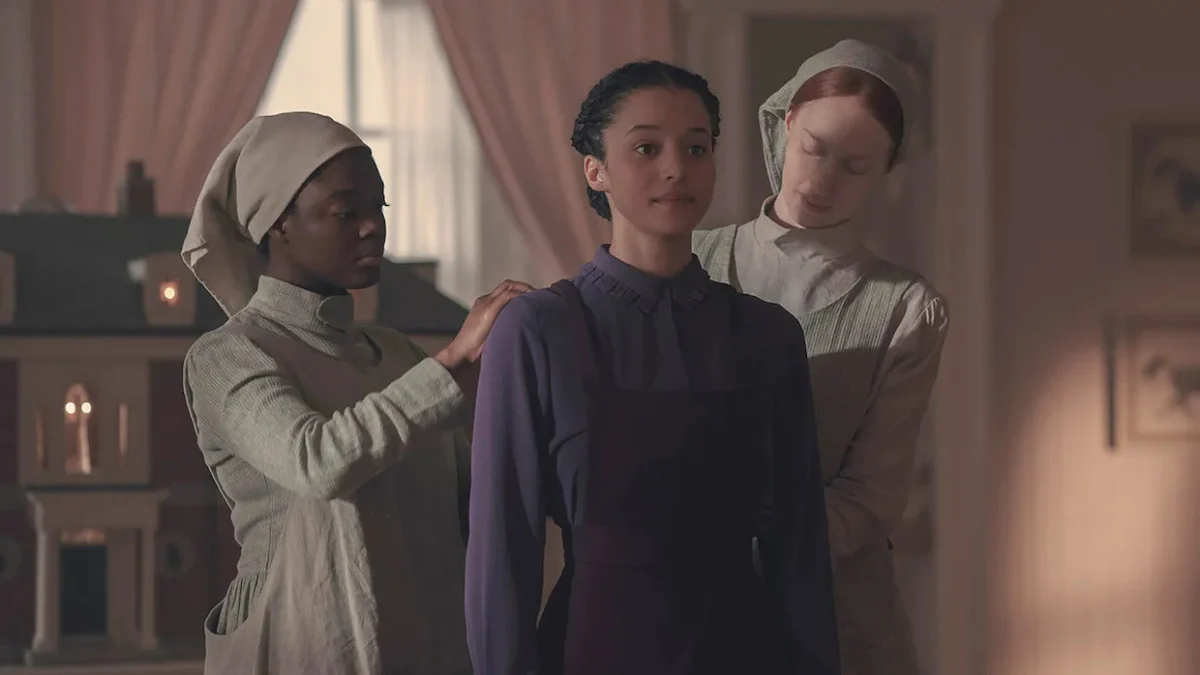
In Miller’s adaptation, the character of June Osborne (Offred) survives and escapes to Canada, a major departure from the novel where her ultimate fate remains a mystery recorded in historical transcripts. This survival allows for a direct narrative link to The Testaments, which follows Agnes, played by Chase Infiniti, a young woman in Gilead who is unaware of her true identity as June’s daughter. By evolving the story to fit the medium of multi-season television, Miller and Atwood have created a continuous timeline that explores the internal collapse of the Republic of Gilead through the eyes of a new generation.
Welcome to Derry: Deciphering the Origins of Pennywise
While The Handmaid’s Tale expands forward in time, HBO’s upcoming series It: Welcome to Derry looks backward, seeking to provide a foundational history for one of Stephen King’s most terrifying creations. Directed and executive produced by Andy Muschietti and Barbara Muschietti—the team behind the two-part cinematic adaptation of It that grossed over $1.1 billion globally—the series serves as a prequel set 27 years before the events of the first film.
The genesis of the series lay in conversations between Andy Muschietti and actor Bill Skarsgård during the production of the films. The pair became fascinated by the "intentionally cryptic" nature of Pennywise the Dancing Clown’s origins. In King’s original 1,138-page novel, the entity known as "It" is an ancient, trans-dimensional predator that arrived on Earth millions of years ago, but the specific human persona of Pennywise remains largely enigmatic.
Welcome to Derry is set in the early 1960s, a departure from the 1950s setting of the first half of King’s book. This chronological shift allows the Muschiettis to ground the supernatural horror in a specific historical context, including the tensions of the Cold War and the burgeoning Civil Rights Movement. The production team aims to explore how the monster utilizes the social anxieties and systemic prejudices of the era to hunt its victims.
A key narrative thread in the prequel involves the human alter ego of Pennywise, a man named Bob Gray. The series depicts Gray as a vaudevillian performer on the carnival circuit during the late Depression era. By showing how the ancient entity lured Gray and assumed his persona, the showrunners aim to provide a clear motivation for the creature—something Andy Muschietti suggests will surprise audiences while remaining faithful to the spirit of King’s work. The project, which is planned to span three seasons, represents a strategic effort to maintain the mystery of a horror icon while providing the depth required for a television procedural.
Alien: Earth and the Intersection of Nature and Technology
In the realm of science fiction, Noah Hawley is undertaking a similar task with Alien: Earth, an FX series that serves as a prequel to Ridley Scott’s 1979 masterpiece. Hawley, known for his critically acclaimed work on the Fargo anthology series, is approaching the Alien franchise by focusing on its core thematic tensions: the conflict between primal nature and cold, corporate technology.
Set approximately 30 years before the events of the original film and several years before Prometheus, Alien: Earth stars Sydney Chandler as Wendy, a "human-cyborg hybrid." This character serves as the lens through which the audience explores the corporate warfare between the Weyland-Yutani Corporation and a rival tech firm called Prodigy. The plot centers on the crash landing of a research vessel on Earth, carrying the lethal xenomorph species.
Hawley’s approach is notably "additive." Rather than simply replicating the "slasher in space" formula of the original film, he utilizes the 10-episode format to explore the societal implications of extraterrestrial contact. By placing the action on Earth, Hawley removes the "haunted house" isolation of the Nostromo and replaces it with a broader geopolitical struggle. He has also introduced new extraterrestrial species, arguing that the franchise’s title, Alien, allows for a diverse ecological exploration beyond the singular xenomorph.
The showrunner’s analysis of the original film suggests that the true horror lies in being trapped between two killers: the biological perfection of the alien and the calculated indifference of the androids and corporations. Hawley asserts that this dynamic is particularly resonant in the modern era, where humanity finds itself increasingly caught between ecological collapse and the rapid, often unchecked advancement of artificial intelligence and corporate power.
Chronology of Expansion: A Timeline of Narrative Development
The trend of expanding these specific universes has followed a distinct chronological path over the last decade, reflecting a broader industry move toward "prestige IP" (Intellectual Property):
- 2017: The Handmaid’s Tale premieres on Hulu, garnering immediate critical acclaim and sparking a cultural movement centered on its visual motifs.
- 2017–2019: The It film duology is released, proving that high-concept horror can achieve blockbuster financial success.
- 2019: Margaret Atwood publishes The Testaments, providing a roadmap for the future of the Gilead narrative.
- 2020–2023: Noah Hawley and FX announce the development of Alien: Earth, shifting the focus of the franchise from the deep reaches of space to a terrestrial setting.
- 2024: Production intensifies on Welcome to Derry and The Testaments (as the final season of Handmaid’s concludes), signaling a new era where television serves as the primary vehicle for franchise longevity.
Industry Implications and the "Additive" Philosophy
The shift toward prequels and sequels in television is driven by both economic and creative factors. In an increasingly fragmented streaming market, established brands offer a degree of "built-in" audience awareness that original projects often lack. However, as Miller, Muschietti, and Hawley demonstrate, the modern audience demands more than a simple remake; they require an expansion that feels essential to the lore.
The "additive" philosophy—the idea that a new series should contribute something meaningful to the existing canon rather than just exploiting it—has become the gold standard for showrunners. This involves:
- Authorial Collaboration: Maintaining a direct line of communication with original creators (like Atwood and King) to ensure thematic consistency.
- Historical Contextualization: Using different time periods to explore how the core themes of the IP manifest in various social and political climates.
- Character Depth: Utilizing the extended runtime of a television season to provide backstories for characters that were previously one-dimensional or enigmatic.
- Thematic Evolution: Updating the "fears" of the original work to reflect contemporary anxieties, such as corporate overreach, reproductive rights, and technological displacement.
As these series prepare for their respective debuts and conclusions, they represent a significant experiment in the durability of 20th-century icons. Whether these expansions will successfully enrich the legacy of their source material or dilute the mystery that made them famous remains to be seen. However, the level of creative investment and the caliber of talent involved suggest that the era of the "television universe" is only just beginning. For audiences, this means a deeper, more granular look into the worlds they have inhabited for decades, transformed by a new generation of storytellers.