At a pivotal moment for the entertainment industry, where the tension between technological advancement and labor preservation has reached a fever pitch, a new production entity is attempting to bridge the gap. Innovative Dreams, a hybrid production services company, has officially launched with a mandate to integrate high-end generative artificial intelligence into every stage of the filmmaking process. Backed by industry giants including Amazon Web Services (AWS) and the $4 billion generative AI startup Luma, the studio aims to demonstrate that AI can serve as a tool for creative expansion and cost-efficiency rather than a mere replacement for human talent.
The launch comes as Hollywood continues to reel from the dual shocks of the COVID-19 pandemic and the 2023 labor strikes, which saw the Writers Guild of America (WGA) and the Screen Actors Guild-American Federation of Television and Radio Artists (SAG-AFTRA) bring the industry to a standstill for months. By combining traditional filmmaking techniques with virtual production, motion capture, and a suite of advanced AI tools, Innovative Dreams seeks to revitalize Southern California’s production landscape, which has seen a significant exodus of projects to more tax-friendly or lower-cost jurisdictions.
A New Paradigm in Hybrid Production
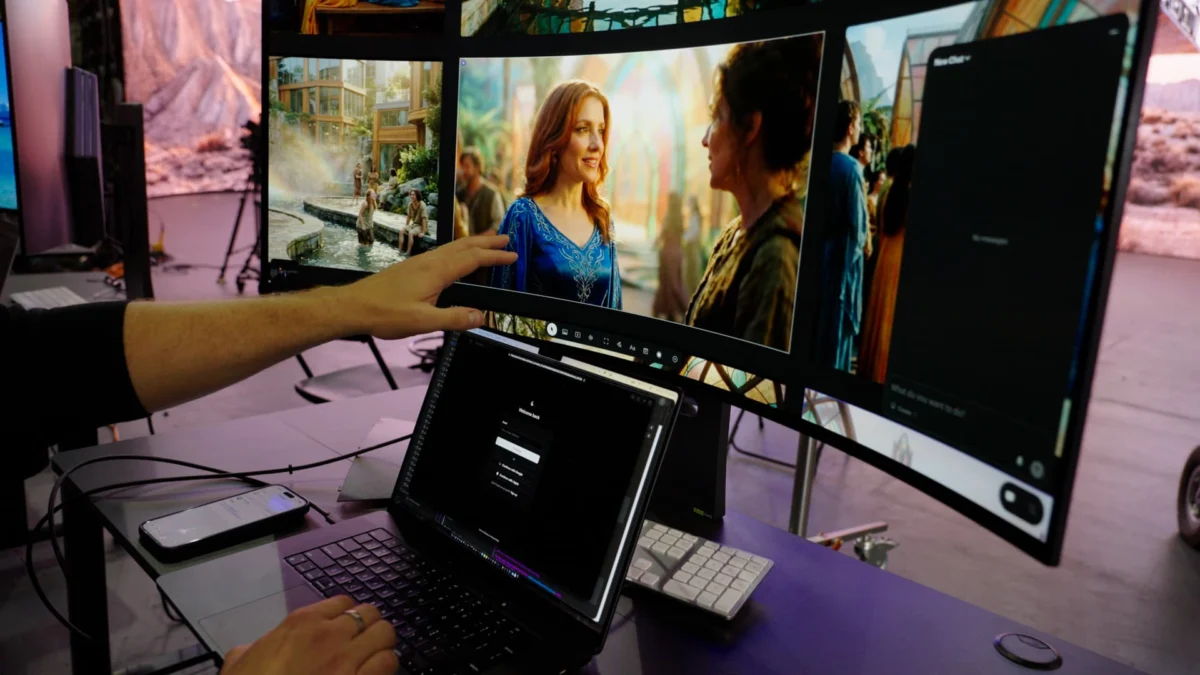
Innovative Dreams operates on a model that merges the physical and digital worlds through a "hybrid" soundstage. This facility utilizes massive LED walls—a technology popularized by series like The Mandalorian—but enhances it with real-time AI processing. The workflow integrates tools from a variety of tech leaders, including Luma’s generative models, Google’s Nano Banana, and Bytedance’s SeeDream.
CEO Jon Erwin, the founder of the production studio Wonder Project, established Innovative Dreams after experiencing a technological breakthrough during the production of his upcoming series, House of David, for Amazon Prime Video. While filming historical sequences that required vast, far-flung locales, Erwin’s team utilized AI to simulate environments and scale that would have been financially prohibitive using traditional methods.
According to Erwin, the goal is not to replace the fundamental elements of cinema—the actor’s performance, the director’s lens choice, and the cinematographer’s lighting—but to augment them. "We visually design and explore the world, then we take the footage that we filmed and start mapping that performance capture to these digital assets," Erwin explained. This process allows a director to fuse a live actor’s performance with digital wardrobe or environments while maintaining the nuances of the human expression and camera movement.
The Case for Efficiency: From Six Weeks to One
The practical implications of this workflow were recently tested on an upcoming three-part series titled The Old Stories: Moses. Starring Academy Award winner Ben Kingsley, the project was filmed entirely on a virtual soundstage in Los Angeles. Despite the script requiring 40 different locations across the globe, the entire series was shot in a single week.
Under a traditional production model, a project of this scale would typically require five to six weeks of principal photography, compounded by the logistical nightmare and massive expense of transporting a full cast and crew to multiple international locations. By using AI to generate and render these environments on LED screens in real-time, Innovative Dreams was able to maintain high production values on a fraction of the budget.
This efficiency is powered by a robust technological backbone. Because AI video generation and real-time rendering require immense computing power, Innovative Dreams partnered with AWS. The cloud provider offers the necessary infrastructure to handle the massive data loads required for high-fidelity digital assets. Samira Bakhtiar, General Manager of Media, Entertainment, Games, and Sports at AWS, noted that the partnership is designed to allow filmmakers to produce content faster and cheaper, accelerating production cycles that were previously bogged down by post-production bottlenecks.
The Strategic Partnership with Luma and the AI Frontier
Central to the studio’s capabilities is its relationship with Luma, an AI startup that has rapidly become a major player in the generative video space. With a valuation exceeding $4 billion, Luma is developing "agent" tools that allow multiple AI services to collaborate within a single workspace.
For Innovative Dreams, this partnership is symbiotic. While the studio uses Luma’s technology to create photorealistic digital elements, Erwin and his team provide real-world feedback that helps shape the development of these tools for professional cinematic use. This collaborative loop ensures that the AI is being tuned to the specific needs of directors and cinematographers, rather than being developed in a vacuum by software engineers.

The integration of Google’s Nano Banana and Bytedance’s SeeDream further diversifies the studio’s toolkit, offering various specialized functions from text-to-video generation to complex 3D scene reconstruction. This "best-of-breed" approach allows the studio to select the specific AI model that best fits a particular creative challenge, whether it be a period-accurate costume or a sprawling ancient city.
Economic Context: The Crisis in Southern California Production
The emergence of Innovative Dreams arrives during a period of deep economic anxiety for the Los Angeles entertainment sector. According to data from FilmLA, production activity in the city has plummeted to its lowest levels since 1995, excluding the pandemic-induced shutdown. Los Angeles County has lost more than 40,000 entertainment industry jobs since 2022, a trend driven by a combination of "runaway production" to international hubs, studio consolidation, and a general contraction in content spending.
"This industry has been battered by one shock after another," said Jonathan Handel, a prominent entertainment attorney and industry analyst. Handel points out that overall production metrics are down 25% to 35% compared to pre-COVID levels. The high cost of living and production in California has made it increasingly difficult for mid-budget projects to remain in the state.
Erwin views AI not as a threat to these jobs, but as the only viable way to save them. By lowering the cost of production to a point where it is competitive with subsidized international markets, he believes he can convince studios to "green light" more projects in Los Angeles. "I think this is necessary to bring jobs back to LA," Erwin stated. "We’re inventing a new method to fix something that’s become unsustainable."
The Labor Debate: Displacement vs. Augmentation
Despite the optimism from the studio’s founders, the rise of AI remains a flashpoint for labor unions. The 2023 strikes were defined by a fight for protections against the use of AI to replicate an actor’s likeness or a writer’s voice without consent or compensation. The resulting contracts established "guardrails," but they did not ban the technology outright.
The concerns extend beyond actors and writers to the "below-the-line" crew members. If a set can be generated digitally, what happens to the carpenters, painters, and prop makers? If wardrobe can be applied via AI-mapped performance capture, what is the future for costumers and makeup artists?
Jonathan Handel notes that the industry is currently in a "wait-and-see" period regarding job displacement. "The question of how much job displacement there’ll be versus how much job augmentation will exist is one that just has not played out yet and is still making people very nervous," he said. There is a particular concern regarding entry-level positions; the traditional "on-ramps" for young professionals—such as being a production assistant or a junior artist—may shrink as AI automates routine tasks.
Erwin acknowledges these fears but argues that the alternative—the total loss of the industry to overseas markets—is worse. He contends that the most skilled workers will adapt, using AI to enhance their craft rather than being replaced by it. For example, a digital costume designer still requires the eye of a traditional costumer to understand fabric movement, historical accuracy, and character psychology.
Future Implications and the Path Forward
The launch of Innovative Dreams marks a significant experiment in the future of entertainment. If successful, it could provide a blueprint for a new era of "sustainable" filmmaking, where high-concept stories can be told without the $200 million price tags that have become common for tentpole features.
The debut of The Old Stories: Moses this spring will serve as the first major public test of this hybrid workflow. Audiences and industry insiders alike will be watching to see if the AI-generated environments and digital mapping can achieve the "uncanny valley" threshold required for prestige television.
As AWS and Luma continue to pour resources into this space, the infrastructure for AI-powered filmmaking is likely to become more accessible. For Hollywood, the challenge will be balancing the undeniable economic benefits of these tools with the ethical and social responsibility of maintaining a human-centered creative workforce. For now, Innovative Dreams stands as a bold attempt to prove that the future of cinema lies in the synergy between the human spirit and the machine.