


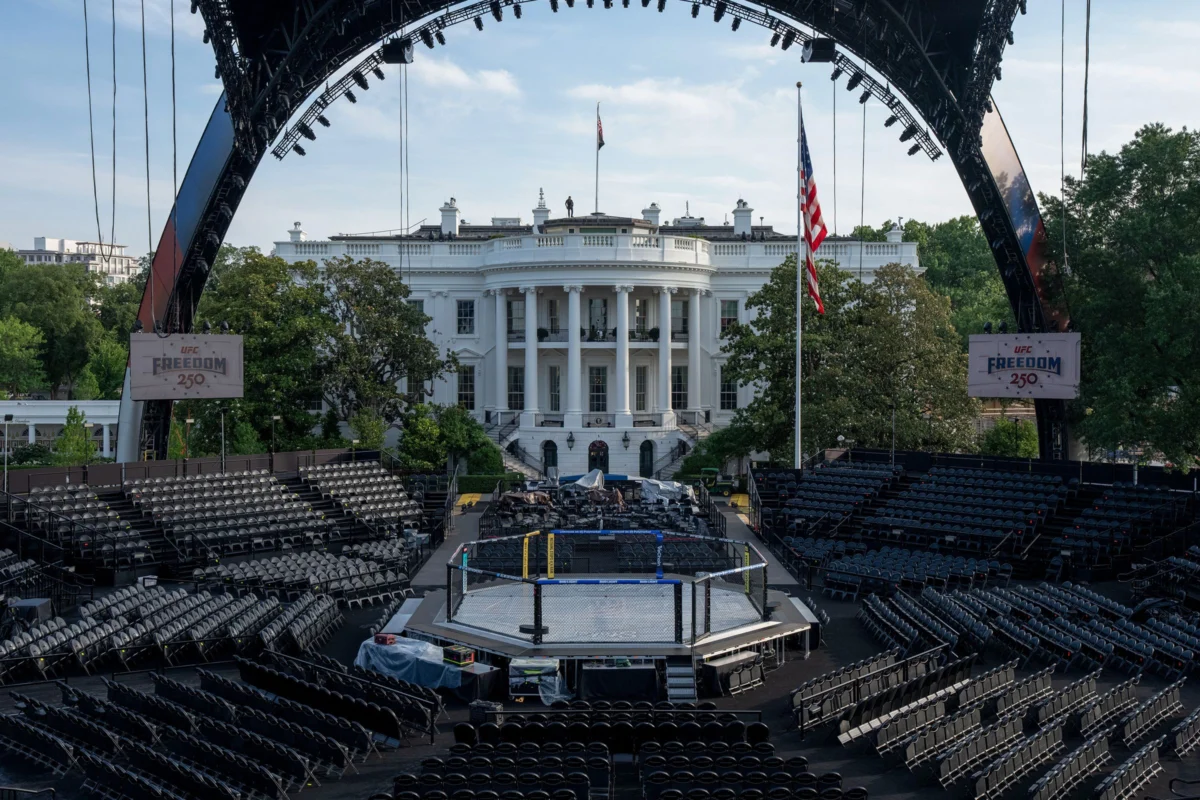
In an unprecedented merger of professional athletics and executive branch ceremony, the South Lawn of the White House is scheduled to host UFC Freedom 250 this coming Sunday. The event, headlined by a lightweight title unification bout and sponsored by Monster Energy, represents the culmination of a long-standing relationship between President Donald Trump and the Ultimate Fighting Championship (UFC). This scheduled fight card serves as the first time a major professional combat sports promotion has utilized the presidential residence as a primary venue for a televised athletic competition.
The logistics of the event involve a significant transformation of the historic grounds. Observers have noted that the setup mirrors the "UFC Apex" style, a specialized production facility typically located in Las Vegas. The installation includes a standard Octagon cage, high-intensity lighting rigs, and a temporary seating arrangement designed to accommodate a select audience of approximately 1,900 guests, along with a contingent of active-duty military personnel.
Strategic Partnership and Sports Diplomacy
The event is framed not merely as entertainment but as a strategic component of American "sports diplomacy." On Thursday, Secretary of State Marco Rubio participated in a formal ceremony alongside UFC CEO Dana White to sign a Memorandum of Understanding (MOU). This document purports to integrate the UFC’s global reach into the State Department’s international outreach initiatives.
During the signing, Secretary Rubio drew a historical parallel between the founding of the UFC and the Apollo 11 moon landing, characterizing the promotion as a uniquely American success story. "The UFC represents the pinnacle of American entrepreneurial spirit and athletic excellence," Rubio stated during the proceedings. However, sports historians have noted that the UFC’s origins were deeply rooted in international influences, specifically the Brazilian jiu-jitsu techniques of the Gracie family, and that the 1993 debut of the promotion followed similar developments in Japanese mixed martial arts, such as the Pancrase organization.
The Fight Card: Topuria vs. Gaethje
The athletic centerpiece of UFC Freedom 250 is the 155-pound championship bout between Ilia Topuria and Justin Gaethje. Topuria, an undefeated champion known for his technical striking and grappling, faces Gaethje, the interim titleholder recognized for a high-volume, aggressive style. While the fight is highly regarded by enthusiasts, analysts have pointed out that the card lacks the star power typically associated with "historic" milestones, as several of the organization’s most recognizable names are absent from the lineup.
The event also features an interim heavyweight title bout and a series of matches involving ranked contenders. Notably, the card does not include any female bouts, a departure from the UFC’s standard practice of featuring diverse divisions. The fighters are expected to make their walkouts from the Oval Office, a choreographed sequence intended to emphasize the gravity of the venue.
Economic Projections and Viewership Discrepancies
Dana White has publicly stated that he expects the event to generate "Super Bowl type numbers" in terms of global viewership. These projections, however, face scrutiny when compared to historical data. The most recent Super Bowl (LVIII) averaged approximately 124.7 million viewers in the United States alone. In contrast, the most-watched MMA event in history—a recent Ronda Rousey bout broadcast via Netflix—peaked at approximately 11.6 million domestic viewers, representing less than 10% of the Super Bowl’s reach.
The financial backdrop of the UFC is also a point of discussion. The organization recently reached a $375 million settlement in a class-action antitrust lawsuit. The suit, brought by former fighters, alleged that the UFC engaged in wage suppression and anti-competitive practices to maintain its market dominance. This legal context has colored recent negotiations with top-tier talent.
Notable Absences: Jon Jones and Conor McGregor
The absence of Jon Jones, widely considered the greatest mixed martial artist in history, has been a subject of public debate. White has maintained that there were no formal negotiations to include Jones on the White House card. Conversely, Jones has alleged that the organization "lowballed" him during preliminary discussions, leading to a breakdown in communication. Jones’s career has been marked by both athletic brilliance and a series of legal and disciplinary issues, which may have influenced the administration’s vetting process.
Similarly, Conor McGregor, the sport’s most commercially successful figure, will not participate. Despite a scheduled return to the Octagon in early July, McGregor was deemed ineligible for the White House event. Official statements from the White House suggest that McGregor had not completed the required duration in the United States Anti-Doping Agency (USADA) testing pool. Additionally, administration officials indicated a desire to avoid the appearance of favoritism toward specific high-profile fighters. McGregor’s recent history includes a civil liability finding for sexual assault and significant involvement in political discourse in his native Ireland, factors that may have complicated his inclusion in a state-sponsored event.
Attendance Criteria and Guest Logistics
The audience for UFC Freedom 250 is divided into two primary categories. The first group consists of roughly 1,900 guests who received invitations directly from the "TKO" leadership—a conglomerate formed by the merger of UFC and WWE—and the White House. This group includes high-ranking executives such as Ari Emanuel, the CEO of TKO.
The remainder of the seating is reserved for active-duty members of the United States Armed Forces. However, attendance for these service members is contingent upon meeting specific physical fitness standards. Specifically, attendees must maintain a waist-to-height ratio of less than 0.55. This requirement has drawn commentary regarding its stringency, as it excludes a portion of the active-duty population and, as some analysts noted, would likely exclude the President himself based on his most recently published physical examination data (6’3” and 238 pounds).
Timeline of the Trump-UFC Relationship
The partnership between Donald Trump and the UFC spans over two decades, providing essential context for Sunday’s event:
- 2001: At a time when mixed martial arts was banned in many states and struggling for legitimacy, Trump hosted UFC 30 and UFC 31 at the Trump Taj Mahal in Atlantic City. This provided the promotion with a high-profile venue and a veneer of mainstream credibility.
- 2018: President Trump issued a posthumous pardon to boxing legend Jack Johnson, a move heavily advocated for by Dana White and other figures in the combat sports world.
- 2019: Trump became the first sitting president to attend a UFC event in person, appearing at UFC 244 at Madison Square Garden.
- 2020-2024: Dana White emerged as a prominent surrogate for Trump’s political campaigns, speaking at multiple Republican National Conventions and emphasizing Trump’s loyalty to the sport.
Operational Risks and Externalities
The outdoor nature of the event introduces significant operational risks. Weather forecasts for Sunday evening indicate a high probability of thunderstorms in the Washington, D.C. area. While Dana White has asserted that the fights will proceed regardless of weather conditions, the presence of high-voltage broadcasting equipment and temporary metal structures on the South Lawn poses logistical challenges.
The event follows a recent incident involving the WWE, a sister organization under the TKO umbrella. Last weekend, a 3,000-square-foot American flag flying above the WWE headquarters in Stamford, Connecticut, was detached by high winds and blown into power lines. The resulting short circuit caused a power outage affecting approximately 40,000 residents and disrupted local transit. This incident has heightened concerns regarding the safety and stability of large-scale temporary installations managed by the promotion.
Broader Implications of the Event
UFC Freedom 250 represents a significant shift in how the White House is utilized for cultural and sporting events. While the executive mansion has long hosted championship-winning teams for brief ceremonies, the staging of a full-scale professional prize fight on the grounds is a departure from historical norms.
For the UFC, the event serves as a powerful marketing tool, further cementing its status as a premier American sporting institution. For the administration, it offers a platform to engage with a specific demographic of sports fans and to project an image of "strength and resilience" through the medium of combat sports. However, the intersection of private enterprise, partisan politics, and state-sponsored athletic competition continues to prompt discussion among constitutional scholars and sports analysts alike regarding the appropriate boundaries of executive branch activities.
As the Octagon is finalized on the South Lawn, the focus shifts to the athletes. Regardless of the political and logistical controversies surrounding the event, the performance of Topuria, Gaethje, and their fellow competitors will ultimately define the legacy of UFC Freedom 250.