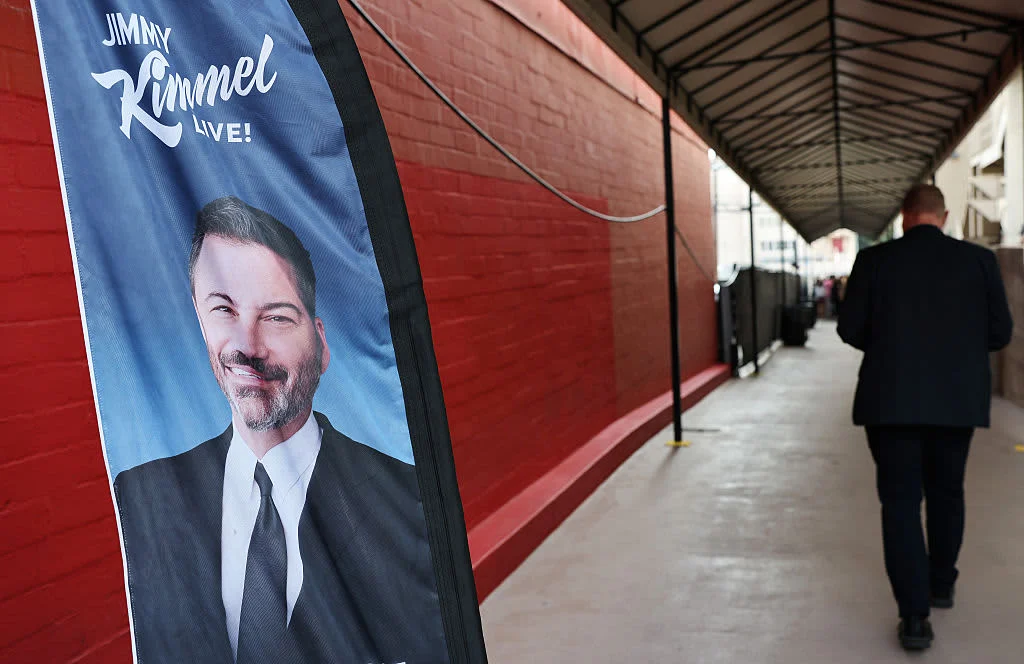
The intersection of late-night entertainment and federal regulatory oversight has reached a critical flashpoint as President Donald Trump intensifies his demands for Disney-owned ABC to terminate comedian Jimmy Kimmel. This latest escalation follows a controversial monologue that has not only drawn the ire of the First Family but has also reignited a broader debate regarding the vulnerability of broadcast licenses in an era of heightened political polarization. For Josh D’Amaro, the newly installed CEO of Disney who took the helm just last month, the situation represents an immediate and high-stakes test of the company’s ability to navigate the complex waters of national politics while protecting its media assets from potential regulatory retribution.
The current firestorm centers on a comedy sketch aired last week in which Kimmel referred to First Lady Melania Trump as an "expectant widow." The remark, intended as a jab at the age gap between the President and the First Lady, occurred just days before an alleged assassination attempt at the White House Correspondents’ Dinner, a timing that the administration has characterized as dangerously provocative. In a post on the social media platform X, Melania Trump condemned the comments as "hateful and violent rhetoric" designed to "divide our country." The President echoed these sentiments on Truth Social, labeling the monologue a "call to violence" that exceeded the boundaries of acceptable public discourse.
Kimmel addressed the controversy during his Monday night broadcast, attempting to clarify the intent behind the joke. He maintained that the remark was a standard comedic observation regarding the couple’s age difference and was "not, by any stretch of the definition, a call to assassination." Despite this clarification, the White House has remained steadfast in its condemnation. Communications Director Steven Cheung argued that Kimmel should be "shunned" for his refusal to issue a formal apology, further signaling that the administration does not view the matter as settled.
A History of Escalating Tensions and Preemptions
This is not the first time Jimmy Kimmel’s late-night platform has served as a battleground for political and regulatory conflict. In September 2025, the program faced a brief suspension following comments made about the killing of conservative activist Charlie Kirk. During that episode, major broadcast station owners, including Nexstar and Sinclair, threatened to preempt the program, effectively removing it from local airwaves in key markets. This internal industry pressure was bolstered by Federal Communications Commission (FCC) Chairman Brendan Carr, who raised public concerns about the content of the broadcast.
The September incident established a significant precedent for how the Trump administration and its allies might leverage the decentralized nature of American broadcasting to exert influence over national networks. While Disney eventually returned Kimmel to the air after an apology, the temporary blackout demonstrated that the "pipeline" through which network content reaches viewers—the local affiliates—can be weaponized. Nexstar and Sinclair, which control a vast majority of the local stations carrying ABC programming, have currently declined to comment on the latest controversy, but their previous willingness to disrupt the broadcast schedule remains a looming threat for Disney executives.
Regulatory Pressures and the FCC License Review
Beyond the immediate calls for Kimmel’s firing, the broader implications for Disney’s corporate interests are becoming increasingly apparent. Reports have surfaced via Semafor suggesting that the FCC is preparing a review of Disney’s broadcast licenses. While sources within the agency have suggested the timing is not directly linked to the Kimmel monologue, the proximity of the review to the President’s public attacks on the network has raised alarms among media analysts and First Amendment advocates.
Under Chairman Brendan Carr, the FCC has taken a more assertive stance regarding the "public interest" obligations of broadcast licensees. In late 2025, Carr suggested that licenses could be at risk of revocation if broadcasters failed to uphold standards of acceptable content. This regulatory posture represents a shift from the traditional "hands-off" approach to content-based regulation, which is usually protected under the First Amendment. However, the legal definition of "public interest" is broad, and the administration appears increasingly willing to test its limits as a means of holding legacy media companies accountable for perceived biases.
The Financial and Legal Burden on ABC News
The pressure on Disney-owned media is not limited to the entertainment division. ABC News has also found itself in the crosshairs of the administration’s legal and political machinery. In December 2024, the network agreed to a $15 million settlement toward the President’s future presidential library to resolve a defamation lawsuit brought by Trump against the network and anchor George Stephanopoulos. This settlement was viewed by many in the industry as a strategic move by Disney to mitigate long-term legal risks, though it also served to embolden critics who argue the network is vulnerable to executive pressure.

Furthermore, the dismissal of national correspondent Terry Moran last year, following his social media comments regarding the President and senior advisor Stephen Miller, suggests a tightening of internal standards at ABC. These actions collectively paint a picture of a media conglomerate attempting to insulate itself from political fallout through a combination of financial settlements and personnel changes. The Kimmel situation, however, represents a more difficult challenge, as late-night comedy is traditionally afforded broader creative latitude than news reporting.
Industry-Wide Impact and the CBS Precedent
The current climate of uncertainty is not unique to Disney. Last year, Paramount-owned CBS announced the termination of "The Late Show with Stephen Colbert" during a sensitive period of regulatory review for its merger with Skydance. While the merger eventually received approval, industry insiders noted the timing of the announcement as a potential concession to regulatory concerns regarding the network’s political output.
For Disney, which has stated it does not currently have plans for major mergers or acquisitions, the stakes are different but no less significant. The company’s broadcast licenses for its "Owned and Operated" (O&O) stations in major markets like New York, Los Angeles, and Chicago are essential to its revenue model. Any disruption to these licenses, or even the threat of a protracted legal battle over their renewal, could have a chilling effect on the company’s stock price and its overall valuation.
Analysis: The Future of Late-Night in the Second Trump Term
As the Trump administration enters the mid-point of its second term, the relationship between the White House and late-night television has transitioned from one of mutual mockery to one of direct confrontation. Traditionally, late-night hosts like Kimmel, Colbert, and Seth Meyers have functioned as the "loyal opposition" in popular culture, using satire to critique the administration. However, the current administration’s willingness to link comedic content to broadcast licensing and corporate liability has fundamentally altered the risk-reward calculation for networks.
Media analysts suggest that the "Kimmel Test" will determine the future of political satire on broadcast television. If Disney yields to the pressure and terminates Kimmel, it may set a standard where network content must be sanitized to avoid regulatory scrutiny. Conversely, if Disney maintains its support for Kimmel, it risks a multi-front war with the FCC, local station owners, and the White House.
The role of Josh D’Amaro in this crisis is pivotal. As a leader coming from the parks and resorts side of the business, D’Amaro is perceived as a pragmatist. His decision-making process will likely weigh the creative integrity of the ABC brand against the cold reality of federal oversight and the need for a stable relationship with the government. With the FCC reportedly moving forward with license reviews, the window for a quiet resolution appears to be closing.
Conclusion and Outlook
The escalating conflict over Jimmy Kimmel’s position at ABC is more than a dispute over a distasteful joke; it is a landmark moment in the relationship between the American presidency and the media. The use of federal regulatory bodies to influence the personnel and content of private media companies marks a significant departure from historical norms.
As the situation develops, the focus will remain on whether Disney chooses to defend its talent or prioritize its regulatory standing. For now, Kimmel remains on the air, but the mounting pressure from the White House, the FCC, and broadcast affiliates suggests that the status quo is increasingly unsustainable. The outcome of this standoff will likely define the boundaries of free speech and corporate responsibility in the American media landscape for years to come. Regardless of the final decision, the precedent of using broadcast licenses as a tool for political leverage has already been established, leaving the entire industry on precarious footing.