

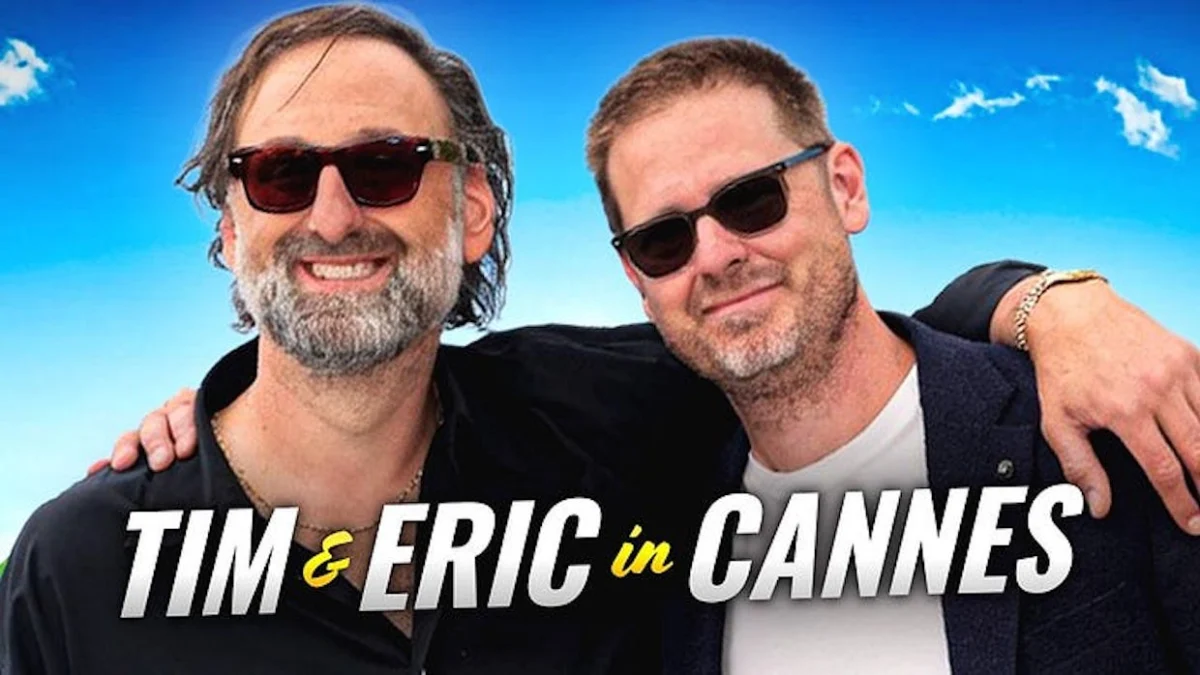
The 79th Festival de Cannes provided an unexpected intersection for two distinct pillars of contemporary counterculture: the surrealist sketch comedy pioneers Tim Heidecker and Eric Wareheim, and French auteur Quentin Dupieux. Meeting at a luxury hotel ahead of the midnight premiere of Dupieux’s newest feature, Full Phil, the duo discussed their enduring creative partnership, their evolving individual ventures, and the shifting paradigms of independent filmmaking.
Long celebrated for altering the landscape of American alternative humor through their landmark Adult Swim series Tim and Eric Awesome Show, Great Job! (2007–2010), Heidecker and Wareheim have spent the subsequent fifteen years expanding into diverse multi-hyphenate careers. Their reunion in Cannes underscores a broader trajectory of cross-pollination between vanguard comedy and European art-house cinema, highlighting the ongoing evolution of creators who first emerged during the nascent stages of digital-era broadcasting.
Main Facts and the Cannes Showcase
At the center of the duo’s French excursion is Quentin Dupieux’s Full Phil, one of two films presented by the prolific director at the 2026 festival. Described by its creator as an existential inversion of television tropes—famously characterized as “Emily in Paris in hell”—the narrative follows a wealthy industrialist, played by Woody Harrelson, attempting an ill-fated reconciliation with his daughter, portrayed by Kristen Stewart.
Within this narrative framework exists a film-within-a-film, a stylistic pastiche of classic Universal monster movies such as Frankenstein (1931) and Creature from the Black Lagoon (1954). Heidecker and Wareheim inhabit this internal pastiche as heightened, Victorian-era mad scientists, utilizing expansive mid-Atlantic accents and broad theatricality to pursue a reptilian creature terrorizing the canvas.
The casting reflects a long-standing creative rapport. Wareheim previously appeared in two of Dupieux’s earlier cinematic works, Wrong Cops (2013) and Reality (2014). This latest collaboration marks Heidecker’s formal introduction to Dupieux’s distinct working methods, characterized by rapid production schedules, minimal direct rehearsal, and automated translation workflows that deliberately challenge traditional English-language performance dynamics.
Chronology of a Double-Act: From Temple University to Global Influence
The professional trajectory of Heidecker and Wareheim began in the late 1990s as students at Temple University in Philadelphia. Bonding over a shared affinity for absurdist media, public-access television aesthetics, and subverted narrative structures, the pair eventually transitioned to the screen with the backing of cable networks seeking unconventional programming.
- 2007: The premiere of Tim and Eric Awesome Show, Great Job! on Adult Swim, which ran for five seasons and fundamentally reshaped online comedy culture.
- 2007: The establishment of their independent production company, Abso Lutely Productions, which grew from an internal infrastructure for their own projects into an incubator for external talent and stand-up specials.
- 2011–Present: Heidecker co-creates On Cinema at the Cinema alongside Gregg Turkington, establishing a sprawling multimedia psychodrama that eventually birthed the independent streaming platform HEI Network. Concurrently, Heidecker releases six independent rock albums.
- 2013–2014: Wareheim collaborates with Quentin Dupieux in Wrong Cops and Reality, establishing a transatlantic artistic brotherhood.
- 2024–2026: Both creators pivot toward new industry models, with Wareheim expanding into artisanal horticulture and bonsai curation, and Heidecker stepping into executive leadership roles connected to satire and digital media infrastructure.
Industry Evolution and the Shift Away from Traditional Studio Models
During their time at Cannes, Heidecker delivered a keynote address at the festival’s American Pavilion, hosted by IndieWire, focusing on the "Future of Filmmaking." Both creators were recognized as early progenitors of the modern creator economy, a status earned through decades of maintaining creative autonomy via Abso Lutely Productions.
However, the operational realities of maintaining a traditional mid-sized production company shifted dramatically in the wake of the COVID-19 pandemic. Changes in network acquisition strategies and the centralization of studio development pipelines prompted Heidecker and Wareheim to divest from the day-to-day operations of Abso Lutely, ultimately selling a stake to producer Jimmy Miller’s management apparatus.
This structural recalibration mirrors a wider industry trend away from traditional television development hell—characterized by protracted notes processes and risk-averse studio gatekeeping—toward direct-to-consumer models and independent financing. Heidecker’s recent involvement with the satirical media ecosystem surrounding The Onion and InfoWars functions as a contemporary proof-of-concept for circumventing traditional studio constraints, utilizing established audience ecosystems to fund uncompromised artistic visions.
Similarly, Wareheim has largely stepped away from traditional culinary ventures and restaurant culture to focus on botanical curation and plant importation, running an independent enterprise sourcing rare specimens, such as Australian grasstrees, from international markets.
Broader Impact and Implications for Independent Cinema
The presence of Heidecker and Wareheim at Cannes—not merely as festival attendees, but as active participants in the international art-house circuit—signals a dissolving barrier between high-brow European cinema and American alternative comedy. Directors like Dupieux frequently draw on the aesthetic signatures of underground digital humor, recognizing that creators trained in the crucible of early-2000s cable and internet sketch possess a unique facility for existential meta-commentary.
At the same time, the duo’s transition into direct-to-consumer digital infrastructure, independent publishing, and specialized trade highlights a viable blueprint for veteran creators seeking to bypass the increasingly consolidated studio system. Whether through the self-sustaining framework of the HEI Network, localized agricultural pursuits, or transnational film collaborations, Heidecker and Wareheim continue to navigate the contemporary media landscape on their own terms—proving that absurdist pioneers can successfully adapt to an evolving global industry without sacrificing their foundational ethos.