Valve Corporation has officially entered the next phase of its hardware ecosystem with the release of the new Steam Controller, a device that seeks to rectify the shortcomings of its 2015 predecessor while leveraging the design successes of the Steam Deck. Priced at £85 and scheduled for broad availability on May 4th, the peripheral arrives at a pivotal moment for PC gaming, as the line between traditional desktop play and living-room console experiences continues to blur. The controller represents a sophisticated fusion of traditional gamepad inputs and specialized touch-sensitive technology, aimed specifically at users who demand the precision of a mouse-and-keyboard setup from the comfort of a sofa.
The launch of the new Steam Controller is not an isolated event but rather part of a broader, albeit complicated, hardware rollout. Valve initially intended to launch the controller alongside a new iteration of the Steam Machine—an in-house designed, console-like PC. However, global economic factors, specifically the ongoing volatility in the semiconductor market driven by the high demand for AI-related hardware, have led to significant delays for the primary unit. Increased costs for SSD storage and RAM have forced Valve to decouple the controller’s release from its parent machine, leaving the Steam Controller 2.0 to stand as a standalone testament to Valve’s current hardware philosophy.
A Chronology of Valve’s Hardware Ambitions
To understand the significance of the new Steam Controller, one must examine the decade-long trajectory of Valve’s hardware division. The journey began in 2013 with the announcement of the Steam Machine initiative, an attempt to bring the Steam ecosystem into the living room via third-party hardware partners. Central to this vision was the original Steam Controller, released in 2015.
The 2015 model was characterized by its radical departure from industry standards, featuring two large haptic trackpads and only a single analog stick. While it was praised by a dedicated niche for its ability to navigate mouse-heavy genres like Real-Time Strategy (RTS) and 4X Grand Strategy, it struggled with mainstream adoption. The lack of a second analog stick made it cumbersome for traditional third-person action games and first-person shooters, leading to its eventual discontinuation in 2019.
The timeline shifted dramatically in 2022 with the release of the Steam Deck. The handheld PC proved that Valve could successfully integrate trackpads with traditional dual-stick controls. The success of the Steam Deck provided the blueprint for the Steam Controller 2.0, which was officially teased in late 2023 before its current 2024 launch cycle. This new iteration is designed to be the bridge between the portable Steam Deck experience and the stationary "Big Picture Mode" environment of a home PC.
Design Architecture and Ergonomic Overhaul
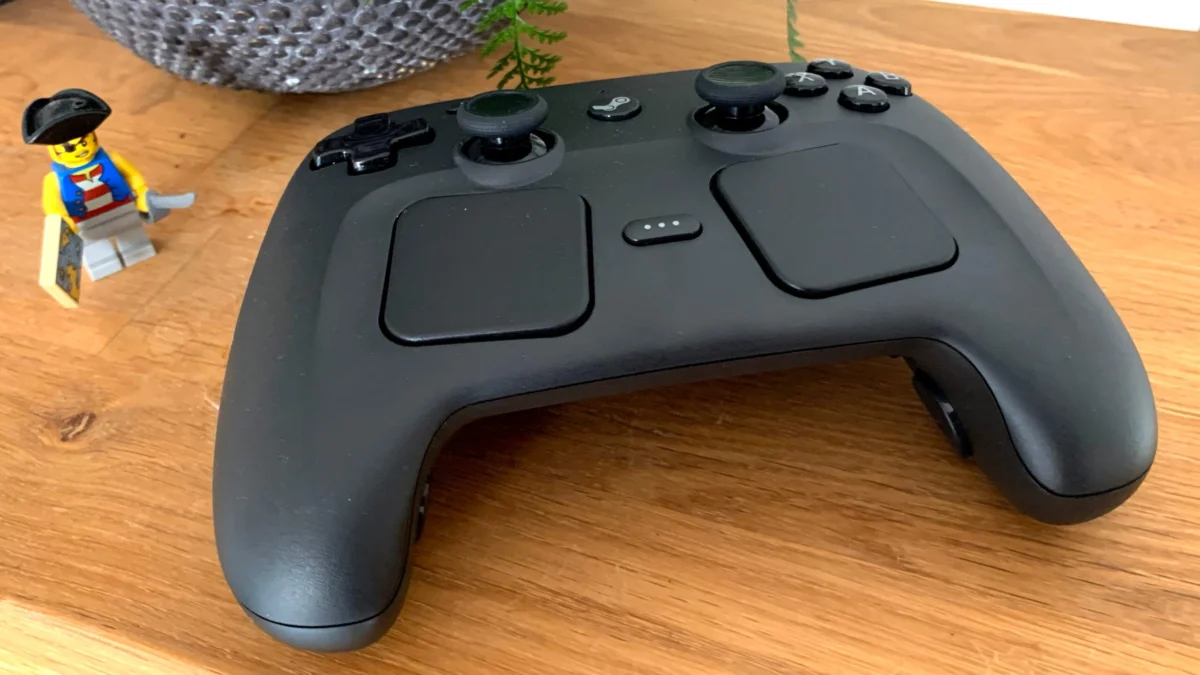
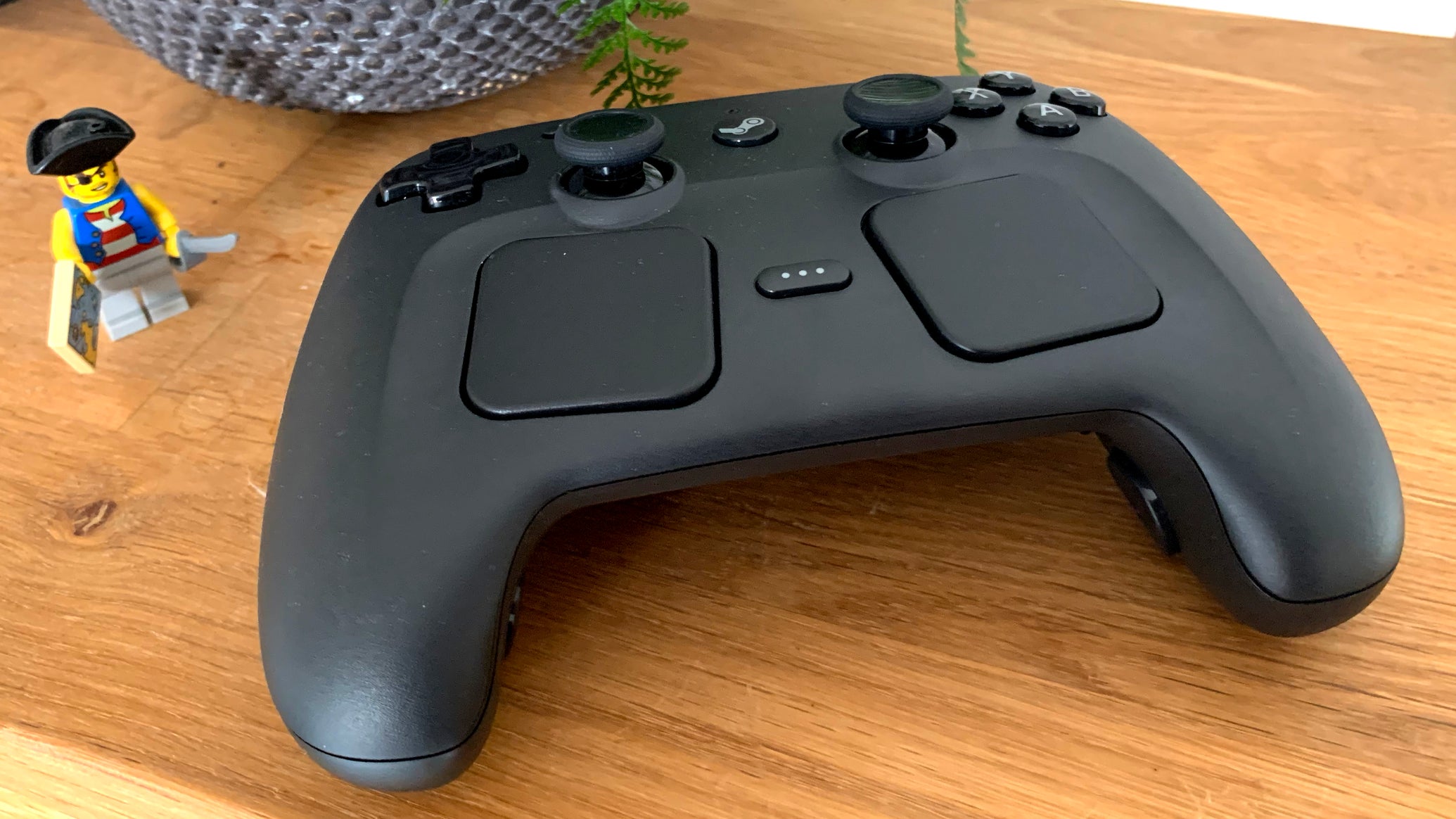
The Steam Controller 2.0 is a substantial departure from the "owl-faced" aesthetic of the original. It adopts the "boxy" and utilitarian design language of the Steam Deck, featuring a solid black plastic chassis with all-over texturing for enhanced grip. While the controller is noticeably larger and heavier than a standard Xbox Wireless Controller or a PlayStation DualSense, the weight is distributed to feel sturdy rather than cumbersome.
The input array is the most comprehensive ever seen on a standard gamepad. On the front face, Valve has included:
- Dual Analog Sticks: Positioned horizontally and utilizing Tunneling Magnetoresistance (TMR) sensors.
- Dual Trackpads: Square-shaped haptic pads located below the thumbsticks, designed for high-precision cursor movement.
- Full D-Pad: A traditional directional pad on the upper left, replacing the trackpad-hybrid D-pad of the original model.
- Standard Face Buttons: Four tactile buttons (A, B, X, Y) on the right.
- System Navigation: A central Steam button flanked by View and Menu buttons, with a dedicated Quick Access Menu button situated between the trackpads.
On the rear, the controller features four customizable grip buttons, an upgrade from the two paddles found on the 2015 model. These buttons provide a satisfying mechanical click, allowing players to map complex keyboard commands to their fingertips without releasing the analog sticks.
Technical Specifications and the Charging Ecosystem
One of the most significant functional upgrades is the transition to an internal rechargeable battery. The original Steam Controller relied on AA batteries, which many users found inconvenient for long-term use. The new model is rated for approximately 35 hours of gameplay on a single charge.

The device comes bundled with a proprietary "puck," which serves a dual purpose as a wireless receiver and a magnetic charging station. This puck connects to the PC via a 1.6-meter USB-C to USB-A cable. Users can charge the controller by placing it on the puck or by attaching the magnetic puck directly to the underside of the controller while playing. This magnetic connection acts as a safety feature, preventing damage to the port if the cable is accidentally tugged. In addition to the low-latency wireless connection provided by the puck, the controller supports standard Bluetooth and direct USB-C wired connections, ensuring compatibility across various platforms and devices.
The inclusion of TMR sensors in the thumbsticks is a notable technical advancement. Unlike traditional potentiometers that rely on physical contact and are prone to "stick drift" over time, TMR sensors use magnetic fields to detect movement. This technology offers higher precision and significantly greater durability, addressing one of the most common points of failure in modern gaming hardware.
Software Integration and Steam Input
The hardware is only half of the equation; the Steam Controller’s utility is fundamentally tied to Steam Input, Valve’s robust software suite for controller remapping. Because the Steam Controller 2.0 features both trackpads and dual sticks, it can be configured to act as a mouse and keyboard, a standard XInput gamepad, or a hybrid of both.
For games such as Planet Zoo, Crusader Kings III, or Masters of Albion, which were designed primarily for mouse interaction, the trackpads provide a level of granular control that analog sticks cannot replicate. The haptic feedback within the pads simulates the "roll" of a trackball, allowing for quick flicks across the screen or precise pixel-perfect clicking. The software allows for "Action Layers," meaning a single button can perform different tasks depending on whether the player is in a menu, driving a vehicle, or on foot.
Market Positioning and Economic Analysis
At £85, the Steam Controller 2.0 is positioned as a premium peripheral. It sits above the price point of standard first-party controllers from Sony and Microsoft but below the "Pro" tier devices like the DualSense Edge or the Xbox Elite Series 2.

Industry analysts suggest that Valve’s pricing reflects the complexity of the internal components—specifically the haptic actuators and TMR sensors—as well as the lower manufacturing volumes compared to console giants. The decision to release the controller despite the delay of the new Steam Machine indicates Valve’s confidence in the Steam Deck user base. Many Steam Deck owners have already grown accustomed to the trackpad-plus-stick layout and are looking for a consistent experience when docking their handheld to a television.
However, the controller faces stiff competition. The rise of "Handheld PCs" from competitors like ASUS and Lenovo has increased the demand for high-quality gamepads, but most developers have responded by adding native controller support to their games. In 2015, thousands of Steam games lacked gamepad support; in 2024, that number has shrunk significantly. This shift makes the Steam Controller’s unique selling point—playing mouse-only games—a more specialized requirement than it once was.
Broader Implications for the Gaming Industry
The release of the Steam Controller 2.0 signals Valve’s refusal to abandon its "living room" ambitions. While the original Steam Machine project was deemed a failure, the Steam Deck has proven that there is a massive market for PC gaming outside of the traditional desk-and-chair setup. By refining the controller, Valve is solidifying the infrastructure for a future where SteamOS becomes a dominant operating system for home entertainment.
The technical innovations, particularly the use of TMR sensors and the magnetic charging puck, may set new standards for other hardware manufacturers. As consumers become increasingly frustrated with the planned obsolescence associated with stick drift in modern controllers, Valve’s move toward magnetic sensing technology could force competitors to follow suit in their future hardware iterations.
Ultimately, the Steam Controller 2.0 is a product of refinement. It does not attempt to reinvent the wheel as the 2015 model did; instead, it perfects a niche tool for a specific, growing audience. For the enthusiast who views their PC as a versatile entertainment hub capable of running everything from high-speed shooters to complex management simulations, the device offers a level of flexibility that no other controller on the market can currently match. While its ergonomics may prove slightly challenging for those with smaller hands due to the thumbstick placement, its technical prowess and deep software integration make it a significant milestone in the evolution of PC gaming peripherals.