

When David Fincher’s The Social Network premiered in theaters in late 2010, critics and audiences alike questioned whether the cinematic treatment of a nascent social media platform had arrived prematurely. Facebook, born six years prior in a modest Harvard University dorm room under the guidance of Mark Zuckerberg, was still in its infancy. At the time, the full scope of how the platform would fundamentally alter human communication, societal infrastructure, and the global digital economy remained largely obscured. Propelled by Aaron Sorkin’s breakneck, rhythmic screenplay, Trent Reznor and Atticus Ross’s menacingly propulsive score, and Jesse Eisenberg’s surgical portrayal of a youthful Zuckerberg, the film functioned as a sleek corporate thriller. It dramatized the foundational conflicts of the platform: intersecting lawsuits concerning equity ownership and the contested lineage of its founding.
Sixteen years later, Facebook—now rebranded as Meta—has amassed a sprawling catalog of corporate controversies, regulatory hearings, and public scandals that far outpace the capacity of Hollywood to chronologically document. Sorkin acknowledges that over the intervening years, numerous pitches for a sequel crossed his desk. Yet, translating the sprawling, ongoing evolution of Big Tech into a coherent dramatic narrative proved daunting. Sorkin has consistently emphasized that prior to achieving relevance or provoking thought, a cinematic work must function fundamentally as entertainment—it must succeed as a compelling narrative experience for the audience. The turning point arrived when Sorkin encountered Frances Haugen, the former Facebook data engineer whose monumental leak of internal documents to investigative reporter Jeff Horwitz reshaped the public discourse surrounding the tech giant.
The Genesis of the Leak and the Anatomy of the Narrative
The catalyst for what would eventually become The Social Reckoning originated from a casual conversation between Sorkin and Haugen. While investigating the human cost of algorithmic acceleration, Sorkin inquired about the precise motivation that compelled Haugen to risk her career and reputation by going to the media. Haugen recounted an offhand narrative regarding a personal acquaintance—a woman from her local pilates class who had historically maintained progressive political views, but gradually underwent radicalization after spending excessive hours engaged with Facebook’s content delivery systems. This real-world anecdote provided the conceptual blueprint for the film’s cold open, framing the intersection of individual psychological vulnerability and automated systemic incentives.
In The Social Reckoning, written and directed by Sorkin, the narrative opens with an intoxicated woman stranded on the side of a California highway due to an overheated vehicle. Confronted by local law enforcement, the interaction escalates into hostility. The subject records the encounter on her mobile device, unleashing a barrage of racially charged abuse before law enforcement officers ultimately execute an arrest following explicit threats of violence. The digital footprint of this event migrates to a far-right ideological page on Facebook. It is precisely here that Frances Haugen—portrayed by Mikey Madison—discovers the footage in 2019, identifying the arrested individual as her former fitness acquaintance and recognizing the chilling trajectory of algorithmic radicalization through hyper-engagement.
Haugen’s initial efforts to sound internal alarms regarding algorithmic pathways that channel users toward extremist content are systematically stonewalled by corporate bureaucracy. Facing institutional resistance, she ultimately establishes a cautious, adversarial alliance with Jeff Horwitz—played by Jeremy Allen White—an investigative journalist whom internal Meta personnel had been explicitly instructed to avoid. The developing dynamic between Haugen and Horwitz reflects a classic Sorkin tension: two dedicated professionals grappling with divergent philosophies. Haugen clings to the idealistic hope of reforming the institution from within, while Horwitz maintains a cynical conviction that the corporate machinery is entirely beyond redemption.
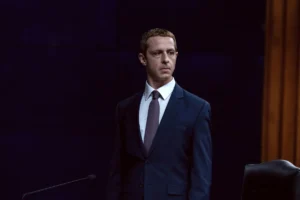
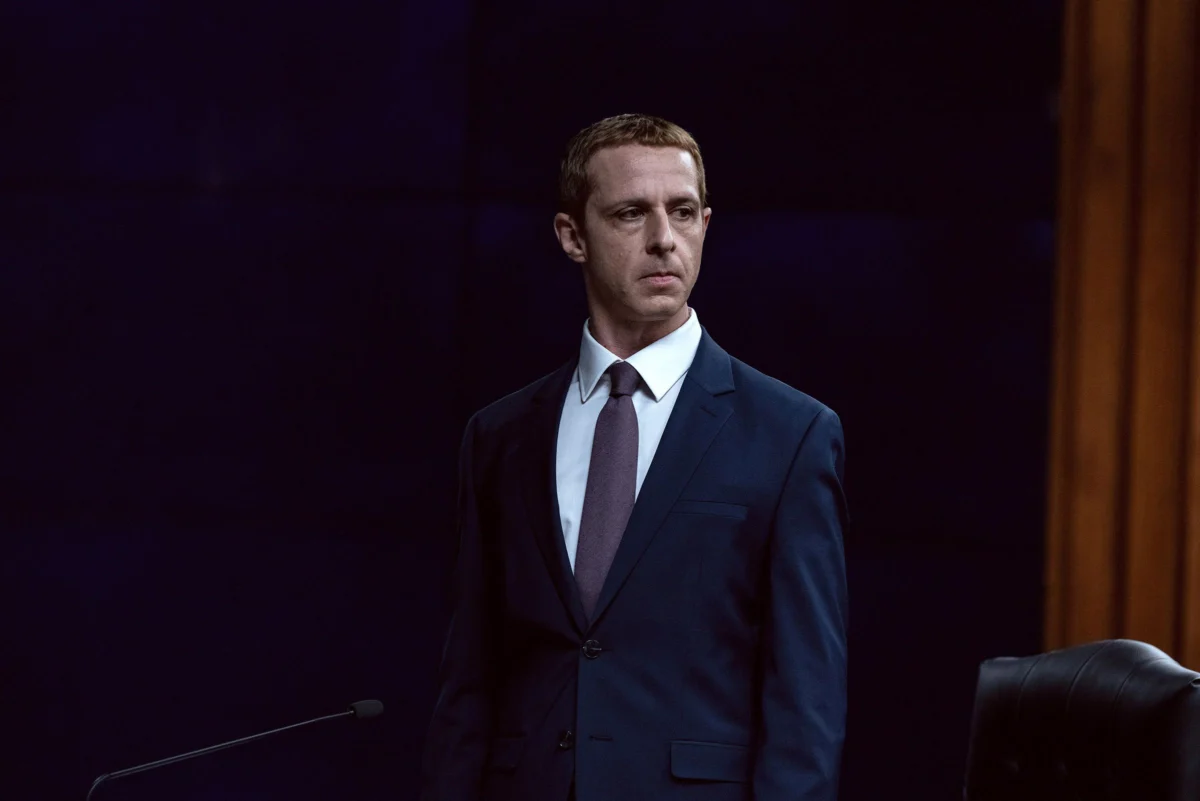
Interwoven with this investigative thread are flash-forwards to 2021, depicting Mark Zuckerberg—portrayed by Jeremy Strong—undergoing rigorous preparation for a high-stakes congressional hearing addressing social media misinformation. Within these strategy sessions, Zuckerberg is flanked by Raya, a crisis public relations strategist played by Wunmi Mosaku, and Charlie, a fictionalized composite ex-employee portrayed by Bill Burr. Charlie serves as an internal dissident granted sufficient operational autonomy to challenge Zuckerberg’s polished talking points and puncture corporate self-delusion.
Structural Evolution and Cinematic Context
Compared to the tightly wound cross-cutting depositions of The Social Network—which organically facilitated the recounting of Facebook’s early history without heavy-handed narrative exposition—The Social Reckoning employs a more fragmented framework. The film relies heavily on deliberate intertitles, such as explicitly labeling its introductory sequence as a "prologue," and visual temporal cues to navigate a complex timeline spanning multiple years. Despite these structural friction points, the production benefits significantly from sharp, kinetic performances and the signature cadence of Sorkinian dialogue, which frequently alternates between high-stakes policy debates and disarming non sequiturs.
The release of The Social Reckoning coincides with a broader cultural and cinematic reckoning concerning the technology sector. A wave of high-profile cinematic and documentary projects has emerged to scrutinize the architects of the modern digital landscape. Among them is Artificial, Luca Guadagnino’s satirical exploration of the abrupt ouster and subsequent reinstatement of OpenAI Chief Executive Officer Sam Altman in late 2023. Guadagnino’s project generated substantial industry buzz before Amazon MGM Studios relinquished distribution rights following a monumental $50 billion strategic partnership between Amazon and OpenAI. Concurrently, Alex Gibney’s expansive documentary Musk chronicles the trajectory of the world’s wealthiest individual, culminating in his controversial tenure within executive governance during subsequent political administrations. Additionally, directors Nathan Fielder and Lance Oppenheim secured intimate access to Theranos founder and convicted fraudster Elizabeth Holmes for You Can See Everything, capturing the final chapters of her journey prior to federal incarceration.
Within this crowded landscape of contemporary tech critiques, The Social Reckoning positions its narrative climax around the events of the January 6 Capitol riot. The film implicates Meta’s systemic failures—specifically its inability to effectively mitigate election conspiracy networks and its prolonged reluctance to restrict the account of Donald Trump—as contributing factors to the escalation of civil unrest. However, viewing these developments halfway through a subsequent political cycle raises legitimate questions regarding whether the complicity of tech oligarchs who openly financed political campaigns remains a revelation or represents an accepted baseline of modern governance.
The Economics of Engagement and Corporate Indifference
A central thematic engine of The Social Reckoning involves the agonizing philosophical debates surrounding truth verification, corporate accountability, and the erosion of traditional media institutions. The film frequently deploys sharp verbal exchanges designed to provoke audience engagement. In one notable sequence, Haugen accuses Horwitz of harboring professional resentment toward technology companies primarily due to the displacement of journalism jobs, to which Horwitz retorts that his critique stems simply from the industry’s catastrophic operational failures. In another confrontation, Zuckerberg taunts Charlie regarding his decision to liquidate his early Facebook equity stake for $200 million rather than holding out until its valuation reached $1.3 billion. Charlie fires back by rejecting the premise that financial restraint or moderation is a source of personal embarrassment.
This dialogue touches upon a deeper pathology within contemporary corporate leadership. Bill Burr’s portrayal of Charlie underscores a blistering critique of modern technology tycoons. In interviews surrounding the film’s release, Burr articulated a parallel between the behavior of contemporary billionaire entrepreneurs and chemical dependency. In his assessment, the relentless accumulation of wealth exhibited by modern tech figures mirrors the insatiable compulsion of a narcotics addict—an endless cycle where human collateral is disregarded in pursuit of the next operational high.
Yet, translating this critique into a cinematic narrative presents a persistent paradox: attempting to shame a corporate ruling class that has repeatedly demonstrated insulation from traditional reputational consequences. While the film effectively captures the immense personal courage required for a whistleblower to challenge a trillion-dollar enterprise, it simultaneously highlights the sobering limitations of such disclosures. Cast members Mikey Madison and Jeremy White noted that reading Sorkin’s screenplay provided an eye-opening confrontation with the empirical data governing algorithmic amplification. White emphasizes that users and regulators must abandon the habit of extending the benefit of the doubt to platform operators, pointing out that engagement-driven business models are executed with hyper-aware, deliberate intent rather than passive negligence.
Broader Implications and the Limits of Accountability
Despite its dramatic ambitions, the title The Social Reckoning arguably overpromises the extent of systemic transformation achieved in reality. The film’s concluding postscript reminds audiences that millions of citizens continue to rely on platforms like Facebook as primary news sources. Furthermore, the operational reality underscores the persistent resistance to structural oversight; Meta’s strategic decision to phase out traditional third-party fact-checking partnerships in favor of crowdsourced context notes illustrates the continuous recalibration of content governance rather than a fundamental retreat from engagement-driven architecture.
Ultimately, The Social Reckoning functions as a meticulous examination of institutional whistleblowing and the staggering inertia of Silicon Valley monopolies. While it delivers sharp performances, incisive dialogue, and an unflinching look at the human cost of algorithmic optimization, it concludes on a sobering, melancholic note. The overarching takeaway for viewers is not the triumphant dismantling of a predatory business model, but rather the stark realization that despite incontrovertible evidence, public outrage, and congressional scrutiny, the architects of the digital age continue to operate with near-total impunity.