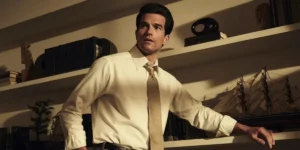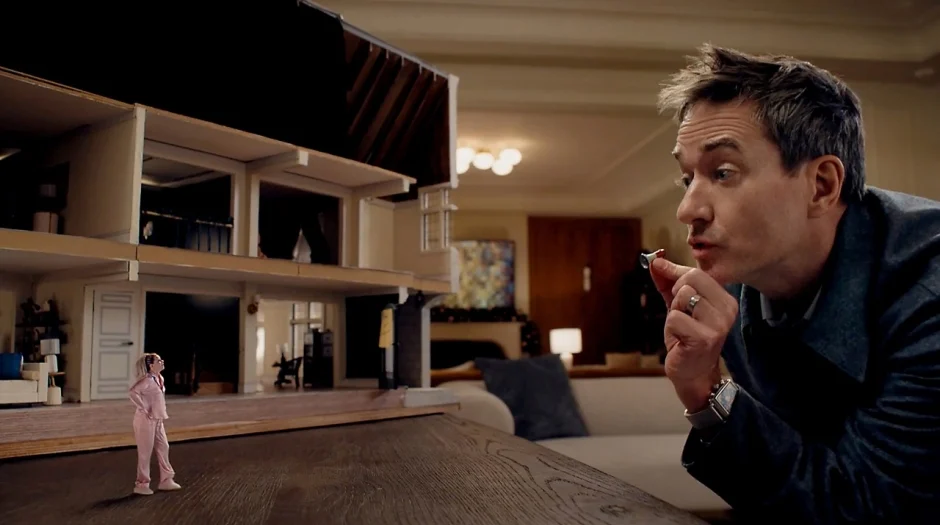
The Miniature Wife, a groundbreaking 10-episode dramedy that premiered on Peacock, offers a unique exploration of marital discord through a fantastical lens. The series, which stars Elizabeth Banks as Lindy Littlejohn and Matthew Macfadyen as her husband Les, centers on an experimental shrinking device that reduces Lindy to a mere six inches in height. This radical alteration in physical scale becomes a potent metaphor for the emotional and power dynamics within their marriage, leading to both profound comedic and dramatic consequences. Executive producer Michael Ellenberg, who previously produced the critically acclaimed Scenes from a Marriage, sees The Miniature Wife as a direct, albeit comically amplified, counterpart. "By design, we weren’t relying on visual effects moments," Ellenberg stated. "We wanted to find as many genuine, grounded moments as possible for Les and Lindy Littlejohn so you’re really in their situation, and it’s delivering maximally. The absurd situation is ultimately an expression of their emotional lives. Sometimes you are that mad or frustrated or feel that small.” The series, adapted from Manuel Gonzales’s short story, delves into how this technological accident forces Lindy and Les to confront the ultimate relationship crisis, fundamentally reshaping their marital balance.
A Bold Premise: The Science and Sentiment of Shrinking
The core concept of The Miniature Wife hinges on the literal miniaturization of one half of a married couple. This premise, while fantastical, is grounded in a deliberate effort to explore emotional truths. "Each project for Ellenberg has been a mix of the familiar and the new," the article notes. Ellenberg elaborated on the unique casting challenge: "I’ve never done a romantic comedy before, so having to cast both simultaneously to know that the show could work was the most unique aspect. It wasn’t enough that Liz and Matthew were each good on their own terms; they had to be good with each other. Fortunately, they responded to this material in the way that we hoped.”

The production faced significant hurdles in bringing this concept to life, particularly given the increasing constraints on television budgets and schedules. Treating a main character as a visual effect across an entire 10-episode series demanded meticulous planning and resource allocation. "You have to write all of the scripts in advance, be smart and intentional, and choose where you put your resources," Ellenberg explained. "If you want to have Lindy fight with a fly or blow up the lab, then you have to commit to those moments. The big gags we went all in on, but the show is not defined only by the big gags. It’s defined just as much by the wedding episode, their first moments falling in love, and their early moments as a couple, where the only visual effects are two wonderful actors.” The success of the series also depended heavily on the collaborative efforts of the creative team behind the camera. "This show can fall apart in every moment: production design, visual effects, and costumes. Each person has to be just so to get it right," Ellenberg added, commending executive producer Michael Aguilar for his role in orchestrating these key creative heads.
Deconstructing the Science: The Square-Cube Law and Narrative Metaphor
A crucial element in making the premise of The Miniature Wife feel plausible, within its fictional context, was the establishment of scientific underpinnings. Steve Turner, co-creator, showrunner, and executive producer, served as the scientific advisor. "Yeah, they picked the science guy who got a degree in film," Turner quipped, but emphasized his genuine understanding of physics. "But I will say that I know my fair bit of physics. The quantum physics that we used in the show is all based on reality. It’s true that we cannot miniaturize Elizabeth Banks to six inches tall yet. But the foundation for the math is all correct."

The scientific basis for the miniaturization in the show is rooted in the square-cube law, a fundamental principle in physics. Turner explained, "The square-cube law is a real paradigm in quantum physics about how something gets smaller and truly gets stronger.” This law dictates that as an object scales down, its surface area decreases by the square of the scaling factor, while its volume (and thus mass, assuming constant density) decreases by the cube. This disproportionate reduction in surface area relative to volume leads to increased relative strength.
This scientific principle was seamlessly woven into the narrative as a powerful metaphor. "That’s why an ant can pick up 50 times its weight," Turner continued. "The metaphor becomes real in our show. When Lindy becomes six inches tall, she finds her true strength and voice again. Metaphors are all over the place on the show!” This narrative choice allows the fantastical element of shrinking to serve as a catalyst for Lindy’s personal growth and empowerment.

The miniaturization opened up a wealth of narrative possibilities that would have been inaccessible without this central conceit. Co-creator and executive producer Jennifer Ames highlighted how the extreme situation served to reset the marital dynamic: "When you have characters like Les and Lindy, who are extremely competitive personalities, but whose relationship is foundationally built on genuine love, you need something extreme to reset the balance in that marriage. This has allowed us to use miniaturization as the big emotional reset that will hopefully bring them back together at the end." Ames also noted the creative freedom this allowed: "What we loved about the miniaturization is that we get to have all kinds of fun with the hijinks and the set pieces, which we like to call a heightened emotional expression of their love and/or anger.”
The writers’ room prioritized imaginative storytelling over immediate technical or financial feasibility. Ames elaborated on this approach: "We wrote down everything we thought would be fun, appropriate, grounded, but also absurd. Frankly, we were talking about this earlier, and I don’t think Ashley Bernes [visual effects supervisor] ever said, ‘No.’ Every time he and I would go into a production meeting, and it would be on the schedule for four hours, with everybody under the sun going, ‘How are we going to pull this episode off?’ we always expected him to say, ‘You have to go back to the drawing board. We can’t do this.’ It never happened. It was so great.” This indicates a remarkable level of innovation and problem-solving from the visual effects team, led by Bernes, who consistently found ways to realize the ambitious creative vision.

Navigating the Scale: Production Design and Visual Effects Challenges
The technical execution of portraying a six-inch-tall character within a full-sized world presented a significant undertaking. Visual effects supervisor Ashley Bernes acknowledged the paramount question that guided the production: "Is this going to work?” The breakthrough moment, according to Ames, came during a virtual chemistry read between Elizabeth Banks and Sofia Rosinsky, who plays their daughter, Lulu. "There is a scene where Lindy reveals to Lulu that she is six inches tall. Elizabeth so brilliantly made herself so small in the frame, Sofia so brilliantly made herself so big, and they performed the scene. It was emotional and funny. I got so excited that, when they were done, I ran out of the room and down the hall to Greg Mottola, one of the directors, and said, ‘Oh, my God, yes!’ Seeing it over Zoom and the shift of perspectives, I was like, ‘I don’t know how, but I know this will work.’ Then, of course, we had to actually do that. But I knew!” This initial spark of confidence, derived from the actors’ performances and the innovative use of perspective, proved critical in moving forward.
To facilitate the actors’ performances, the production team meticulously recreated the world from a miniature perspective. Turner explained, "Having Elizabeth be six inches tall is a big stretch. That’s a big swing for her to act and perform. We did everything we could, as far as props and sets, to make it as real as possible. There are few things that aren’t real, like the fly, but all of those other props were real.” This included the creation of a dollhouse that served as a detailed replica of the Littlejohns’ home, allowing Lindy to navigate her environment authentically. Another ingenious set piece was a Christmas diorama, designed as a hiding place for Lindy. "Lindy needed a place to hide, and we didn’t want her to be in the dollhouse," Turner recalled. "She needed to be somewhere else in the house. We were like, ‘Maybe there’s a Christmas diorama under the Christmas tree. That would be a nice place to hole up for a little while and hide from her husband.’ It seemed like a good idea at the time. It was a challenge, and our production designer, Maxwell Orgell, and his crew killed it.” The commitment to tangible, well-crafted sets, even for miniature environments, significantly contributed to the grounded feel of the fantastical premise.

Establishing the Visual Language: Scale, Perspective, and Execution
Defining the precise scale ratio for the miniaturization was an early and critical decision. Bernes detailed the process: "Are we 10 percent smaller? How miniature is miniature? Does everything play out in a wide shot? Are we with them? We established that our scale relationship was 12:1. We had to take a deep dive into the balance between wide shots and digital doubles. What is the camera language of the show? How much motion control are we going to be dealing with? How much movement do we think we have?” This 12:1 ratio became the foundational rule for translating the world from Lindy’s perspective.
The visual effects team, comprised of Mavericks VFX, Zoic Studios, Tippett Studio, Spin VFX, Mr. X, Pixomondo, and an in-house team, faced the monumental task of executing approximately 3,000 visual effects shots. Bernes described the logistical strain: "The single hardest thing on this project was the volume of shots. We were prepping, shooting, and posting all at the same time. With a 10-episode series, Episode 101 was well into post-production while we were still scouting the last two episodes. We were working on a visual effects schedule while shooting. This is today’s market. These are the conditions we are all in. But it was particularly difficult on this one.” This concurrent production schedule, common in the current television landscape, amplified the challenges of integrating complex visual effects seamlessly.

The visual language of the show was carefully constructed to maintain a sense of photographic realism. Bernes explained, "This show can’t be made without visual effects, but I wanted everything to be grounded in photography. We didn’t necessarily employ forced perspective, but if something needs to appear 12 times smaller, then we would move it 12 times farther away from the camera.” This meticulous approach involved precise calculations for camera placement and movement. "Something as trivial as the camera being four feet off the ground on a tripod, and us having somebody on the floor. Well, now the camera needs to be out of the roof of our sound stage because it’s 12 times taller in order to create the right perspective." This attention to detail ensured that even when characters were in miniature, their interactions with the environment felt consistent and believable.
The preparation for complex sequences was paramount, given the intricate coordination required. Bernes elaborated on the storyboard process: "Before the new directors and DP would arrive, I would make my own list from the scripts: ‘Here are the 10, 15, or 20 things that we need to storyboard’ so we could have practical conversations about what the production designer needed to construct and design. If we move the camera one foot in the big world, and then we need to do Lindy’s side of it, now the camera is moving 12 feet so those elements stay together in the same frame.” This foresight allowed departments to anticipate and plan for the cascading effects of camera movement on scale and perspective, impacting everything from set construction to camera rigging.

One of the most complex set pieces involved Lindy traveling on a toy train. Bernes described the elaborate setup: "The engine compartment Elizabeth was sitting on was 12 times larger than the toy. That buck was operated on a five-axis gimbal, so it could rock, tilt, vibrate, and shift forward and backward. The whole set piece was on a turntable so that we could minimize the distance that the camera had to move. All of this was tested over several weeks with stunts and stand-ins.” This multi-faceted approach, combining practical effects with sophisticated motion control, allowed for the seamless integration of Lindy’s performance with pre-shot background plates, ensuring a cohesive and immersive experience for the audience. The ability to live-composite elements on set also proved invaluable for the actors to visualize their surroundings and for the crew to verify scale and lighting integration.
Bending the Rules for Impact: Enhanced Realism and Character Expression
While the production adhered to strict rules of scale, there were instances where these were intentionally bent to enhance dramatic impact or character expression. Bernes explained, "You have to elevate things and make them feel slightly more perilous. You have to change the rules a little bit here and there." A prime example of this was the depiction of a housefly. When viewed at the established 12:1 scale, the fly did not convey the intended level of menace. "We wanted it to be bigger, to show more character in its face, and to give it emotion. We wanted to take it from something relatively inanimate to something that could convey menace, frustration at not being able to capture Lindy, or peril when she was fighting it. The housefly did end up being a little larger than reality.” This creative decision underscored the show’s commitment to using its visual effects not just for spectacle, but to amplify the emotional stakes of Lindy’s experiences.

The depiction of the housefly was a testament to the blend of scientific accuracy and artistic license. "In the more gruesome flight sequence, we still wanted to ground it in a light-hearted tone," Bernes noted. "At times, you might notice the housefly almost as if an eyebrow is raising, or its mandibles moving in a slightly anthropomorphized way. We did take some liberties. But the anatomy, the iridescence of the body, and the way the wings operate—Tippett Studio put this together and rigged it as a correct housefly. It’s a healthy mix of reality and unreality.” This nuanced approach ensured that while the fly might have been given anthropomorphic qualities for emotional resonance, its fundamental design remained rooted in biological reality.
Beyond the insectile antagonist, the series continued to push creative boundaries with other visual effects. "Other major moments include a playful miniature cat and exploding buildings," Bernes shared. "The momentum builds in the show, and we get to see so many crazy scenarios and exciting surprises. There’s a lot still to come, and I can’t wait for people to see it.” These diverse visual elements contribute to the show’s dynamic pacing and offer a constant stream of inventive scenarios that leverage Lindy’s unique predicament. The series promises a compelling narrative arc that fully utilizes its high-concept premise to deliver both emotional depth and thrilling visual storytelling.