


Set against the humid, tension-filled landscape of Okinawa in the early 2010s, director Xavier Tera’s debut feature, The Color of the Sun, offers a poignant examination of the friction between local Japanese tradition and the enduring presence of the United States military. The narrative follows Kamei, a teenager navigating the grief of his father’s death and the claustrophobic expectations of his family, as his life is irrevocably altered by an encounter with Colin, a young American living on the local base. Through their burgeoning relationship, the film dissects themes of belonging, sexual awakening, and the psychological weight of living under the constant, sonic reminder of geopolitical dominance.
The Historical Context of the Ryukyu Islands
To understand the gravity of the setting, one must examine the status of the Okinawa prefecture. Following the devastating Battle of Okinawa in 1945—a pivotal conflict during the Pacific War—the United States assumed administrative control of the Ryukyu Islands. While the islands were formally returned to Japanese sovereignty in 1972, the transition did not result in a total military withdrawal.
According to data from the Okinawa Prefectural Government, approximately 70% of the land occupied by U.S. military bases in Japan is concentrated in Okinawa, despite the prefecture accounting for only about 0.6% of Japan’s total land area. This concentration has created a permanent, often contentious, coexistence between local residents and the American military personnel stationed at facilities such as Kadena Air Base and Marine Corps Air Station Futenma. The "roar" of the base—the constant, low-frequency hum of helicopters and the piercing sound of fighter jets—serves as the film’s auditory backdrop, representing an external authority that dictates the rhythm of daily life for the inhabitants.
Chronology of Tensions and Modern Friction
The early 2010s, the period in which the film is set, was a particularly volatile time for Okinawan-U.S. relations. The decade began with heightened protests against the planned relocation of the Futenma base to the Henoko coastal area, an environmental and political flashpoint that remains a central grievance for the local populace.
In 2012, a high-profile incident involving the deployment of MV-22 Osprey tiltrotor aircraft to the Futenma base sparked massive public demonstrations. Okinawan residents expressed deep concerns regarding the safety of the aircraft, citing their history of accidents and the noise pollution they introduced to densely populated residential areas. This era of local activism, marked by a growing sense of disenfranchisement, provides the ideological framework for the film’s portrayal of Kamei’s internal struggle. The narrative utilizes this historical backdrop not merely as scenery, but as a catalyst for the characters’ personal conflicts. As the community rallies against perceived injustices—specifically regarding the legal immunity often afforded to soldiers accused of misconduct—Kamei finds himself caught between the prejudices of his elders and his own curiosity toward the "other."
Cinematic Technique and Narrative Analysis
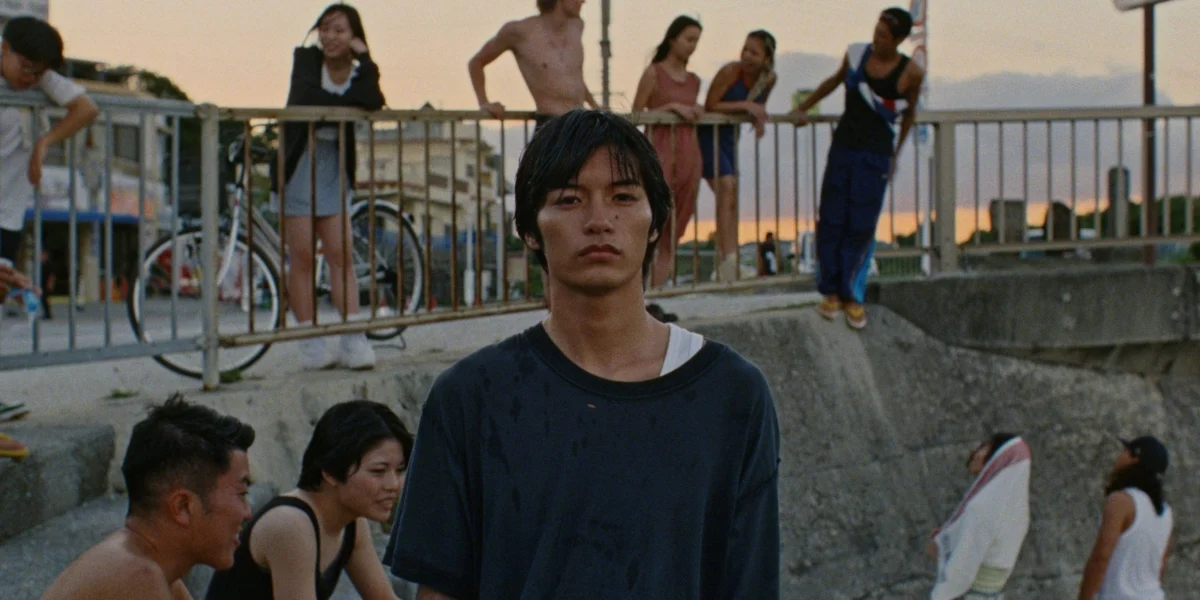
The film’s visual language, orchestrated by director Xavier Tera and cinematographer Sayombhu Mukdeeprom, utilizes the rule of thirds to mirror the protagonist’s psychological state. During the first act, Kamei is frequently framed in isolation, physically separated from his peers by the composition of the shot. This technique serves as a visual metaphor for his alienation, both from his family and from the broader social fabric of an island that feels like a prison to him.
As the narrative progresses and Kamei encounters Colin, the cinematography undergoes a transition. The frames become more fluid and inclusive, signifying a shift in Kamei’s perspective. Tera’s directorial choice to favor long, sustained takes over rapid-fire exposition allows the actors to convey the complexities of desire and hesitation through non-verbal cues. The film’s handling of the relationship between Kamei and Colin avoids the trap of romanticizing their bond; instead, it acknowledges the power imbalance inherent in their respective social positions. Their interactions are framed by the reality of their backgrounds—Kamei as the native son of an occupied territory, and Colin as the representative of the occupying force.
Sociopolitical Implications and Public Reaction
The portrayal of the U.S.-Okinawa relationship in The Color of the Sun mirrors broader debates regarding the "Status of Forces Agreement" (SOFA). Under this agreement, U.S. service members accused of crimes in Japan are often handled through American military justice systems, a practice that has historically led to claims of impunity by local victims’ rights groups.
While the film remains a work of fiction, its themes resonate with the real-world experiences of the Okinawan people. Scholars and observers of the region have noted that the intergenerational trauma resulting from the wartime occupation, combined with the ongoing presence of foreign military bases, creates a unique social psyche. For many young Okinawans, the desire to escape the islands for the Japanese mainland or international destinations is a common response to the perceived stagnation of their home. Tera captures this restlessness, framing it as a search for identity in a place where the borders are literally and figuratively dictated by foreign policy.
Critics and cultural analysts have noted that the film’s strength lies in its refusal to offer simplistic solutions to the friction it presents. Instead, it invites the audience to consider the human cost of geopolitics. By focusing on the intimate, often awkward, and ultimately transformative connection between two teenagers, the film highlights how empathy can serve as an act of resistance against systemic prejudices.
Critical Reception and Production Details
With a runtime of 110 minutes, The Color of the Sun is a deliberate, meditative experience. The cast, including Naoto Shimajiri and West Mulholland, delivers nuanced performances that anchor the film’s philosophical questions in tangible, relatable human behavior. The decision to set the film during the cusp of the social media age—using outdated interfaces and early digital aesthetics—serves as a reminder of a time when the world was becoming smaller, yet the barriers between cultures remained stubbornly intact.
Industry analysts have praised the film for its sensitive approach to "othering." By humanizing the American soldier through the character of Colin—who is presented not as a political archetype but as a flawed, spontaneous teenager—Tera avoids the pitfalls of nationalist propaganda. This allows the film to function as a universal commentary on the nature of "the enemy," suggesting that fear is often a product of proximity and lack of understanding rather than inherent malice.
Conclusion
The Color of the Sun concludes not with a resolution of the geopolitical crisis, but with an evolution of the characters’ internal landscapes. As Kamei and his peers navigate the transition into adulthood, the film posits that self-acceptance is the only true form of liberation from the burdens of history.
In the broader context of contemporary cinema, Xavier Tera’s work stands as a significant contribution to the coming-of-age genre. It successfully integrates historical research with a deeply personal narrative, providing a lens through which to view the enduring impact of the post-WWII order. By centering on the voices of the marginalized—those living in the shadow of global power structures—The Color of the Sun serves as both a historical document and a timeless exploration of what it means to belong in a world that is constantly shifting beneath one’s feet. As the film concludes, the viewer is left with the impression that while the roar of the helicopters may never truly vanish, the capacity for connection, understanding, and personal growth remains the most powerful tool for navigating the complexities of the modern world.