

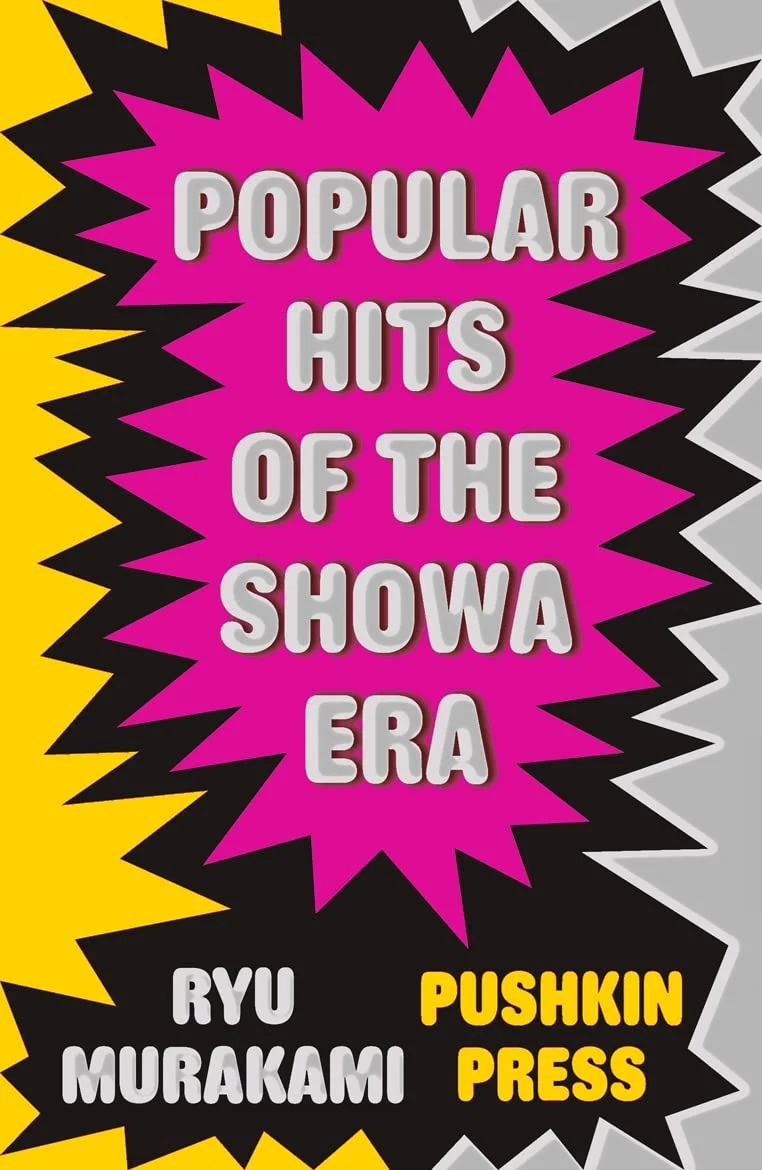
Ryu Murakami’s 1994 novel, Popular Hits of the Showa Era, originally serialized in “Weekly Playboy” before its publication by Shueisha, presents a starkly different facet of the acclaimed author’s literary output. This work, translated into English by Ralph McCarthy and published by W. W. Norton in 2011, with a subsequent edition by Pushkin Press in 2013, emerged in the same year as Murakami’s critically recognized Piercing. Unlike the visceral psychological horror of Piercing, Popular Hits of the Showa Era delves into an increasingly absurd, yet brutally violent, conflict between two disparate groups of social outsiders. The narrative masterfully blends black humor, extreme violence, a peculiar brand of nostalgia, and incisive social satire, positioning it stylistically closer to Murakami’s earlier work, Sixty Nine, albeit with a significantly more pronounced and unsparing layer of graphic violence, often referred to as “splatter.”
Genesis and Publication History
The journey of Popular Hits of the Showa Era from its initial serialization to its international recognition is a testament to Murakami’s enduring appeal and the growing global interest in contemporary Japanese literature. The novel first captured the attention of readers through the pages of “Weekly Playboy,” a popular Japanese men’s magazine known for its diverse content, ranging from entertainment news to serialized fiction. This choice of venue for its debut suggests an intention to reach a broad audience, potentially one seeking entertainment that pushed conventional boundaries. The subsequent publication by Shueisha in 1994 solidified its status as a standalone literary work.
The English-speaking world was introduced to this unique narrative through Ralph McCarthy’s translation, published by W. W. Norton in 2011. This marked a significant step in making Murakami’s more niche or genre-bending works accessible to a wider international readership. The subsequent release by Pushkin Press in 2013 further cemented its availability and reach, allowing a new generation of readers to engage with Murakami’s distinctive voice and thematic explorations. The year 1994, when the novel was first released in Japan, was a pivotal one for Murakami, also seeing the publication of Piercing, a work that garnered significant critical acclaim for its chilling psychological depth and unsettling exploration of desire and violence. The juxtaposition of these two novels, released in the same year, highlights Murakami’s remarkable versatility and his capacity to navigate diverse literary landscapes.
Thematic Underpinnings: Alienation and Absurdity
At its core, Popular Hits of the Showa Era is a searing commentary on societal alienation and the desperate search for identity and connection in a world that often leaves individuals feeling adrift. The novel’s central conflict is ignited by the collision of two profoundly disconnected groups: a cohort of six aimless young men, and a society of six divorced women who have banded together under the banner of the "Midori Society."
The young men, including characters such as Ishihara, Nobue, and Sugioka, are depicted as lacking common interests and struggling with meaningful communication. Their interactions are characterized by unpredictable bursts of laughter and peculiar, almost involuntary, physical movements. Despite their apparent disconnect, they find solace and a semblance of community in late-night gatherings, elaborate costumes, and the shared ritual of singing popular songs from the Showa era (1926-1989). This nostalgic engagement with the past serves as a fragile anchor in their otherwise disoriented present.
Similarly, the six women of the Midori Society, all sharing the name Midori, are united not by genuine intimacy but by a pervasive sense of loneliness, the monotony of routine, and their shared status as social pariahs. Their existence outside the conventional social mainstream forms the bedrock of their connection, a bond forged in shared isolation rather than mutual understanding or affection. This shared sense of being on the periphery of society becomes the unlikely crucible for the escalating violence that defines the novel.
The Spark of Conflict and Escalating Retribution
The narrative’s trajectory into extreme violence is initiated by a sudden, brutal act. Sugioka, one of the young men, impulsively murders Yanagimoto Midori, a member of the Midori Society, on a public street with shocking savagery. His subsequent detailed narration of the act to his comrades instantly elevates him to the status of a hero within their group, highlighting their distorted values and their thirst for a form of recognition, however macabre.
This brutal act triggers a cycle of retaliatory violence. The surviving members of the Midori Society, identifying Sugioka as the perpetrator, exact their revenge by killing him. The news of Sugioka’s demise reaches Ishihara, who then informs the remaining young men. Fueled by a desire for vengeance, they procure a Tokarev pistol from a clandestine hardware dealer, setting the stage for their own counter-retaliation. What begins as a localized act of brutality rapidly escalates, transforming from a knife attack into a full-blown guerrilla warfare, complete with shootings, the deployment of rocket launchers, and ultimately, destruction on a scale that mirrors actual warfare. This rapid escalation underscores the theme of unchecked violence and the destructive potential of unaddressed societal grievances.
The Ironic Juxtaposition: Nostalgia and Annihilation
A particularly striking element of Popular Hits of the Showa Era is the profound and often jarring contrast between its title and its content. The title evokes a sense of warm nostalgia, a gentle celebration of vintage Japanese music and cultural heritage. Indeed, each chapter of the novel is structured around a popular song from the Showa era, intended to provide a thematic framework. However, these familiar melodies serve as a strangely sentimental backdrop to a blood-soaked confrontation between socially alienated men and embittered middle-aged women. The nostalgic music, meant to evoke comfort and shared history, instead underscores the bleakness and brutality of the characters’ lives, creating a disquieting dissonance that amplifies the novel’s dark humor.
The songs, beyond providing chapter titles, represent one of the few tenuous connections the characters have to a shared cultural landscape. The young men, struggling to forge genuine interpersonal connections, invest an immense amount of energy into karaoke. Music, in this context, becomes a vehicle for temporary community, a means of creating a sense of belonging, even if that belonging is founded on imitation, elaborate costumes, and a shared performance of absurdity. This reliance on external cultural artifacts for identity and connection speaks volumes about the characters’ internal void.
A Mirror to an Isolated Society
Murakami utilizes the escalating feud as a potent metaphor for the absence of imagination and empathy within contemporary society. Neither group makes any genuine attempt to understand the motivations, fears, or desires of the other. Every action is interpreted as a personal insult, demanding an escalation of violence as the only conceivable response. This relentless cycle of retaliation transforms a personal dispute into an exaggerated, almost grotesque, reflection of an increasingly isolated and fragmented society, where understanding and compassion are scarce commodities.
Ironically, the pervasive violence, despite its destructive nature, provides both groups with something they desperately lacked: a sense of purpose and identity. The young men, previously aimless, begin to collaborate, developing military strategies and a shared objective. The Midori Society, similarly fractured by their individual struggles, finds discipline and unity in their collective quest for revenge. Murder and mayhem, in this dark comedic portrayal, become the catalysts that transform individuals drifting through life into members of functioning, albeit violent, communities. The profound irony lies in the fact that ordinary social interaction failed to provide them with this sense of belonging, while extreme violence paradoxically succeeded. Furthermore, the novel subtly highlights that it is only through the shared experience of violence that members of both groups begin to truly perceive and understand one another, adding another layer to Murakami’s biting social commentary.
Murakami’s Stylistic Prowess: Rhythm and Tone
Murakami’s distinctive writing style plays a crucial role in enhancing the novel’s unique blend of comedy and brutality. His prose is often characterized by lengthy sentences that can span significant portions of a paragraph, creating a dense, almost overwhelming, initial impression. However, this deliberate stylistic choice gradually establishes a unique rhythm, a cadence that propels the reader through the escalating chaos of the narrative. Once this narrative tempo takes hold, the story, despite its extreme subject matter, becomes surprisingly accessible.
However, this rhythmic flow is not consistently maintained. The review notes that after the initial wave of retaliation, the pacing falters, and the narrative can feel as though it is lagging. This dip in momentum, though present, is ultimately redeemed by a compelling and impactful ending. The narration itself employs a detached, matter-of-fact tone when describing grotesque and violent events. Murakami frequently presents the most deranged occurrences with the same quiet objectivity one might use to describe an ordinary daily routine. This stark contrast between the dispassionate tone and the extreme nature of the actions generates a significant portion of the novel’s dark humor. The characters themselves rarely acknowledge the absurdity of their behavior, even as their dispute morphs into something resembling a full-scale military campaign.
Caricature, Chaos, and Fleeting Fragility
The narrative occasionally leans more heavily on emotional drivers and narrative convenience rather than strict logical progression, and many characters function as deliberate caricatures. However, this exaggeration is entirely in keeping with the novel’s overarching satirical approach. Popular Hits of the Showa Era is not an attempt at a realistic depiction of a criminal conflict; instead, it systematically expands its absurd central premise until the very fabric of social order appears to be consumed by it.
Despite the pervasive violence and dark humor, brief moments of sadness and vulnerability interspersed between the violent encounters prevent the book from devolving into a mere collection of elaborate killings. Similar to themes explored in Murakami’s earlier novel, Coin Locker Babies, moments of destruction occasionally reveal a fragile humanity beneath the characters’ hardened exteriors and relentless hostility. However, the critique also acknowledges that Popular Hits of the Showa Era operates on a somewhat lower level of intricacy when compared to Murakami’s more lauded works, a point that becomes evident as the narrative unfolds.
Conclusion: An Outrageous Fusion of Entertainment and Satire
In essence, Popular Hits of the Showa Era stands as an outrageous fusion of nostalgic music, simmering gender conflict, profound alienation, and escalating violence. The novel’s premise is intentionally ludicrous, yet its execution is remarkably controlled and deliberate. Murakami masterfully transforms a seemingly senseless feud into a vivid black comedy, offering a stark portrayal of individuals who find their only sense of companionship, motivation, and identity in the act of destroying one another. While it may not reach the thematic or structural complexity of his most celebrated works, the book undeniably delivers entertainment. Its humor, though occasionally dated in its cultural references, is undeniably effective in its delivery. Murakami’s primary aim with this novel appears to have been pure entertainment, a goal he unequivocally achieves through his signature blend of the absurd, the violent, and the darkly humorous. The book serves as a potent, if unsettling, reminder of the extreme measures individuals may take to forge connection and find meaning in a world that often feels indifferent.