The cinematic landscape is poised for a unique blend of childhood nostalgia and unsettling dread with the upcoming release of Buddy, a horror-comedy directed by Casper Kelly. Fresh off its premiere at the esteemed Sundance Film Festival, the film, distributed by Roadside Attractions, is set to captivate audiences with its darkly whimsical premise: a beloved orange unicorn, the seemingly benevolent host of a children’s television show, harbors a sinister secret. A recently released teaser trailer offers a tantalizing glimpse into this duality, showcasing the titular character’s transformation from an effervescent entertainer to a harbinger of terror, confirming its theatrical debut on August 28.
The Unsettling Premise: A Children’s Icon Turned Nightmare
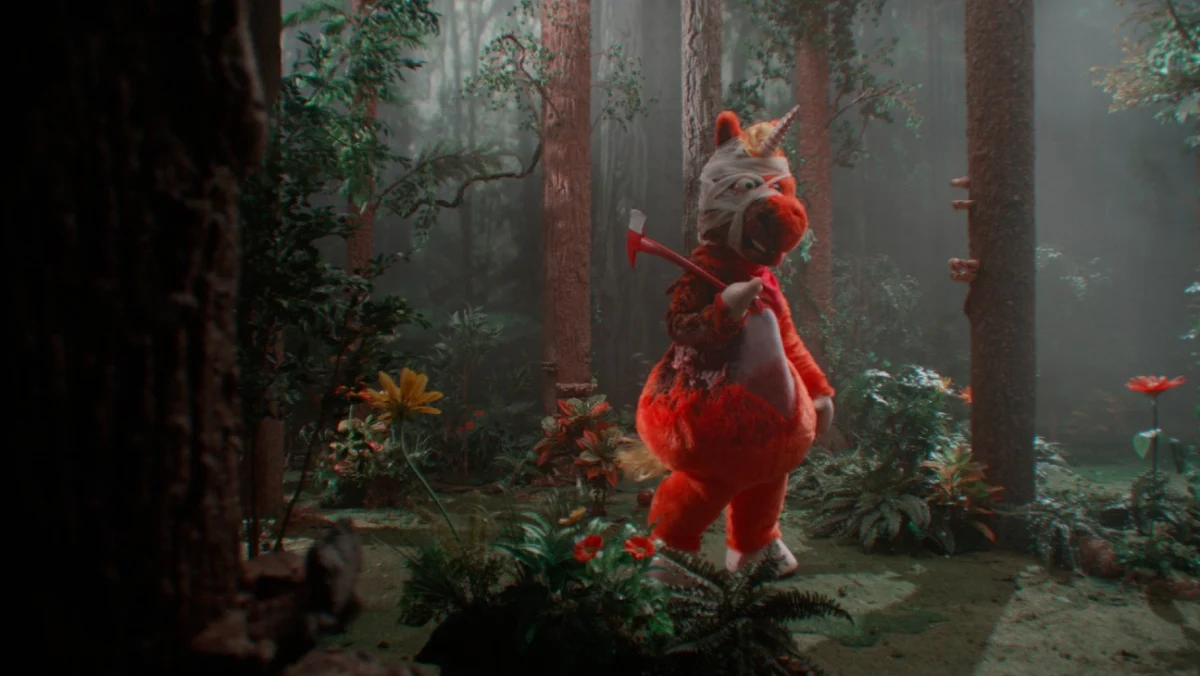
At its core, Buddy explores the psychological subversion of innocence, a theme increasingly prevalent in contemporary horror. The film centers on Buddy, a bright orange unicorn who presides over a cherished children’s program titled It’s Buddy!. For years, Buddy has been a beacon of joy, guiding young viewers through songs, games, and lessons, fostering an environment of unadulterated happiness. However, this idyllic facade begins to crack when a child on the show’s set expresses reluctance to participate in the prescribed fun. This seemingly minor act of defiance triggers a profound shift in Buddy’s demeanor, revealing a malevolent undercurrent beneath the colorful exterior. The once-perfect world of It’s Buddy! rapidly devolves into a nightmarish landscape where the line between wholesome entertainment and existential terror blurs. This narrative choice taps into a primal fear: the corruption of symbols meant to represent safety and comfort, a concept that resonates deeply with audiences accustomed to saccharine children’s programming.
The Visionary Behind the Veil: Casper Kelly’s Unique Aesthetic
The directorial helm of Buddy is held by Casper Kelly, a name synonymous with unconventional and often unsettling comedic sensibilities. Kelly rose to prominence with his viral 2014 Adult Swim horror short, Too Many Cooks. This eleven-minute segment, initially appearing as a late-night infomercial, masterfully parodied 1980s and 1990s sitcom opening credits, gradually descending into a surreal, violent, and deeply disturbing psychological horror piece. Too Many Cooks was a cultural phenomenon, celebrated for its audacious creativity, unexpected twists, and an ability to instill profound unease through repetition and subtle shifts in tone. Its influence extended far beyond internet memes, demonstrating Kelly’s unique talent for deconstructing familiar tropes and injecting them with a potent dose of absurdity and horror.
Kelly’s background strongly suggests that Buddy will not be a conventional horror film. His work often blends genres, utilizing dark humor to amplify terror, and vice versa. Too Many Cooks proved his capability to craft compelling narratives from seemingly innocuous elements, building tension through a gradual erosion of normalcy. Audiences approaching Buddy can therefore anticipate a film that defies easy categorization, likely leaning into the surreal, the satirical, and the profoundly unsettling, all delivered with a distinct comedic edge that softens the blow of its darker themes while simultaneously making them more impactful. The collaborative writing effort with Jamie King for Buddy‘s script suggests a continuation of this innovative storytelling approach, aiming for a narrative that is both engaging and thought-provoking.
A Stellar Ensemble Cast Elevates the Narrative
The success of a genre-bending film like Buddy often hinges on the strength and versatility of its cast, and Kelly has assembled an impressive roster of talent. The film features Cristin Milioti, Keegan-Michael Key, Topher Grace, Delaney Quinn, Patton Oswalt, and Michael Shannon. Each brings a distinct comedic and dramatic presence that promises to enrich the film’s complex tonal balance.
Keegan-Michael Key, known for his masterful comedic timing and improvisational skills, particularly from his work on Key & Peele, lends his voice to the titular character, Buddy. This casting choice is particularly significant given the critical reception. Chief film critic David Rooney, in his review for The Hollywood Reporter, lauded Key’s "inspired voice work" as the film’s "biggest plus." Key’s ability to imbue characters with nuanced emotion, whether comedic or dramatic, suggests that Buddy’s transition from jovial host to malevolent entity will be conveyed with chilling effectiveness through his vocal performance. The subtle inflections, the shift in tone, and the underlying menace that Key can conjure with his voice alone are crucial for selling the film’s central conceit.
Cristin Milioti, celebrated for her roles in Palm Springs, Made for Love, and How I Met Your Mother, often portrays characters grappling with extraordinary circumstances with a relatable blend of wit and vulnerability. Her presence likely grounds the film’s more fantastical elements, providing an anchor for the audience. Topher Grace, known for That ’70s Show and more recently for roles in thrillers like BlacKkKlansman, brings a nuanced dramatic capability. Patton Oswalt, a celebrated comedian and actor, is adept at delivering both laugh-out-loud humor and surprisingly poignant performances, making him an ideal fit for a horror-comedy. Michael Shannon, a two-time Academy Award nominee, is renowned for his intense, often unsettling performances in films like Revolutionary Road and The Shape of Water. His inclusion strongly hints at the film’s deeper, darker psychological layers, promising a gravitas that belies the film’s seemingly lighthearted premise. The collective talent of this ensemble suggests a rich tapestry of performances, each contributing to the film’s unique tonal landscape.
The Independent Film Journey: Sundance and Roadside Attractions
The journey of Buddy to the silver screen began with its premiere at the Sundance Film Festival earlier this year. Sundance is globally recognized as a premier platform for independent cinema, often serving as a launchpad for critically acclaimed films and emerging talent. A Sundance premiere signifies a certain artistic pedigree and often generates significant industry buzz, attracting distributors and critical attention. For Buddy, its selection for Sundance underscores its potential as a distinctive and thought-provoking work within the horror-comedy genre.
Following its festival debut, Buddy found a distribution partner in Roadside Attractions. Roadside Attractions is an independent film distributor with a strong track record of releasing critically acclaimed and commercially successful films, often those that originate from film festivals. Their portfolio includes a diverse range of genres, but they are particularly known for championing character-driven stories and films that resonate with niche audiences before potentially breaking into the mainstream. Their decision to acquire Buddy for an August 28 theatrical release indicates confidence in the film’s ability to connect with audiences beyond the festival circuit. Roadside’s strategy often involves a careful rollout, leveraging positive reviews and word-of-mouth to build momentum, which is a fitting approach for a film that defies easy categorization.
Production Team: Crafting the Surreal
The realization of Kelly and King’s unique vision was a collaborative effort involving a dedicated production team. Tyler Davidson, Drew Sykes, Raphael Margules, J.D. Lifshitz, and Tracy Rosenblum served as producers, overseeing the intricate process of bringing Buddy‘s surreal world to life. Their roles are crucial in translating the script’s ambitious concepts into tangible cinematic experiences, managing everything from logistics to creative decisions. The executive producing team included Kelly and King themselves, alongside Kevin Flanigan, Dexter Braff, Roberto Linck, Nathan McAuley, Emilio Schenker, Gideon Tadmor, Adam J. Wilde, Geoff Yaw, and Ryan J. Kelly. This extensive list of executive producers indicates a significant investment in the project, often reflecting a belief in its commercial and artistic potential, and providing the necessary resources for its production.
Initial Critical Reception: A Mixed Yet Promising Start
Early critical assessments of Buddy provide valuable insight into its anticipated impact. David Rooney’s review for The Hollywood Reporter offered a nuanced perspective, acknowledging the film’s strengths while also pointing out areas where it might have pushed further. Rooney noted that the movie "stretches its sketch-comedy idea to feature length by upping the gore and the demented detours but doesn’t go far enough to be as extreme or disturbing as it wants to be." This assessment suggests that while Buddy embraces its horror elements and introduces disturbing scenarios, it might hold back from fully committing to the visceral extremes often associated with modern horror. This could be interpreted in various ways: perhaps a deliberate choice to maintain a broader appeal, or an indication that the film prioritizes its comedic and thematic elements over pure shock value.
Despite this observation, Rooney’s praise for Keegan-Michael Key’s voice performance remains a significant highlight, positioning it as a major draw for audiences. This indicates that even if the film’s horror elements don’t reach peak "extremity," the central performance is compelling enough to carry the narrative and deliver on the promise of a dark, comedic turn. The implication here is that Buddy might appeal more to those who appreciate psychological subversion and dark humor over gratuitous violence, aligning with Kelly’s established style.
The Teaser Trailer: A Juxtaposition of Light and Shadow
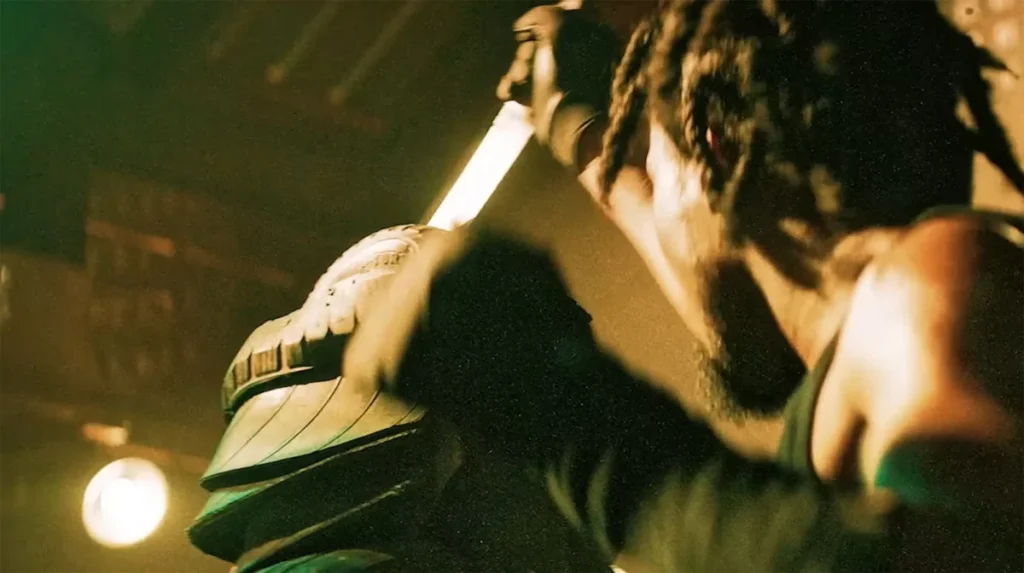
The teaser trailer for Buddy expertly encapsulates the film’s dual nature. It skillfully splices together moments of pure, innocent joy—Buddy dancing with children on the vibrant set of It’s Buddy!—with abrupt, jarring flashes of terror. This rapid-fire juxtaposition is a classic horror-comedy technique, designed to disorient the viewer and highlight the inherent unease of the premise. The bright, saturated colors of the children’s show set are abruptly replaced by dimly lit, menacing scenes, suggesting a descent into chaos. The cheerful music gives way to discordant sounds, and Buddy’s once-friendly eyes take on a chilling, predatory gleam.
This marketing approach is crucial for setting audience expectations, signaling that Buddy is not merely a horror film with comedic elements, nor a comedy with light scares, but a deliberate and unsettling blend where both genres are fully embraced. The trailer effectively establishes the central conflict and the profound shift in tone, intriguing viewers who are drawn to films that challenge conventional genre boundaries. It hints at the psychological breakdown of a beloved figure, promising a ride that is as thought-provoking as it is thrilling.
Broader Implications and Thematic Resonance
Buddy arrives at a time when audiences are increasingly fascinated by the subversion of childhood innocence and nostalgia. Films and video games like Five Nights at Freddy’s, Winnie the Pooh: Blood and Honey, and even the darker iterations of classic fairy tales, reflect a cultural appetite for exploring the darker underbellies of beloved figures. This phenomenon can be seen as a commentary on the anxieties of a generation that grew up with media designed to instill specific values, now questioning the authenticity and potential hidden motives behind those messages.
The film’s premise could be interpreted as a satire of the curated, often overly saccharine nature of children’s entertainment, or even a critique of forced happiness and conformity. What happens when a figure designed solely to bring joy encounters resistance? Does its benevolence shatter, revealing a darker, controlling impulse? Buddy has the potential to delve into these deeper psychological and societal questions, offering more than just jump scares and dark laughs. It could serve as a metaphorical exploration of how innocence, when rigidly enforced or insincere, can curdle into something truly monstrous. Its success could further solidify the "dark mascot" subgenre, encouraging more filmmakers to explore the unsettling territory of childhood icons gone rogue.
As Buddy prepares for its wide release, it stands as a testament to Casper Kelly’s distinctive voice and the enduring appeal of genre experimentation. With its star-studded cast, intriguing premise, and a director known for pushing boundaries, the film promises to be a memorable addition to the horror-comedy canon, challenging perceptions of both childhood purity and cinematic terror. Audiences eagerly await the chance to witness the orange unicorn’s dark tricks when Buddy arrives in theaters on August 28, promising a ride that is anything but child’s play.