


A new, comprehensive four-minute featurette titled "Completely in IMAX" has been released, offering an unprecedented look into the production of Christopher Nolan’s highly anticipated film, The Odyssey. This promotional deep dive confirms a cinematic milestone: The Odyssey is the first-ever feature film to be shot entirely using IMAX cameras. The featurette, available on YouTube, details the revolutionary technical advancements and artistic ambitions behind this monumental undertaking, further escalating anticipation for its worldwide release on July 17th, 2026. This development marks a significant moment in the evolution of large-format filmmaking, pushing the boundaries of immersive storytelling.
The Vision Realized: A Full IMAX Experience
For years, director Christopher Nolan has been a fervent advocate for the IMAX format, consistently integrating its expansive canvases into his critically acclaimed works. From the urban sprawl of Gotham in The Dark Knight to the cosmic vistas of Interstellar and the historical gravitas of Dunkirk and Oppenheimer, Nolan has utilized IMAX to deliver unparalleled visual grandeur and immersion. The sentiment, "A long-held dream to do an entire film on IMAX," articulated by Nolan himself, now finds its ultimate realization with The Odyssey. This project represents the culmination of a decade-long push by the filmmaker to fully embrace the format’s potential, moving beyond select sequences to an all-encompassing visual strategy.
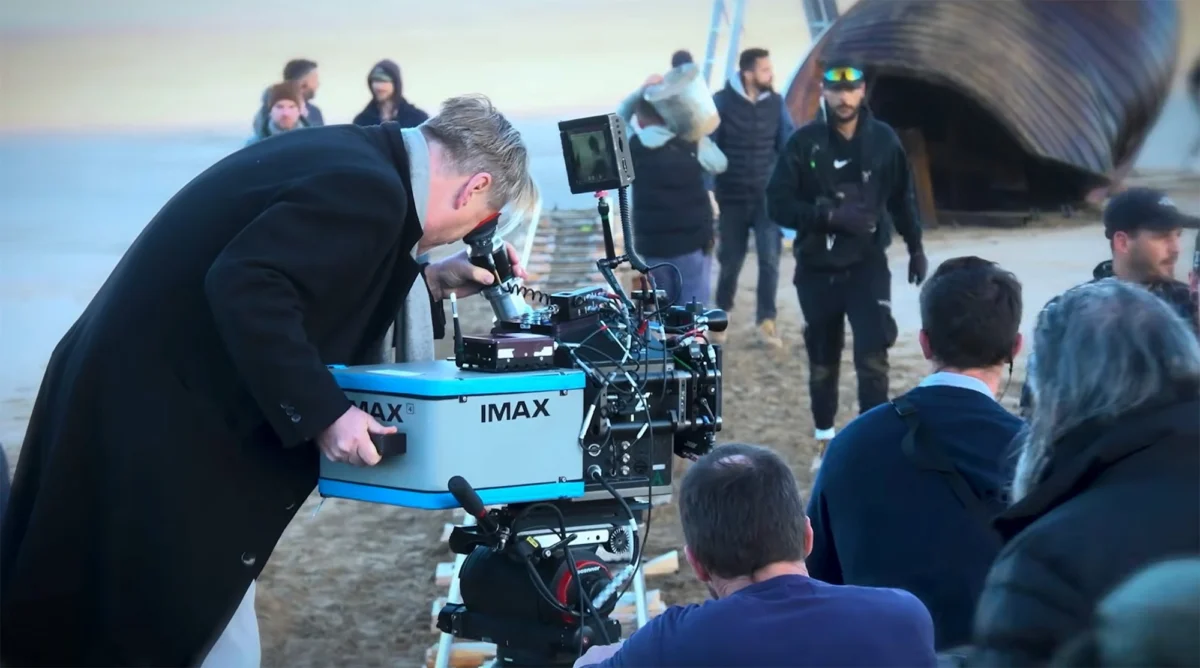
The featurette highlights the immense technical challenges and subsequent innovations required to achieve this feat. IMAX cameras, renowned for their unparalleled resolution and large film negative, are also notoriously bulky and loud, posing significant hurdles for dialogue-heavy scenes and intimate moments. The "Completely in IMAX" promo reveals a pivotal advancement: the invention and deployment of a specialized camera "blimp." This acoustic housing fits over the IMAX camera, effectively dampening its operational noise to a degree previously thought impossible for continuous narrative filmmaking. This innovation is a game-changer, allowing Nolan and his team to capture synchronous sound on set, rather than relying solely on post-production ADR (Automated Dialogue Replacement), thereby preserving the raw immediacy of performances.
Nolan’s regular cinematographer, Hoyte van Hoytema, a crucial collaborator since Interstellar, features prominently in the new material. Van Hoytema discusses the intricate dance of harnessing these powerful machines while maintaining artistic fluidity. His insights, accompanied by never-before-seen behind-the-scenes footage, underscore the meticulous planning and sheer logistical effort involved. The featurette provides glimpses into various global filming locations, showcasing the vast scale of the production and how the IMAX cameras were deployed in diverse, often challenging, environments to capture the epic scope of Homer’s ancient Greek poem.

Adapting an Epic: Homer’s The Odyssey Reimagined
Christopher Nolan’s decision to adapt The Odyssey, one of the foundational texts of Western literature, is as audacious as his choice of filmmaking technology. Homer’s epic poem, attributed to a blind poet from ancient Greece around the 8th century BCE, chronicles the arduous ten-year journey of the hero Odysseus, King of Ithaca, as he strives to return home after the fall of Troy. It is a tale rich with mythical creatures, divine interventions, perilous landscapes, and profound human struggles – themes that resonate deeply with Nolan’s established cinematic interests in journeys, perseverance, and the human condition against vast, often indifferent, backdrops.
Nolan’s take on The Odyssey is described as a "mythic action thriller," a categorization that promises to infuse the classical narrative with the director’s signature blend of high-stakes tension, complex narrative structures, and visceral action sequences. The story follows Odysseus through his encounters with iconic figures and challenges: the monstrous Cyclops Polyphemus, the enchanting Sirens whose songs lure sailors to their doom, the sorceress Circe who transforms men into beasts, and the treacherous whirlpool of Charybdis and the six-headed monster Scylla. The narrative culminates in his long-awaited, often brutal, reunion with his loyal wife Penelope and son Telemachus on his home island of Ithaca.
This adaptation presents unique opportunities for Nolan to explore themes of time, memory, and perception, which are hallmarks of his filmography. The subjective nature of Odysseus’s journey, his prolonged absence, and the differing experiences of those waiting for him at home could lend themselves to Nolan’s non-linear narrative techniques, offering fresh perspectives on a story thousands of years old. The vast, sweeping landscapes and fantastical elements of the poem are perfectly suited for the immersive capabilities of IMAX, promising audiences a truly transportive experience into the heart of ancient mythology.
A Star-Studded Pantheon: The Ensemble Cast
Beyond its technical innovations and epic source material, The Odyssey boasts an extraordinary ensemble cast, a hallmark of Nolan’s high-profile productions. Leading the charge as the legendary hero Odysseus is Academy Award-winner Matt Damon. Damon, no stranger to physically demanding and psychologically complex roles, and having previously collaborated with Nolan on Interstellar, brings a gravitas and relatability essential for portraying a character who embodies cunning, resilience, and profound longing. His portrayal is expected to capture both the heroic fortitude and the deep weariness of a man battling gods, monsters, and his own destiny to return home.

The supporting cast is a veritable who’s who of Hollywood talent, further amplifying the film’s appeal. Anne Hathaway, another Nolan veteran from The Dark Knight Rises and Interstellar, steps into the role of Penelope, Odysseus’s steadfast and resourceful wife. Her performance is anticipated to bring depth to Penelope’s decade-long vigil, her resistance to persistent suitors, and her unwavering hope. Tom Holland is cast as Telemachus, Odysseus’s son, who embarks on his own journey of self-discovery and defends his mother’s honor in his father’s absence. Holland’s proven ability to blend youthful earnestness with heroic determination makes him an intriguing choice for a character grappling with the legacy of a legendary but absent father.
The ensemble extends to a diverse array of acclaimed actors portraying the pantheon of gods, mythical figures, and human adversaries Odysseus encounters. Charlize Theron, known for her powerful and commanding presence, could embody a formidable goddess like Athena or a challenging sorceress. Zendaya, with her rapidly rising star power and dramatic range, and Lupita Nyong’o, an Oscar-winner celebrated for her intense performances, are expected to bring captivating interpretations to their roles, possibly as Sirens, Nymphs, or powerful human queens. Robert Pattinson, who previously collaborated with Nolan on Tenet, and Jon Bernthal, known for his intense character work, add further dramatic weight, potentially as warriors, suitors, or even mythical antagonists.
Rounding out this formidable lineup are John Leguizamo, Elliot Page (who starred in Nolan’s Inception), and Himesh Patel, among "many others." This diverse collection of talent underscores Nolan’s commitment to delivering a character-driven epic, ensuring that the human drama is as compelling as the visual spectacle. The breadth of the cast suggests a faithful yet innovative exploration of the Odyssey‘s vast narrative tapestry, where every encounter and character leaves a lasting impact on Odysseus’s journey.
The Global Canvas: Filming Locations and Production Scale
The declaration that The Odyssey was "shot across the world" is a testament to the film’s immense production scale and Nolan’s dedication to authentic, practical filmmaking. While specific locations have been kept largely under wraps, the nature of Homer’s epic suggests a globe-trotting production spanning the Mediterranean and beyond. Inferred filming sites could include coastal regions of Greece, Italy, Turkey, and other countries bordering the Aegean and Ionian Seas, which are rich with historical and mythological significance. Ancient ruins, dramatic coastlines, volcanic islands, and rugged mountainous terrain would all provide visually stunning and historically resonant backdrops for Odysseus’s arduous voyage.
The logistical challenges of transporting and operating large-format IMAX cameras across multiple international locations are staggering. This involves intricate planning for equipment movement, crew housing, local permits, and ensuring the continuity of the immense film stock required for IMAX production. Nolan’s preference for practical effects over extensive CGI likely meant constructing elaborate sets and deploying thousands of extras, further complicating the logistical matrix. This commitment to tangible environments and practical effects, a hallmark of Nolan’s style, promises an unparalleled sense of realism and immersion, enhancing the epic’s mythical elements through grounded, tactile visuals. The featurette’s snippets of diverse landscapes confirm the ambition to bring the ancient world to life with unprecedented grandeur and geographical accuracy.

The Evolution of IMAX in Filmmaking
IMAX has long been synonymous with large-scale spectacle, originally designed for educational documentaries in museums and theme parks. Its entry into narrative feature filmmaking gained significant traction in the early 2000s, but it was Christopher Nolan who truly championed its integration into mainstream blockbusters. His use of IMAX for specific action sequences in The Dark Knight (2008) revolutionized audience expectations, demonstrating the format’s capacity for dramatic impact beyond mere scale. He expanded this use in The Dark Knight Rises (2012), then pushed further with Interstellar (2014) and Dunkirk (2017), where substantial portions of the films were captured with IMAX cameras, albeit not the entirety. Oppenheimer (2023) continued this trend, notably shooting black and white sequences in IMAX, showcasing its versatility.
The Odyssey represents the zenith of this progression. By committing to an entirely IMAX-shot feature, Nolan and his team have overcome significant technical barriers, particularly concerning camera noise and portability. This achievement not only sets a new precedent for large-format cinematography but also signals a potential shift in how filmmakers approach epic narratives and immersive experiences. The sheer volume of IMAX film stock processed for The Odyssey would be immense, and the post-production workflow, including scanning and digital intermediates, would be equally complex. This project serves as a monumental proof-of-concept for the viability and artistic merit of full IMAX productions, potentially inspiring a new generation of filmmakers to explore the format’s capabilities.
The Soundscape of an Epic: Beyond the Visuals
While IMAX is primarily known for its visual fidelity, the auditory experience is equally crucial for immersion. The historical challenge of IMAX cameras generating significant noise has often forced filmmakers to either shoot MOS (without synchronized sound) or employ extensive post-production sound work. The innovation of the "blimp" for The Odyssey‘s production is therefore a critical advancement. By allowing for clearer on-set dialogue and ambient sound capture, it enables a more naturalistic and immediate soundscape, essential for the dramatic intimacy required in a narrative feature.
Complementing this, the film features an original score by Academy Award-winning composer Ludwig Göransson. Göransson, who previously collaborated with Nolan on Oppenheimer and crafted iconic scores for Black Panther and The Mandalorian, is known for his ability to blend orchestral grandeur with innovative electronic textures. His score for The Odyssey is expected to be a pivotal element in shaping the film’s emotional resonance and thematic depth, guiding the audience through Odysseus’s psychological and physical trials. A previously released featurette offered a "First Listen" to Göransson’s score, hinting at a powerful and evocative musical landscape that will underscore the epic’s mythological scope and human drama.

Marketing the Myth: A Phased Promotional Campaign
The marketing campaign for The Odyssey has been meticulously orchestrated, building anticipation through a series of strategic releases designed to highlight different facets of the film. This tiered approach began with the release of a "stunning first trailer" in late 2025, which introduced audiences to Matt Damon’s Odysseus and the film’s breathtaking visual scope. This was followed by a "riveting trailer #2," further showcasing the ensemble cast, the mythical encounters, and the film’s dramatic intensity.
Beyond the trailers, a series of in-depth featurettes have provided unprecedented access to the filmmaking process. An "On Set" promo offered glimpses into the challenging production, while Christopher Nolan’s "60 Minutes Interview" provided his personal insights into the project and his artistic vision. The "First Listen" featurette dedicated to Ludwig Göransson’s score teased the auditory dimensions of the epic. The latest "Completely in IMAX" featurette, however, serves as the ultimate technical deep dive, directly addressing the unique selling proposition of the film and Nolan’s long-held ambition. This phased release strategy has ensured a sustained buzz, educating audiences about the film’s groundbreaking nature and solidifying its status as a must-see cinematic event.
Anticipation and Implications for the Industry
With less than a month remaining until its worldwide release on July 17th, 2026, The Odyssey is poised to be one of the cinematic events of the decade. The combination of Christopher Nolan’s visionary direction, an iconic narrative, a stellar cast, and groundbreaking IMAX technology has generated immense anticipation among critics, film enthusiasts, and the general public. Universal Pictures, entrusted with its global distribution, is undoubtedly banking on its potential to be a major box office success, attracting audiences eager for an unparalleled immersive experience.
The implications of The Odyssey‘s all-IMAX production extend beyond its immediate box office performance. It could herald a new era for large-format filmmaking, inspiring other directors to push the boundaries of cinematic immersion. The technical innovations, particularly the quiet IMAX blimp, could become standard tools, making the format more accessible for narrative features. Furthermore, Nolan’s successful adaptation of a classical epic could reignite interest in ancient mythology and literature, demonstrating the timeless appeal of these stories when brought to life with modern cinematic artistry. The film’s success could pave the way for more ambitious, technically daring adaptations of literary classics, proving that the big screen remains the ideal canvas for tales of grand scale.

Nolan’s Legacy and the Future of Cinema
Christopher Nolan’s filmography is a testament to his relentless pursuit of cinematic innovation and complex storytelling. From the intricate narrative of Memento to the mind-bending realities of Inception and the historical intensity of Oppenheimer, he has consistently challenged audience expectations and pushed the technical limits of the medium. The Odyssey represents a pivotal moment in his career, embodying his long-standing ambition to fully immerse audiences in a story through the most powerful cinematic tools available.
This film is not merely an adaptation; it is a reinterpretation and a technological marvel that solidifies Nolan’s legacy as a master of grand-scale, intellectually stimulating cinema. By proving that a full-length narrative can be shot entirely on IMAX, Nolan is not just making a movie; he is potentially reshaping the future of theatrical exhibition, reaffirming the unique, communal experience of cinema in an increasingly fragmented entertainment landscape. As the release date approaches, the question isn’t just "Who’s ready to watch now?" but "How will this film redefine what’s possible on the big screen?" The world waits to embark on The Odyssey as never before imagined, through the unparalleled lens of IMAX.