

A catastrophic rupture in a vital 36-inch steel water main in the early hours of Thursday morning transformed significant stretches of West Hollywood’s affluent landscape into a raging river, causing widespread flooding, severely damaging vehicles, and inundating numerous residential and commercial properties. The incident, which occurred at approximately 2:30 a.m. at the critical intersection of Sunset Boulevard and Holloway Drive, swiftly escalated into a major emergency, prompting extensive road closures, disrupting daily life, and drawing immediate responses from municipal and utility agencies across the region. This dramatic event serves as a stark and costly reminder of the persistent challenges posed by aging urban infrastructure, particularly within densely populated and economically vital areas.
The initial reports of the water main break painted a grim picture of a powerful torrent of water, unleashed with immense pressure, carving a destructive path through one of Los Angeles County’s most iconic and vibrant communities. The gushing water, stemming from a century-old pipe, rapidly overwhelmed storm drains and street capacities, cascading downhill with surprising force. Within hours, major arteries like Sunset Boulevard, Holloway Drive, Palm Avenue, and Santa Monica Boulevard were submerged, some under several feet of water. The sheer volume and velocity of the floodwaters were such that parked cars were seen partially submerged, with water cresting over their hoods, while ground-floor apartments and homes experienced significant intrusion, leading to immediate property damage and the potential displacement of some residents.
Chronology of a Crisis: From Rupture to Response
The unfolding crisis began subtly in the pre-dawn hours of Thursday. According to Anselmo Collins, chief operating officer at the Los Angeles Department of Water and Power (LADWP), the rupture in the substantial 36-inch steel pipe occurred around 2:30 a.m. The immense pressure within such a large transmission line, designed to deliver vast quantities of water across the metropolitan area, meant that water began to gush out almost immediately, turning the intersection of Sunset Boulevard and Holloway Drive into the epicenter of an unfolding disaster. This critical juncture lies just below Sunset Boulevard, where the terrain inclines steadily from a relatively flat baseline near Santa Monica Boulevard to steeper elevations moving northward, past the famed Sunset Strip and into the Hollywood Hills.
As dawn approached, the scale of the flooding became alarmingly clear. Emergency services began receiving multiple calls reporting severe inundation. The City of West Hollywood quickly mobilized its Department of Public Works personnel, deploying crews to the scene to assess the damage and coordinate with other agencies. By approximately 5:00 a.m., the Los Angeles County Sheriff’s Department recognized the severity of the situation and issued a Nixle advisory, detailing extensive road closures designed to protect motorists and allow emergency responders unobstructed access. These closures, which affected critical east-west thoroughfares like Sunset Boulevard (closed between Larrabee Street and Sherbourne Drive) and Eastbound Santa Monica Boulevard (closed between San Vicente Boulevard and Hancock Avenue), as well as several north-south connectors including Palm Avenue, Larrabee Street, and Hancock Avenue (closed northbound and southbound between Sunset and Santa Monica Boulevards), immediately snarled morning commute traffic throughout the area.
The arduous task of shutting off the water supply proved complex due to the pipe’s size and the inherent dangers of working with highly pressurized systems. LADWP crews worked meticulously for several hours, finally managing to isolate and shut off the flow by around 7:30 a.m. local time. This five-hour period of uncontrolled gushing water was sufficient to cause the extensive damage witnessed across the affected neighborhoods. Following the water shut-off, the immediate focus shifted to damage assessment, debris removal, and initiating the planning for what promises to be a complex and lengthy repair process. The City of West Hollywood confirmed that it is now collaborating closely with the LADWP and the Metropolitan Water District (MWD) to determine the comprehensive next steps, acknowledging the multi-agency effort required for recovery. Currently, there is no definitive timeline for the water main repairs, indicating the complexity and scale of the task ahead.
Immediate and Widespread Devastation
The geographic reach of the floodwaters was extensive, illustrating the dramatic incline of the terrain in West Hollywood. Originating at the nexus of Sunset Boulevard, Holloway Drive, and Palm Avenue, the water rushed downhill, following the natural contours of the land. Helicopter footage captured by ABC7 provided a bird’s-eye view of the destructive flow, showing torrents of water surging down Palm Avenue for several blocks, ultimately reaching and impacting Santa Monica Boulevard. This rapid descent amplified the force of the water, increasing its erosive power and capacity for damage as it swept through a densely populated residential and commercial corridor.
The consequences for local infrastructure and property were severe. Cars parked along Palm Avenue and adjacent streets bore the brunt of the initial surge, with many vehicles partially submerged, their engines and interiors likely compromised. Residential properties, particularly those with street-level access or subterranean garages, were inundated. West Hollywood Mayor John Heilman, speaking at a morning press conference, acknowledged the "street flooding" and "sub-garages that were flooded," although he offered reassurance that, to their knowledge, all residents were safe and no immediate evacuations were necessary. This assessment, however, did not diminish the significant clean-up and repair challenges faced by homeowners and renters, many of whom faced substantial property damage and the disruption of their daily lives.
Beyond the immediate property damage, the structural integrity of the urban environment was also compromised. A massive sinkhole, reportedly several feet deep and wide, opened up on a West Hollywood sidewalk near Sunset Boulevard, as reported by KTLA. This dangerous void swallowed two men, who fortunately were able to escape without serious injury, serving as a terrifying testament to the subterranean erosion caused by the powerful torrent. The sight of cars driving precariously past the sinkhole during morning rush hour underscored the public safety hazards created by the incident and the rapid deterioration of ground stability.
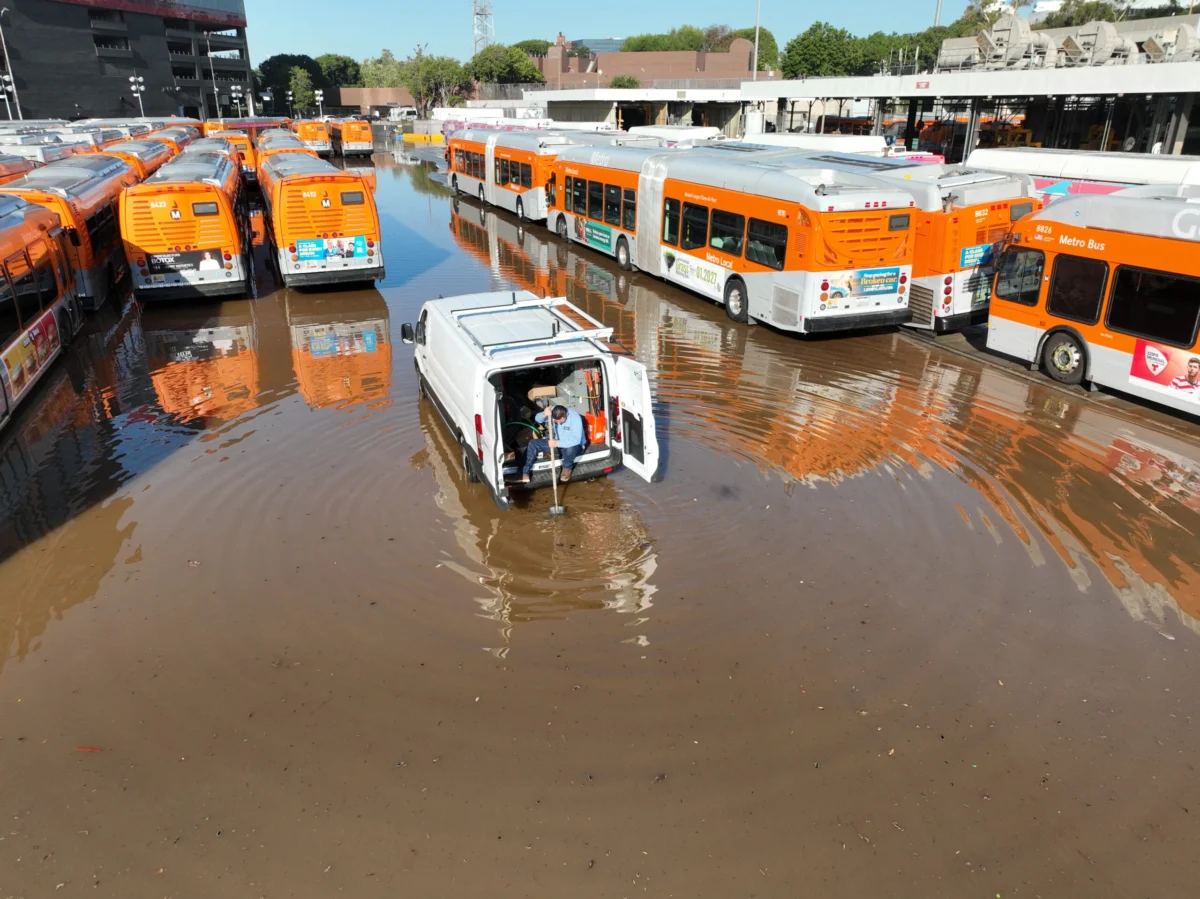
The flooding also had a direct impact on public services and transportation. A West Hollywood bus yard located below Santa Monica Boulevard was completely inundated with water, severely disrupting operations for the Los Angeles Metro. Officials confirmed that this would significantly impact bus service in the area, necessitating detours for lines 16 and 105. Northbound and westbound buses were rerouted to lay over on San Vicente Boulevard in front of the Pacific Design Center, while eastbound and southbound buses detoured via Robertson Boulevard between Santa Monica Boulevard and Melrose Avenue. These changes caused considerable delays and inconvenience for thousands of daily commuters relying on public transportation, adding to the broader traffic gridlock in the area.
Official Reactions and Collaborative Response
The gravity of the situation prompted a swift and unified response from local and regional leadership. Los Angeles Mayor Karen Bass was on the scene in West Hollywood early Thursday morning to personally assess the damage and confer with emergency personnel. At a subsequent press conference, Mayor Bass emphasized the urgency of the situation while also highlighting the inherent dangers involved in addressing such a large-scale rupture. "I have to urge everyone to avoid this area," Bass stated, underscoring the ongoing hazards and the need for public cooperation during the initial response phase. She also pointed to a systemic issue, remarking, "This is one of the challenges when our infrastructure is so old — it’s my understanding that these pipes are over 100 years old." Her comments resonated with growing concerns nationwide regarding the deferred maintenance and underinvestment in critical urban infrastructure.
West Hollywood Mayor John Heilman echoed these sentiments regarding safety, stating, "The good news is that all of our residents, to our knowledge, are safe." He confirmed that while an evacuation zone had been established as a precautionary measure, it did not appear to be necessary at that time. He also noted that the street flooding and sub-garage inundation seemed to be "abating" as the water supply had been shut off. This focus on resident well-being was a key message from the municipal leaders, even as the broader implications of the infrastructure failure began to sink in for the community.
LADWP officials also addressed the public. Dave Hanson, Chief Operating Officer and Senior Assistant General Manager, confirmed that the emergency command center for the Department of Water and Power had been activated. This activation ensures seamless communication and coordination with both the city emergency management department and West Hollywood, critical for a multi-jurisdictional response. Hanson extended an apology to the community for the significant impact and disruption caused by the incident, while also reassuring residents about the safety of their drinking water. "Luckily, at this time, we don’t have services that are out, so everybody does have clean water that’s safe to drink," Hanson confirmed, addressing a primary public health concern immediately following such an event and distinguishing the flooding from a broader contamination issue.
The collaborative effort extends beyond the immediate emergency response. The City of West Hollywood, LADWP, and the Metropolitan Water District are now engaged in joint discussions to outline the "next steps." This partnership is crucial for addressing both the immediate repairs and the longer-term implications, especially considering the interconnected nature of water supply systems in a sprawling metropolitan area like Los Angeles. The MWD, responsible for delivering imported water to its 26 member agencies, including LADWP, plays a vital role in regional water security and infrastructure planning.
The Pervasive Challenge of Aging Infrastructure
The West Hollywood water main break is not an isolated incident but rather a potent illustration of a systemic vulnerability facing many older American cities. The pipe that ruptured, a 36-inch steel main, is reportedly over a century old. This age places it well beyond the typical design life of most municipal water infrastructure, which for large steel or cast iron pipes can range from 50 to 100 years, depending on material, soil conditions, internal water chemistry, and external stresses. Los Angeles, like many other major urban centers established in the late 19th and early 20th centuries, relies heavily on an extensive network of pipes laid down during periods of rapid growth, often with materials and engineering standards that predate modern advancements in metallurgy and pipe coating.
The LADWP manages a vast water distribution system, including over 7,200 miles of pipelines, some dating back to the early 1900s. The sheer scale of this infrastructure, combined with the continuous demands placed upon it by a metropolitan area of nearly 4 million people, makes proactive replacement and maintenance a monumental and costly undertaking. Replacing a large diameter pipe, especially one buried beneath a major arterial road like Sunset Boulevard, involves not only the cost of the new materials and labor but also significant expenses related to traffic management, temporary road closures, extensive excavation, and the meticulous restoration of the surrounding environment, including roads, sidewalks, and landscaping. Industry estimates for replacing a mile of large diameter water main can easily run into several million dollars, not including the substantial economic losses from business disruption and the costs of property damage from breaks.
The topography of West Hollywood, with its "steep elevations moving northward, past the Sunset Strip and into the Hollywood Hills," further exacerbates the impact of such breaks. Water pressure naturally increases in lower elevations, and a rupture at a higher point can unleash a more destructive flow downhill, as evidenced by the torrents rushing towards Santa Monica Boulevard. This geographical context means that breaks in areas like Sunset Boulevard can have a disproportionately wide-ranging impact compared to those in flatter areas. The significant elevation changes contribute to higher pressures in the distribution system, increasing the stress on aging pipes.
Moreover, the "trendy city" status of West Hollywood, with its high concentration of businesses, luxury residences, and world-renowned tourist attractions like the Sunset Strip, means that any disruption carries significant economic implications. The immediate vicinity of the rupture is home to numerous high-value commercial properties, entertainment venues, and upscale apartments. Extended road closures and property damage in such a high-value area translate directly into lost revenue for businesses, increased operational costs for emergency services, and substantial repair bills for property owners and insurance companies. The economic ripple effect extends to commuters facing longer travel times and the general inconvenience for residents and visitors alike.
Broader Implications and the Path Forward
Beyond the immediate chaos, the West Hollywood water main break carries several broader implications that resonate far beyond the city limits. First, it underscores the critical need for sustained, substantial investment in infrastructure upgrades at local, state, and federal levels. While incidents like this are often framed as unfortunate accidents, they are frequently the predictable outcome of deferred maintenance and chronic underfunding. Discussions around infrastructure often focus on highly visible assets like roads and bridges, but the subterranean networks of water, sewer, and gas lines are equally, if not more, vital to urban functionality, public health, and economic stability.
Second, the event highlights the importance of municipal resilience and proactive planning. Cities must not only respond effectively to such emergencies but also develop comprehensive strategies to mitigate future risks. This includes accelerated pipe replacement programs, leveraging advanced monitoring systems to detect leaks early, and implementing robust emergency response plans that account for diverse urban landscapes and population densities. The collaborative effort between West Hollywood, LADWP, and MWD is a positive sign of such coordination, but the underlying systemic issues demand long-term, strategic solutions that transcend individual incidents.
Third, there are significant environmental considerations. The massive volume of water lost in this incident represents a considerable waste, especially in a region perennially concerned with water conservation and drought conditions. While the immediate focus is on cleanup and repair, the long-term goal must include minimizing such losses through infrastructure modernization and efficient water management practices. The environmental impact also extends to potential soil erosion, sediment runoff into storm drains, and the associated ecological consequences.
Finally, the incident serves as a poignant call to action for policymakers and the public alike. The "out of sight, out of mind" nature of much of our critical infrastructure often leads to neglect until a catastrophic failure occurs. Mayor Bass’s direct reference to the age of the pipes is a clear signal that this issue requires greater political will and financial commitment. Repairing and replacing infrastructure built over a century ago is not merely a matter of convenience; it is a fundamental imperative for public safety, economic stability, and environmental stewardship in the 21st century.
As West Hollywood begins the arduous process of cleanup and repair, with no immediate timeline for the full restoration of the ruptured water main, the ripple effects of this early morning deluge will continue to be felt. The incident will undoubtedly prompt renewed discussions about the vulnerability of critical urban systems and the urgent necessity for proactive investment to prevent future, potentially more devastating, infrastructure failures. The community, renowned for its resilience and vibrant spirit, now faces a period of recovery that will test its resolve and reinforce the shared responsibility of maintaining the unseen lifelines that sustain modern urban life.