

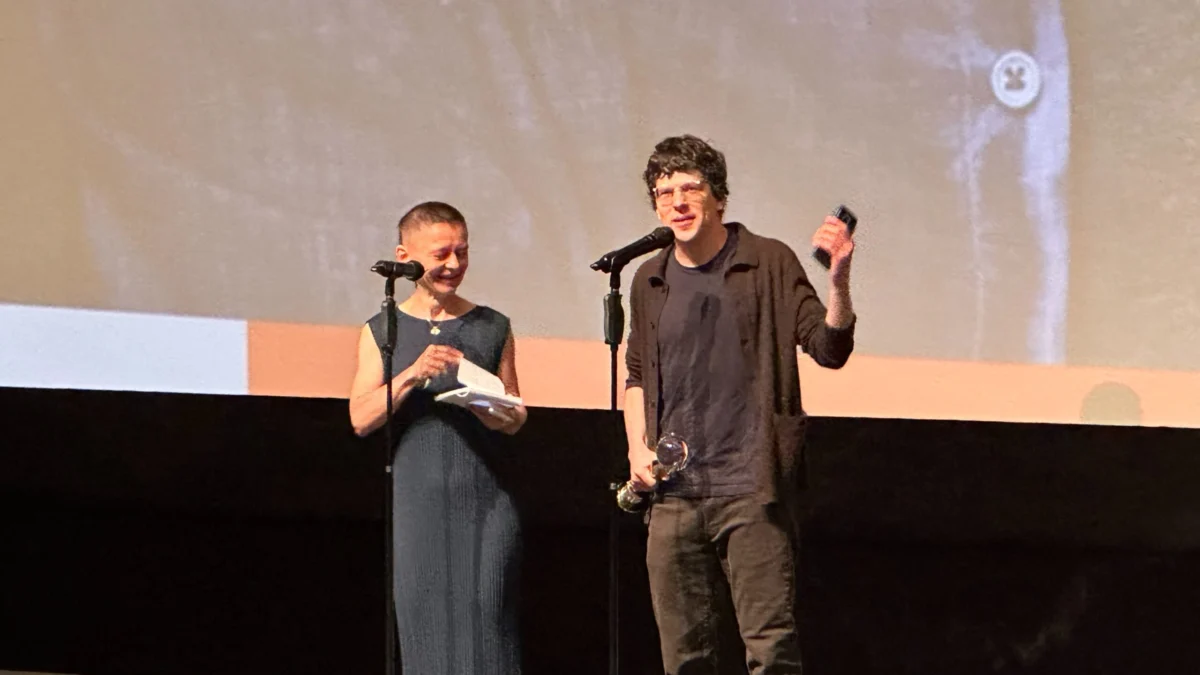
Acclaimed actor, writer, and director Jesse Eisenberg, known for his incisive performances in films like The Social Network and A Real Pain, is poised to receive Polish citizenship in the coming days, signaling a significant shift in his artistic and personal trajectory. The multifaceted talent publicly announced his intention to dedicate more of his professional life to filmmaking in Central Europe, expressing a growing frustration with the diminishing opportunities for "human scale, strange mid-budget films" within the contemporary Hollywood system. This pivotal declaration was made on Saturday at the prestigious Karlovy Vary International Film Festival (KVIFF) in the Czech Republic, where Eisenberg was honored with the President’s Award amidst a wave of critical acclaim for his recent directorial endeavors.
A Moment of Recognition at Karlovy Vary
The announcement unfolded during a poignant ceremony at KVIFF, a venerable institution in the global film festival circuit. Eisenberg, visibly moved, received a standing ovation and what he playfully described as a "massive collective hug" from the appreciative audience gathered in the Grand Hall of the Hotel Thermal, the festival’s bustling headquarters. Clutching the President’s Award statuette, a symbol of the festival’s recognition of his profound contributions to cinema, Eisenberg articulated the deep personal and professional significance of the moment. "Being here has particular meaning for me right now," he stated, "because in exactly one week I am receiving my Polish citizenship. I pursued Polish citizenship because of my family’s heritage, but also because I want to spend more time in my life and my career working in Europe, specifically Central Europe."
His address preceded a special screening of Richard Ayoade’s critically lauded 2013 film, The Double, in which Eisenberg delivered a memorable dual performance. He introduced the film by calling it "wonderfully strange" and highlighted its deep indebtedness to Central European cinematic traditions, a sentiment that underscored his growing affinity for the region’s artistic ethos. This recognition at KVIFF, a festival renowned for championing arthouse and independent cinema, serves as a fitting backdrop for Eisenberg’s announcement, reflecting a broader alignment between his artistic aspirations and the European film landscape.
The Shifting Sands of Hollywood: A Quest for Creative Autonomy
Eisenberg’s candid remarks about the challenges of making certain types of films in America resonate with a widely discussed trend within the entertainment industry. He elaborated, "In America, many of the kind of films that I love so much — human scale, strange mid-budget films — have become increasingly difficult to make, but in Europe, those movies are thriving and celebrated." This observation points to a fundamental recalibration of priorities within Hollywood, which has increasingly gravitated towards tentpole blockbusters, franchise extensions, and high-concept spectacles, often leaving less room for original, character-driven narratives that don’t promise massive global box office returns.
The economic realities of modern filmmaking play a significant role in this shift. Studio financing for films with budgets in the $10 million to $50 million range—precisely the "mid-budget" category Eisenberg refers to—has become scarcer. These films, often relying on strong scripts and nuanced performances rather than extensive special effects, struggle to compete for theatrical distribution slots against superhero epics or established intellectual properties. While streaming services initially offered a lifeline for such projects, the ongoing industry consolidation and a renewed focus on profitability have led platforms to prioritize content with broad appeal or those that fit specific algorithmic profiles, further narrowing the creative window for idiosyncratic, auteur-driven works. The result is a more homogenous cinematic output, making it increasingly challenging for artists like Eisenberg, who are drawn to exploring complex human emotions and niche narratives, to find funding and distribution within the traditional American studio system.
The Allure of Central European Cinema: A Thriving Ecosystem
In stark contrast to Hollywood’s commercial pressures, the European film industry, particularly in Central Europe, offers a robust and often publicly supported ecosystem for diverse storytelling. Countries like Poland, the Czech Republic, and Hungary boast a rich cinematic heritage, characterized by a deep appreciation for auteur-driven films, psychological depth, and social commentary. Government subsidies, national film funds, and co-production treaties between European nations provide crucial financial backing for projects that might be deemed too niche or risky in the US market. These mechanisms allow filmmakers to pursue artistic vision over pure commercial viability, fostering an environment where "human scale" stories can not only survive but thrive.
Eisenberg’s comment about The Double‘s debt to Central European cinema is particularly insightful. The film, with its darkly comedic, Kafkaesque exploration of identity and alienation, mirrors themes and stylistic approaches often found in the works of legendary Central European directors. From the existential absurdism of the Czech New Wave to the philosophical inquiries of Polish masters like Krzysztof Kieślowski and Roman Polański, the region has long cultivated a cinematic tradition that prioritizes intellectual engagement and character interiority. This cultural predisposition, combined with a supportive funding landscape and an audience accustomed to diverse cinematic offerings, makes Central Europe an increasingly attractive destination for filmmakers seeking creative freedom beyond Hollywood’s conventional boundaries.
Embracing Polish Heritage: A Personal and Professional Journey

Eisenberg’s decision to pursue Polish citizenship is not merely a strategic career move but also a deeply personal one, rooted in his family’s heritage. While the specific details of his lineage were not extensively elaborated upon, the mention of "family heritage" often implies a connection to the historical diaspora, particularly in the context of Polish-Jewish history. Many individuals with Polish-Jewish ancestry, whose families were impacted by historical events such as World War II and the Holocaust, have pursued citizenship by descent, a process that allows them to reclaim a connection to their ancestral homeland. This act of reclaiming heritage can be profoundly meaningful, offering a sense of belonging and continuity across generations.
For an artist like Eisenberg, whose work frequently delves into themes of identity, belonging, and complex interpersonal relationships, this personal journey could profoundly influence his future artistic endeavors. His critically acclaimed film A Real Pain, which he wrote, directed, and starred in alongside Kieran Culkin, explicitly explores themes of heritage and identity through the lens of two cousins on a journey through Poland to connect with their family roots. The film’s success, including an Oscar nomination for Eisenberg’s screenplay and an Oscar win for Kieran Culkin’s performance, underscores his capacity to weave personal narratives with universal themes, further suggesting that his deeper engagement with his Polish heritage could inspire a new phase of creatively rich and resonant projects. This move signifies a desire not just for geographical relocation but for an artistic immersion that connects his personal history with his professional ambitions.
Jesse Eisenberg: A Multifaceted Artist’s Evolution
Jesse Eisenberg’s career trajectory has been marked by a remarkable versatility, transitioning seamlessly from a highly sought-after actor to an accomplished writer and director. His initial foray into acting saw him garner early recognition with films like Roger Dodger (2002) and Noah Baumbach’s The Squid and the Whale (2005), the latter earning him Independent Spirit and Critics’ Choice Award nominations. Mainstream success followed with the apocalyptic horror comedy Zombieland (2009), but it was his transformative portrayal of Facebook founder Mark Zuckerberg in David Fincher’s The Social Network (2010) that catapulted him to international stardom, earning him Oscar, Golden Globe, and BAFTA nominations for Best Actor.
In recent years, Eisenberg has increasingly channeled his creative energies into filmmaking behind the camera. His screenwriting and directing debut, When You Finish Saving the World, starring Julianne Moore and Finn Wolfhard, premiered at Sundance and Cannes, signaling his arrival as a director with a distinct voice. However, it was A Real Pain (2024) that truly solidified his reputation as a formidable auteur. The film garnered widespread critical acclaim, earning Eisenberg an Oscar nomination for Best Screenplay, a BAFTA Award for Best Original Screenplay, the Waldo Salt Screenwriting Award at the Sundance Film Festival, and an Independent Spirit Award. He also received a Golden Globe nomination for Best Actor for his performance in the film, while Kieran Culkin won an Oscar for Best Supporting Actor.
Looking ahead, Eisenberg’s upcoming film as a writer and director, The Debut, promises to further showcase his talents. Starring Julianne Moore and Paul Giamatti, Eisenberg also contributed to the film’s musical-within-the-movie by writing its music and lyrics. Set for a fall release by A24, The Debut exemplifies his continued commitment to crafting unique, character-driven stories that defy easy categorization. KVIFF’s earlier commendation of Eisenberg as "one of the most multifaceted figures in contemporary cinema" is thus not merely an honorific but an accurate reflection of an artist constantly pushing the boundaries of his craft across multiple disciplines.
Karlovy Vary: A Beacon for Independent and World Cinema
The Karlovy Vary International Film Festival, where Eisenberg made his pivotal announcement, holds a significant place in the global cinematic landscape. This year’s edition marks a double anniversary – the 60th edition of the festival within its 80th year since its founding. Established in 1946, shortly after World War II, KVIFF rapidly evolved into one of the world’s oldest and most respected film festivals, earning an "A" category accreditation from FIAPF (International Federation of Film Producers Associations), placing it among elite festivals like Cannes, Berlin, and Venice. Throughout the Cold War, KVIFF served as a crucial cultural bridge, showcasing films from both Eastern and Western blocs and fostering dialogue across ideological divides. Today, it remains a vibrant platform for independent, art house, and world cinema, celebrated for its discerning programming, intimate atmosphere, and commitment to discovering new talent.
Eisenberg was in esteemed company among this year’s honorees. The festival’s opening night ceremony saw Hollywood legend Dustin Hoffman, known for iconic roles in The Graduate and Rain Man, awarded the Crystal Globe for Outstanding Artistic Contributions to World Cinema. Maggie Gyllenhaal, a versatile actress and acclaimed director (The Lost Daughter), also received a President’s Award, mirroring Eisenberg’s recognition. Veteran actor Harvey Keitel, celebrated for his work in films like Mean Streets and Pulp Fiction, was also a prominent figure on the festival’s expanded red carpet in the picturesque Czech spa town, underscoring KVIFF’s enduring appeal to international cinematic luminaries. The festival, running from July 3rd to 11th, continues to be a crucial gathering point for industry professionals and film enthusiasts, reaffirming its role as a vital nexus for global cinematic discourse.
Broader Implications for the Film Industry
Jesse Eisenberg’s decision to embrace European citizenship and shift his professional focus eastward carries broader implications for the global film industry. It highlights a growing trend among American and international filmmakers who are increasingly seeking alternative funding models and creative environments outside the traditional Hollywood system. As the American industry continues its consolidation and emphasis on massive-budget spectacles, other regions, particularly Europe with its robust public funding mechanisms and cultural appreciation for diverse narratives, are emerging as fertile grounds for artistic innovation.
This movement of talent could lead to an increase in international co-productions, fostering greater cultural exchange and enriching the global cinematic tapestry. It also raises questions about the long-term viability of Hollywood’s current trajectory for nurturing diverse storytelling. If acclaimed artists like Eisenberg find more creative satisfaction and support abroad, it may prompt a reevaluation of priorities within the American film industry. Ultimately, Eisenberg’s bold step underscores the evolving nature of filmmaking in the 21st century—a landscape where geographical boundaries are becoming increasingly porous, and artists are empowered to seek out environments that best serve their creative vision, ensuring that "human scale" stories continue to find their place on the world stage.