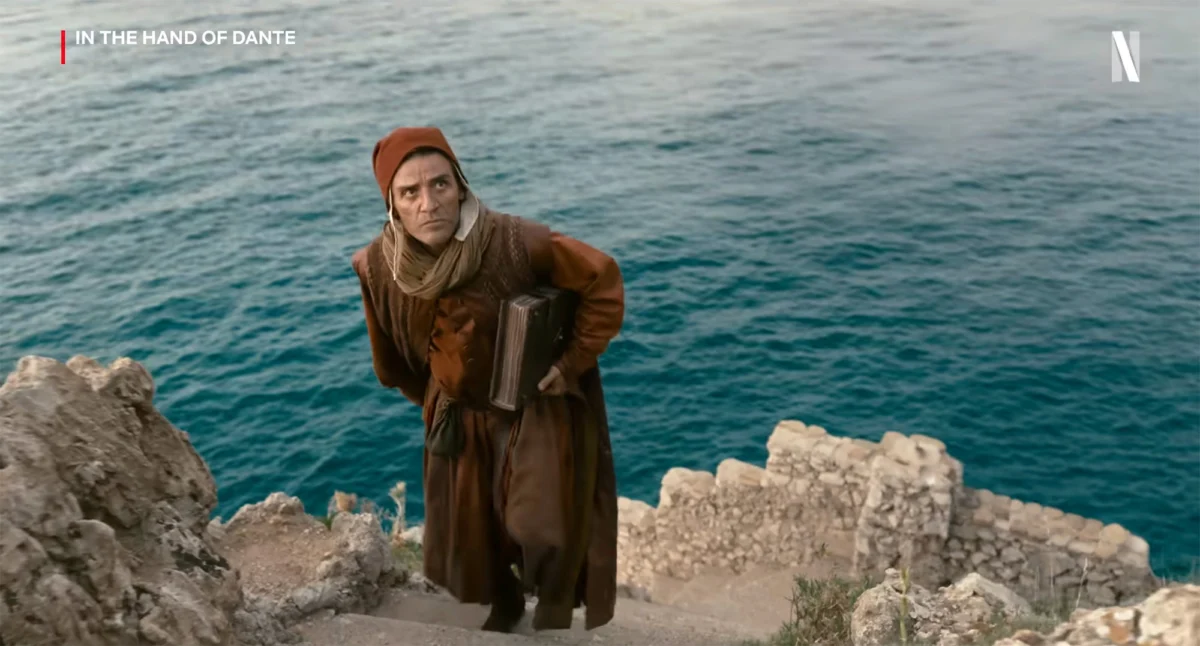
Netflix has officially unveiled the trailer for Julian Schnabel’s latest directorial effort, In the Hand of Dante, a film that has garnered significant attention not only for its ambitious premise and star-studded cast but also for its remarkably polarizing reception following its premiere at the 2025 Venice Film Festival. Scheduled for a global streaming release on Netflix on June 24th, 2026, the film promises a journey through time and literary obsession, yet arrives shrouded in a critical cloud, prompting questions about the intersection of artistic vision, commercial viability, and the sometimes-harsh realities of film festival scrutiny.
The narrative of In the Hand of Dante is an intricate tapestry weaving together two distinct timelines, each centered on an obsessive quest for understanding, beauty, and the divine. In the 21st century, the story follows Nick Tosches, a real-life American author and literary figure, portrayed by Oscar Isaac. Tosches finds himself drawn into a perilous underworld when he is recruited by a mafia don, played by John Malkovich, to authenticate and ultimately steal a manuscript believed to be Dante Alighieri’s seminal work, "The Divine Comedy," written in the poet’s own hand. This contemporary storyline plunges Tosches into a violent journey, where he navigates the treacherous demands of the criminal underworld with the assistance of an unpredictable assassin named Louie, brought to life by Gerard Butler. Their mission to secure and verify this priceless literary artifact propels the plot through a dark and often murderous landscape, hinting at the high stakes involved in preserving or exploiting cultural heritage.
Parallel to Tosches’ modern-day ordeal, the film transports viewers back to 14th-century Italy, where Dante Alighieri himself, also portrayed by Oscar Isaac, grapples with the monumental task of creating his most important work. This historical thread delves into Dante’s personal struggles, his search for inspiration, and the profound experiences that shaped "The Divine Comedy." The film posits that both men, separated by seven centuries, are unknowingly connected through their shared, almost feverish pursuit of love, beauty, and the divine, suggesting a transcendent link forged by art and obsession. This dual portrayal of Isaac as both the contemporary author and the historical poet underscores the film’s ambitious thematic scope, aiming to explore the enduring power of literature and the human condition across vast expanses of time.
Julian Schnabel’s Artistic Trajectory and the Weight of Expectation
Julian Schnabel, the acclaimed artist and filmmaker behind In the Hand of Dante, is known for his distinctive visual style and a filmography that often explores the lives of complex creative figures. His previous works include Basquiat (1996), a biographical drama about the painter Jean-Michel Basquiat; Before Night Falls (2000), which earned Javier Bardem an Academy Award nomination for his portrayal of Cuban writer Reinaldo Arenas; and the critically lauded The Diving Bell and the Butterfly (2007), a poignant account of a paralyzed editor, which garnered Schnabel the Best Director award at the Cannes Film Festival and four Academy Award nominations. More recently, he directed At Eternity’s Gate (2018), starring Willem Dafoe as Vincent van Gogh, another exploration of an iconic artist’s inner world, which also received significant critical acclaim and an Oscar nomination for Dafoe.

Given Schnabel’s established reputation for crafting visually rich and emotionally resonant biopics and character studies, the announcement of In the Hand of Dante immediately generated considerable anticipation. His films frequently blend painterly aesthetics with profound narrative depth, making him a unique voice in contemporary cinema. The expectation was that In the Hand of Dante would continue this tradition, offering a meditative yet compelling examination of creativity, legacy, and the transcendent nature of art. The involvement of such a high-caliber cast further amplified these expectations, suggesting a project of significant artistic ambition and potential awards season contention.
The Venice Film Festival Premiere: A Critical Chasm
However, the film’s debut at the 2025 Venice Film Festival proved to be a pivotal and, for many, a disheartening moment. While film festivals are often platforms for celebrating cinematic artistry and generating buzz, In the Hand of Dante reportedly became a focal point for negative critical commentary. Initial reviews emerging from the Lido were unusually harsh, with many critics labeling it as one of the festival’s weakest entries. The film’s current Rotten Tomatoes score of 43% reflects this initial critical consensus, indicating a widespread perception of artistic misfire rather than a divisive masterpiece.
Reports from Venice described the film as a "jumbled mess of narratives" and cited "hilariously awful performances," particularly in the context of its more dramatic or intense scenes. This critical reaction stands in stark contrast to Schnabel’s past successes and raised immediate questions about how a director of his caliber, working with such a formidable cast and compelling source material, could produce a film so widely panned. Film festival premieres are high-stakes events, often shaping a film’s trajectory for the rest of its release cycle. For In the Hand of Dante, the Venice premiere cast a long shadow, suggesting that its artistic ambitions may have overreached, resulting in a narrative that struggled to cohere or resonate with professional critics.
The Ensemble Cast: A Gathering of Stars
One of the most remarkable aspects of In the Hand of Dante is its truly bonkers ensemble cast, a testament to Julian Schnabel’s reputation and the allure of the project’s high concept. Leading the charge is Oscar Isaac, taking on the challenging dual roles of Nick Tosches and Dante Alighieri. Isaac, known for his versatility and magnetic screen presence in films like Inside Llewyn Davis, Ex Machina, and the Star Wars sequel trilogy, is tasked with anchoring both timelines, embodying a contemporary literary figure and one of history’s most revered poets. His involvement alone signals a certain level of artistic commitment and draws significant audience interest.
Beyond Isaac, the film features a constellation of talent:

- Gal Gadot, widely recognized for her role as Wonder Woman, adds a significant level of star power, though her specific role remains less detailed in initial reports.
- Gerard Butler, typically associated with action franchises, reportedly takes on the role of a "hilariously ruthless mobster enforcer," a casting choice that, depending on execution, could either be a brilliant subversion of his persona or contribute to the film’s reported tonal inconsistencies.
- John Malkovich, a veteran actor celebrated for his eccentric and captivating performances, plays the mafia don who recruits Tosches, a role that aligns well with his capacity for sophisticated villainy.
- The cast further expands with esteemed actors like Louis Cancelmi, Franco Nero, Benjamin Clementine, Paolo Bonacelli, and Sabrina Impacciatore.
- Perhaps most surprisingly, the film features appearances from cinematic titans Martin Scorsese and Al Pacino, whose involvement, even in what might be cameo roles, speaks volumes about their respect for Schnabel or the project’s initial appeal.
- Even Jason Momoa, another actor known for blockbuster action, is listed among the ensemble, further cementing the film’s status as a veritable who’s who of Hollywood talent.
The sheer breadth of this cast, encompassing dramatic stalwarts, action heroes, and legendary figures, creates an undeniable intrigue. It raises questions about how such diverse talents are integrated into a cohesive narrative and whether their collective star power can elevate a film that has faced such a challenging critical reception. For many, the prospect of seeing such an eclectic group of actors, under Schnabel’s direction, remains a compelling reason to watch, despite the critical warnings.
The Source Material: Nick Tosches’ Literary Provocation
The film is based on the 2002 novel of the same name by Nick Tosches, an American journalist, novelist, and poet renowned for his distinctive voice and often provocative explorations of culture, history, and the underworld. Tosches’ work frequently blurs the lines between fiction and non-fiction, incorporating extensive historical research with his unique brand of literary style. "In the Hand of Dante" is no exception, presenting a complex, metafictional narrative that delves deeply into the life and work of Dante Alighieri while simultaneously exploring the author’s own struggles with identity, creation, and the elusive nature of truth.
The novel is celebrated for its erudition, its daring structure, and its fearless confrontation of grand themes. Adapting such a dense and intellectually demanding work to the screen presents a formidable challenge. Tosches’ prose is rich with literary allusions, historical digressions, and philosophical musings, elements that are often difficult to translate visually without sacrificing depth or clarity. The novel’s blend of hard-boiled detective story, literary analysis, and spiritual quest requires a delicate balance, and any cinematic adaptation risks either oversimplifying the source material or becoming bogged down in its complexities. The screenplay, co-written by Julian Schnabel and Louise Kugelberg, had the unenviable task of distilling Tosches’ sprawling vision into a cinematic experience, a task that, according to early reviews, may have proved too ambitious.
Netflix’s Strategic Acquisition and Distribution
Netflix’s decision to acquire and globally distribute In the Hand of Dante is noteworthy, especially given the film’s controversial reception at Venice. Streaming platforms frequently invest in projects with significant star power and prestigious directorial names, even if they come with a degree of artistic risk. For Netflix, a film featuring Oscar Isaac, Gal Gadot, Gerard Butler, Al Pacino, and Martin Scorsese, directed by an Oscar-nominated filmmaker like Julian Schnabel, represents a significant draw for its global subscriber base, irrespective of early critical feedback.
The streaming model offers a different calculus compared to traditional theatrical releases. While a poor critical reception can severely impact box office performance, a film on a streaming platform can still attract a substantial audience simply by virtue of its availability, its high-profile cast, and the curiosity it generates. Netflix has a history of supporting auteur-driven projects, even those that might be considered challenging or unconventional. The acquisition of In the Hand of Dante aligns with their strategy to offer a diverse range of content, from mainstream blockbusters to more niche, artistically inclined films, thereby catering to a broad spectrum of tastes. It also positions Netflix as a platform for major festival titles, even those that spark debate, further solidifying its presence in the landscape of prestige cinema. The global release on June 24th, 2026, ensures maximum accessibility, allowing audiences worldwide to form their own opinions on the film.

Thematic Depth and Adaptation Challenges
At its core, In the Hand of Dante attempts to grapple with profound themes: the nature of obsession, the pursuit of beauty, the essence of love, and the search for the divine. Dante Alighieri’s "The Divine Comedy" is one of the foundational texts of Western literature, a journey through Hell, Purgatory, and Paradise that explores sin, redemption, and the human soul’s ultimate destiny. By intertwining this epic with a modern-day quest involving crime and literary intrigue, the film aims to draw parallels between historical and contemporary forms of human ambition and spiritual longing.
The challenge lies in translating these complex philosophical and literary concepts into a coherent and engaging visual narrative. Schnabel’s artistic background suggests a director unafraid of symbolic imagery and non-linear storytelling, but critics at Venice indicated that this approach may have led to a film that felt disjointed rather than elegantly interwoven. The ambition to connect a 14th-century poet’s spiritual odyssey with a 21st-century author’s violent entanglement with the mafia, while thematically rich, requires exceptional narrative dexterity to avoid falling into incoherence. The reported tonal shifts, with moments described as "hilariously awful," suggest a struggle to maintain a consistent voice or to effectively balance the profound with the absurd.
Broader Implications and Future Outlook
The release of In the Hand of Dante carries several broader implications for the film industry. For Julian Schnabel, it marks a significant departure in critical reception from his previous, largely acclaimed works. While one film does not define a career, a project of this scale and ambition receiving such a polarizing response could influence future opportunities or how his artistic risks are perceived. For the ensemble cast, particularly Oscar Isaac in his dual role, the film presents a moment to test their range and commitment to artistically challenging projects, regardless of the ultimate critical outcome. Their collective participation underscores the continued allure of working with visionary directors, even when the final product is contentious.
For Netflix, the film represents another high-profile, director-driven acquisition that will test the waters of audience reception versus critical consensus. In an era where streaming metrics often prioritize viewership over critical acclaim, In the Hand of Dante will be a fascinating case study. Will the star power and the intriguing premise be enough to attract a significant global audience, even if critics remain largely unconvinced? The film’s journey from a highly anticipated festival premiere to a streaming release under a cloud of controversy highlights the ever-evolving landscape of film production and distribution, where artistic vision, market forces, and critical judgment constantly intersect.
As the June 24th, 2026, release date approaches, anticipation remains high for many, fueled by curiosity about Schnabel’s unique vision and the sheer magnetism of the cast. Despite the early critical challenges, In the Hand of Dante stands as a testament to audacious filmmaking, an attempt to bridge centuries and themes in a single, ambitious cinematic endeavor. Whether it ultimately finds its audience or remains a cautionary tale of artistic overreach will soon be determined by the millions of viewers who will experience it on Netflix.