

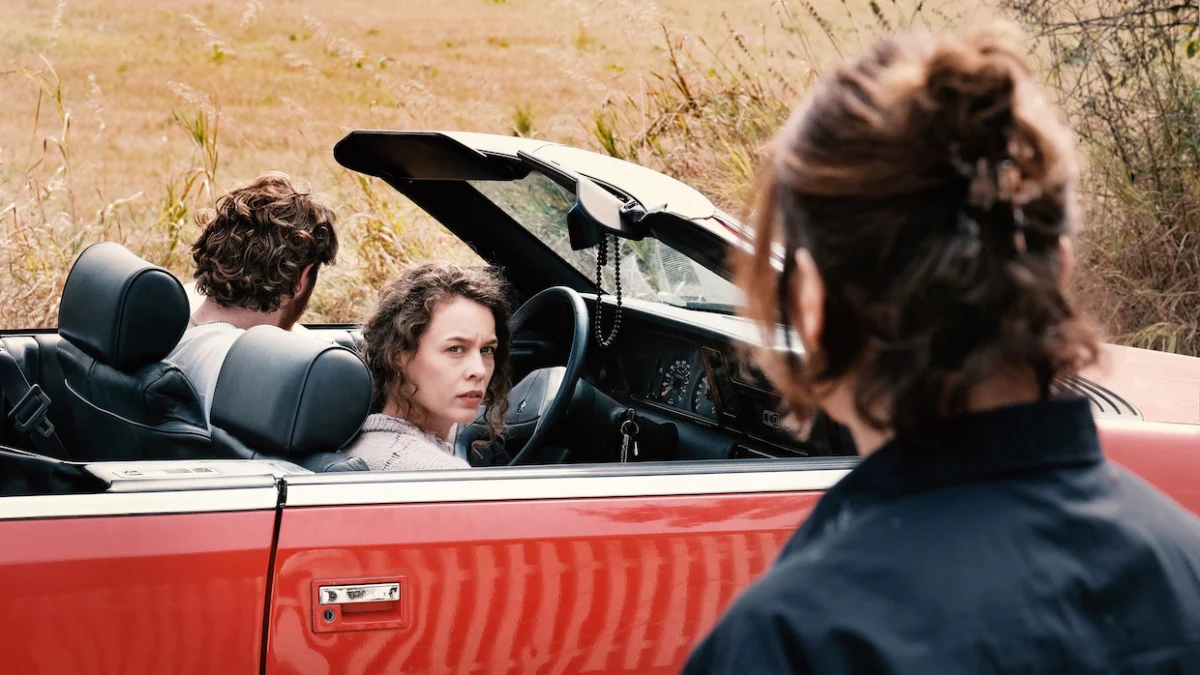
The release of Miroirs No. 3 marks a significant milestone in the career of Christian Petzold, a filmmaker whose body of work has come to define the contemporary German cinematic landscape. Following the critical success of Undine (2020), Petzold returns with a narrative that blends the stark realism of the "Berlin School" with the ethereal qualities of a modern fairy tale. The film stars Paula Beer as Laura, a concert pianist from Berlin who find herself stranded in the German countryside following a catastrophic car accident. As she is nursed back to health by a mysterious local woman named Betty, played by Barbara Auer, the film transitions from a survival drama into a complex meditation on grief, surveillance, and the porous boundaries between the past and the present.
Narrative Structure and the Fairy Tale Motif
Miroirs No. 3 functions as a psychological chamber piece, set against the backdrop of a rural landscape that Petzold describes as a realm of "looking glasses." The director has frequently cited Lewis Carroll’s Alice in Wonderland as a foundational influence for the project, suggesting that the car crash serves as the "rabbit hole" through which Laura enters a distorted reality. This fantastical framing is not merely aesthetic; it serves as a vehicle for exploring the internal states of characters who are untethered by tragedy.
In the film, the interaction between Laura and Betty is defined by a series of subtle revelations. Betty, who initially appears to be a solitary figure living in an isolated farmhouse, is gradually revealed to have deep-seated motivations for keeping Laura within her domestic sphere. Both women are navigating the aftermath of loss—Laura grieving her boyfriend who perished in the crash, and Betty grappling with a historical trauma that Petzold links to his earlier filmography. The presence of symbolic objects, such as a lost shoe reminiscent of Cinderella, reinforces the idea that these characters are moving through a world where the laws of "German reality" have been suspended in favor of a more mystical, scientific structure of storytelling.
The Morality of the Lens: Collaboration with Hans Fromm
A defining feature of Petzold’s filmography is his long-standing partnership with cinematographer Hans Fromm. Their collaboration is rooted in a shared philosophy regarding the ethics of the camera. Drawing on the theories of Nouvelle Vague masters like Éric Rohmer and Jacques Rivette, Petzold and Fromm treat camera placement as a "position of morality." This approach intentionally rejects the conventions of "Direct Cinema" and handheld photography, which Petzold characterizes as a lack of perspective that merely follows action without interpreting it.
The production process for Miroirs No. 3 involved an unconventional timeline. Petzold typically dedicates the early hours of a shooting day exclusively to rehearsals with actors, excluding the camera and technical crew entirely. These sessions, which can last several hours, allow the performers to inhabit the space and establish the emotional rhythm of the scene. Only after the performances are solidified does Fromm observe a final rehearsal to determine the camera’s position. This methodology ensures that the cinematography is a response to the human dynamics on screen rather than a pre-determined technical exercise. In Miroirs No. 3, this is most evident in the use of static shots that emphasize surveillance and the feeling of being watched—a recurring theme in Petzold’s work since his 2012 film, Barbara.
Architecture and the Cinema of Abandoned Places
The setting of Miroirs No. 3 is a meticulously constructed environment that serves as a physical manifestation of the characters’ psychological states. Petzold’s production team built Betty’s house from the ground up, including the porch, the piano room, and the surrounding white fence. This decision was driven by the director’s belief that cinema has a natural affinity for "abandoned places," which he defines as projects that have failed.
The house was designed to contrast with traditional German domestic architecture. While Petzold notes that German families often build "cave-like" homes that face inward to avoid contact with the outside world, Betty’s house is characterized by transparency. It is filled with windows and doors, designed to allow wind and light to pass through the structure. This "open space" represents a failed social project—a family’s attempt to live a life of engagement and "refresh" the German spirit, only to be defeated by circumstances. The camera frequently captures open windows and doors in the background, creating a sense of vulnerability and inviting the "intrusion" of the viewer’s gaze.

Musical Intertextuality and the Influence of The Deer Hunter
Music plays a pivotal role in establishing the emotional and class-based context of Miroirs No. 3. The film prominently features "The Night" by Frankie Valli and The Four Seasons, a choice that links the film to a broader cinematic lineage. Petzold has cited Michael Cimino’s The Deer Hunter (1978) as a major influence, particularly in its depiction of the working class and the use of popular music to express collective energy and trauma.
The director draws a direct parallel between the final scene of Miroirs No. 3—where characters sit on a porch eating eggs and drinking coffee—and the conclusion of The Deer Hunter. Both scenes depict a traumatized group of people choosing to continue their lives in the face of immense loss. The inclusion of Frankie Valli’s music serves as a bridge between these worlds. Petzold discovered "The Night" through the work of Portuguese director Miguel Gomes, specifically The Tsuga Diaries (2021). For Petzold, the song captures the sense of social life and open spaces that were lost during the global pandemic, echoing the themes of isolation and the desire for connection present in the film.
Production Chronology and the Reshot Finale
One of the most notable aspects of the production of Miroirs No. 3 was the decision to reshoot the final scene months after principal photography had concluded. Originally, the script ended with Laura choosing to remain with Betty’s family permanently, assuming the role of a surrogate daughter. However, lead actors Paula Beer and Enno Trebs expressed reservations about this conclusion, arguing that it didn’t align with the character’s development.
During the editing process, Petzold and his longtime editor Bettina Böhler realized the actors were correct. The original ending felt stagnant rather than transformative. Despite the film being in post-production, Petzold’s producer authorized a one-day reshoot at a cost of approximately 20,000 Euros. By the time of the reshoot, Paula Beer was eight months pregnant, which Petzold integrated into the visual storytelling. The new ending depicts Laura as an independent adult who leaves the family to forge her own path, a change that Petzold believes was essential for the film’s integrity.
Broader Impact and the Future of the Petzold-Beer Collaboration
Miroirs No. 3 is currently being distributed in select U.S. theaters by 1-2 Special, following a highly successful retrospective of Petzold’s work at Film at Lincoln Center. The director’s popularity in the American arthouse community has surged in recent years, with his Q&A sessions often selling out as "can’t-miss" cultural events. This interest reflects a growing appreciation for the "Berlin School" filmmakers, who prioritize formal rigor and historical consciousness.
The film also marks another chapter in the collaboration between Petzold and Barbara Auer, their first since The State I Am In (2000). Petzold views Auer’s role in Miroirs No. 3 as a companion to her character in the earlier film; whereas she once played a mother forced to live underground as a political fugitive, she now plays a woman attempting to rebuild a family through a surrogate daughter.
Looking ahead, Petzold has confirmed several upcoming projects that will continue to explore these themes. He is slated to shoot a new film with Barbara Auer this summer and is currently developing a script for a project featuring both Paula Beer and Nina Hoss. That film, set to begin production in approximately two years, will center on a theater troupe performing Anton Chekhov’s The Cherry Orchard. The narrative will deal with the encroachment of capitalism on the arts and will feature Beer and Hoss as antagonists. At 65, Petzold remains prolific, viewing his current output as a way to secure a cinematic legacy that interrogates the intersections of German history, personal desire, and the moral responsibility of the artist.