

The 2025 edition of CPH:DOX, the Copenhagen International Documentary Film Festival, has solidified its reputation as a premier global forum for non-fiction cinema that bridges the gap between high-art aesthetics and urgent geopolitical discourse. As the festival celebrates over two decades of operation, its programming continues to reflect a world grappling with expanding conflicts, technological surveillance, and the pursuit of historical justice. This year’s selection was characterized by a distinct shift toward hybrid narratives—films that blend documentary observation with poetic reconstruction—to capture realities that traditional reportage often fails to convey.
The Geopolitical Prelude: Opening with Facing War
The festival commenced with the world premiere of Facing War, directed by Tommy Gulliksen. The documentary offers an unprecedented look at the final year of Jens Stoltenberg’s tenure as NATO Secretary General, specifically focusing on the internal mechanisms of political lobbying and international diplomacy during the Russo-Ukrainian war. While the film faced scrutiny from some critics for what was perceived as a cautious approach to its subject matter, its timing proved remarkably prescient. Premiering against the backdrop of shifting political tides in the United States and growing anxieties regarding the stability of European alliances, Facing War provided a stark look at the administrative machinery of global security.
The inclusion of Facing War as the opening film follows a consistent trend at CPH:DOX of prioritizing works that engage with the immediate security concerns of the European continent. Industry analysts noted that the film’s focus on the "backroom" of international relations served as a sobering counterpoint to the more visceral, front-line imagery that would dominate other sections of the festival.
A Decade in the Donbas: The Cinematic Vision of Mariinka
Building on the festival’s commitment to Ukrainian narratives, Pieter-Jan De Pue presented Mariinka, a project ten years in the making. De Pue, known for his 2016 Sundance-winning film The Land of the Enlightened, which utilized 16mm celluloid to document orphaned children in Afghanistan, applied a similar aesthetic rigour to the Donbas region. Mariinka follows a group of orphaned children whose formative years have been entirely consumed by the conflict on the Russia-Ukraine border.
De Pue’s choice to shoot on 16mm film is a significant technical departure from the rough, digital aesthetic that characterizes most contemporary war documentaries. The use of celluloid serves several functions:
- Dignity and Texture: The warmth of the film grain provides a sense of dignity to the subjects, particularly in close-ups of the young paramedic Natascha and the siblings caught on opposing sides of the front line.
- Visual Exaltation: The format allows for a more "exalted" register, capturing star-filled skies and the rhythmic pulsing of arteries with a visceral force that digital sensors often flatten.
- Durability of Image: In an era of disposable digital media, the physical nature of film mirrors the long-term, grinding reality of a decade-long siege.
Mariinka effectively exposes the "bipolar" nature of war cinema, balancing visually immaculate compositions with the relentless, graphic reality of active combat. It stands as a testament to the ability of documentary film to function as both a historical record and a work of high art.
The Dox Award and the Rise of Improvised Fiction
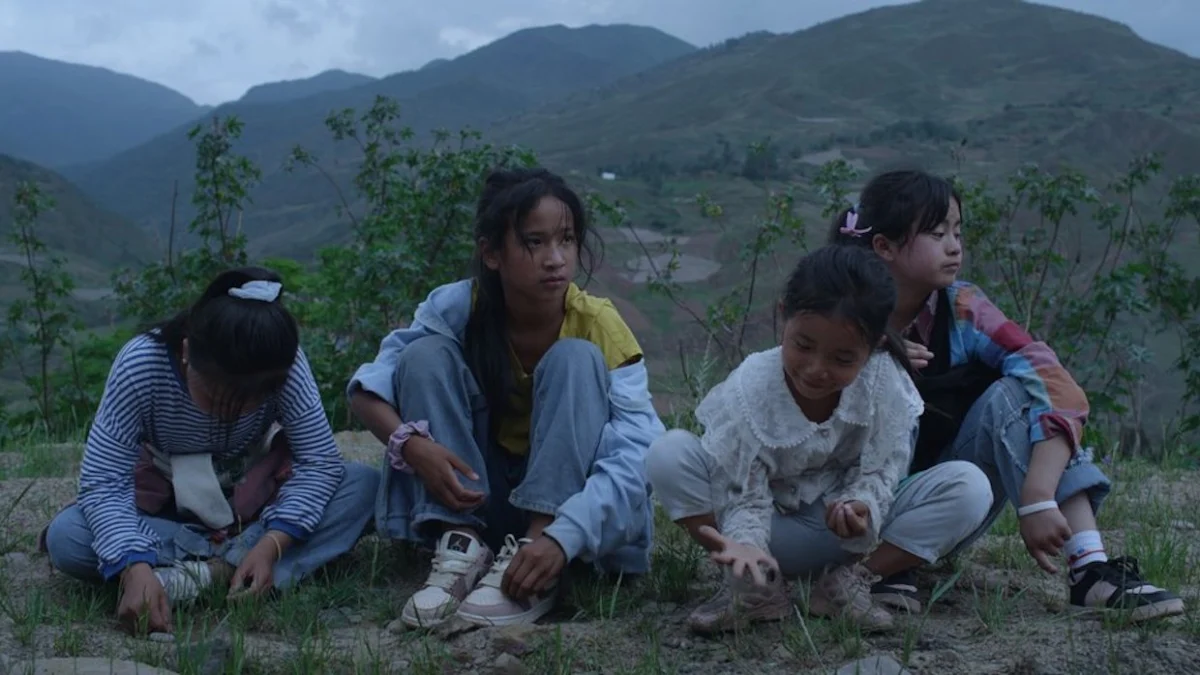
The festival’s top honour, the Dox:Award, was bestowed upon Whispers in May, directed by Dongnan Chen. The film represents a growing trend in documentary filmmaking termed "improvised fiction." Set in the Liangshan Mountains of China, the film follows fourteen-year-old Qihuo and her friends as they embark on a journey to find a traditional skirt marking the rite of passage into womanhood.
Whispers in May highlights the socio-economic pressures facing China’s rural youth. Qihuo’s mother, a migrant labourer working in a distant factory, communicates primarily through phone calls, oscillating between encouraging her daughter’s education and calculating the financial benefits of an early marriage. The film’s structure is enriched by:
- Mythological Interludes: The use of still illustrations and voiceovers narrating the oral myth of Coqotamat, which provides a cultural framework for the girls’ journey.
- Persistent Camerawork: The cinematography maintains a balance between intimate proximity—following the girls into rain-soaked shelters—and respectful distance during their private conversations about the future.
The jury’s decision to award Whispers in May reflects a broader industry recognition of films that explore the intersection of traditional folkways and modern economic displacement.
Chronology of the 2025 Festival Cycle
The 2025 edition of CPH:DOX followed a strategic timeline designed to maximize international industry engagement and public accessibility:

- Phase 1: The CPH:FORUM (Pre-Festival): Financing and co-production meetings where over 40 projects in development were pitched to international commissioners.
- Phase 2: Opening Night (Facing War): A high-profile event attended by diplomatic figures and NATO representatives, setting the political tone.
- Phase 3: The Competition Screenings: A ten-day period featuring the world premieres of the Dox:Award, Factual:Award, and New:Vision categories.
- Phase 4: CPH:CONFERENCE: A five-day industry event focusing on the ethics of AI in filmmaking and the safety of documentary filmmakers in conflict zones.
- Phase 5: Award Ceremony and Public Encores: The announcement of Whispers in May as the grand prize winner, followed by nationwide screenings across Denmark.
Surveillance and the Global Border Machine
Kenya-Jade Pinto’s debut feature, The Sandbox, introduced a more clinical and harrowing perspective to the festival. The film investigates the global surveillance industry, documenting how drones, robots, and AI are deployed to monitor and control migration. Pinto’s work traces the development of these technologies from their testing grounds in Africa and the Middle East to their implementation at the borders of Europe and North America.
Data presented in the film suggests a multi-billion dollar "border security" market that treats migrants as test cases for autonomous systems. Formally, The Sandbox utilizes the very tools it critiques, intercutting thermal imaging and drone footage with ground-level testimonies from survivors. While some critics noted that the film’s vast geographic scope occasionally sacrificed depth for breadth, its impact lay in its ability to render a borderless, inhuman gaze that mirrors the experience of those being tracked.
Forensic Aesthetics and Historical Justice
The intersection of science, technology, and human rights was most clearly articulated in Manuel Correa’s Atlas of Disappearance. As a member of the research agency Forensic Architecture, Correa spent eight years investigating the traces of Spain’s Francoist dictatorship. The film documents the efforts of three families to locate the remains of disappeared relatives through:
- 3D Reconstruction: Digital mapping of sealed mausoleums and mass graves.
- Architectural Analysis: Using computer models to identify where physical evidence has been suppressed or built over by the state.
- Legal Evidence: Treating the film itself as a forum for evidence that has been denied in traditional courtrooms.
Correa’s work exemplifies the "forensic turn" in documentary cinema, where the filmmaker acts as a researcher and the cinema serves as a site of public mourning and legal advocacy. The film argues that while the state may seal archives, the physical evidence contained in human remains carries a "truth" that cannot be fully erased.
Internal Democracy and the Danish Context
While the festival looked outward at global crises, it also examined domestic social experiments. Karl Friis Forchhammer’s Christiania provides a critical history of the famous Danish freetown. Founded in 1971 by anarchists in a former military barracks, Christiania has long been a symbol of alternative living.
Forchhammer’s documentary avoids the pitfalls of pure nostalgia by addressing the "inconvenient cracks" in the utopian vision:
- The Conflict of Tolerance: How an open-door policy led to challenges with organized crime and drug trafficking.
- The Tourism Paradox: The transition of a radical commune into a major Copenhagen tourist attraction.
- Consensual Democracy: The difficulty of maintaining a society based on total consensus in the face of modern political and economic pressure.
The film utilized animated sequences to bring local legends to life, providing a whimsical contrast to the somber themes of displacement and surveillance found elsewhere in the festival.
Impact and Industry Implications
The 2025 edition of CPH:DOX demonstrated that the documentary field is moving toward a more sophisticated integration of technology and traditional storytelling. The success of films like Whispers in May and Mariinka suggests that audiences and juries are increasingly drawn to works that prioritize "cinematic" values—composition, texture, and rhythm—alongside investigative rigor.
Furthermore, the festival’s emphasis on forensic filmmaking and surveillance critiques reflects a growing awareness of the filmmaker’s role as a digital archivist. As governments and corporate entities increasingly use AI and data to shape reality, documentary filmmakers are positioning themselves as the primary counter-narrative providers.
Official responses from festival organizers emphasized that attendance numbers remained strong, with a significant increase in international industry delegates. This growth indicates that despite the rise of streaming platforms, the film festival remains a vital ecosystem for the distribution and legitimization of high-impact non-fiction cinema. CPH:DOX 2025 ultimately reaffirmed that in a time of global fragmentation, the documentary serves as a necessary, if sometimes painful, connective tissue between disparate human experiences.