


A Return to Form: Production Context and Creative Vision
Tony Gilroy’s career trajectory shifted significantly following the 2012 release of The Bourne Legacy. Since that time, his creative output has been largely focused on the critically acclaimed television series Andor. Behemoth! represents his first return to the big screen, signaling a transition from sprawling, plot-heavy action sequences to a more intimate, character-driven narrative.
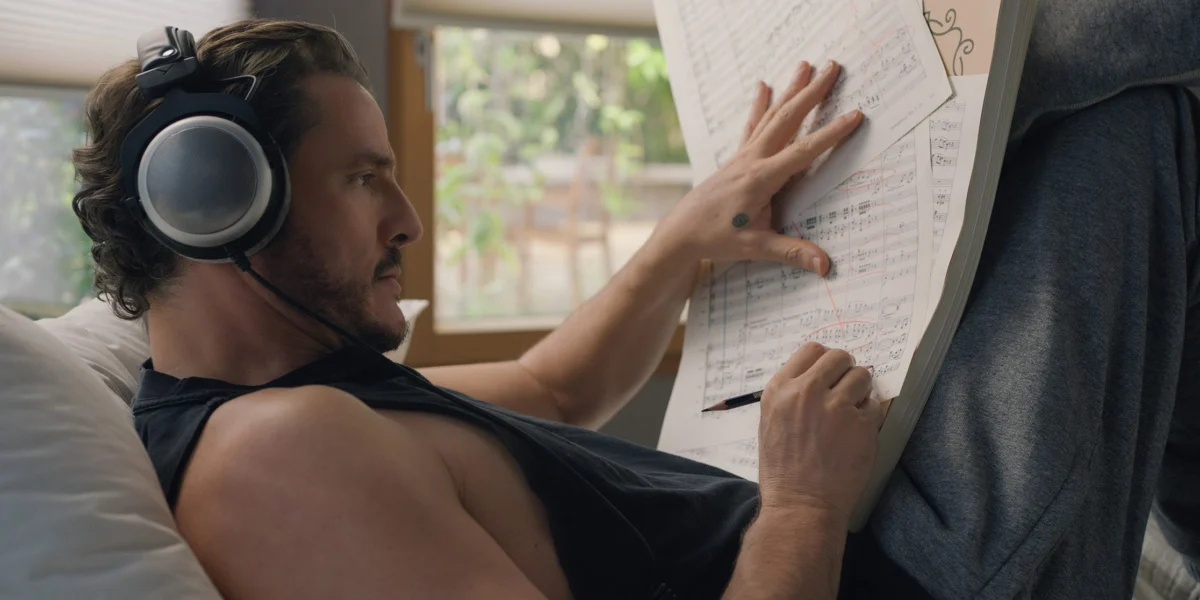
The film centers on Alex Serian, played by Pedro Pascal, a former child prodigy who occupies a liminal space between his storied musical lineage and a present defined by professional instability. Having abandoned a prestigious position with a Chicago-based orchestra, Serian relocates to Los Angeles to pivot toward film scoring. This geographic shift is accompanied by a thematic exploration of familial duty and unresolved trauma. The production utilized an expansive collective of composers—including Michael Abels, Emily Bear, and Alan Silvestri—to create a score that functions as a narrative device, acting as the primary lens through which the protagonist’s memories are presented.
Chronological Narrative and Character Dynamics
The narrative follows a non-linear path, utilizing musical cues to bridge the distance between Serian’s past and present. The timeline begins in a Los Angeles recording studio, where Serian’s internal dissonance is established through his interactions with session musicians. The story then pivots to a series of flashbacks, primarily focused on his departure from Chicago.
The conflict originates from his relationship with Carol, portrayed by Olivia Wilde, whose emotional entanglement with Serian serves as the catalyst for his exit. This segment of the film highlights the tension between Serian’s professional ambitions and the personal entanglements he seeks to leave behind. Further complicating his trajectory are his familial responsibilities in Los Angeles, specifically his relationship with his brother, Andy (Will Arnett), and his mother, whose struggle with Alzheimer’s serves as the narrative’s emotional anchor.
Secondary characters provide context for Serian’s past. These include Nadia, played by Eva Victor, a violinist whose history with Serian informs much of his current reticence, and a younger protege, played by Alexa Swinton, who represents the cycle of musical talent that initially defined Serian’s youth. The film’s structure relies heavily on these figures to piece together a portrait of a man who, despite his technical brilliance, remains emotionally fragmented.
The Technical Architecture of Memory
At the heart of the film’s critical appeal is its exploration of “the invisible art” of music. Gilroy, alongside editor John Gilroy and cinematographer Damián García, constructs a world where the soundtrack is not merely accompaniment but a fundamental component of memory reconstruction.
Statistical analysis of modern cinema often highlights the role of the musical score in audience retention and emotional resonance. By utilizing a "Behemoth! Collective"—a diverse group of composers—the film intentionally mimics the tropes of various cinematic genres, from high-octane thrillers to melancholic dramas. This technique forces a conversation about the manipulative nature of media. The film suggests that, much like an audience is guided by a score, individuals often unconsciously apply “soundtracks” to their own memories, thereby altering their subjective reality to fit a more palatable or dramatic narrative.
This metacinematic approach challenges the viewer to differentiate between objective historical events and the emotional color applied to those events in hindsight. It is a calculated risk that moves the film beyond the standard tropes of the “troubled artist” genre.
Ensemble Contributions and Performance Analysis
The cast of Behemoth! features a wide range of talent, each contributing to the mosaic of Serian’s history:
- Pedro Pascal (Alex Serian): His performance is marked by a deliberate, minimalist approach, focusing on internalizing conflict rather than externalizing it.
- Olivia Wilde (Carol): Serves as the primary catalyst for the narrative’s forward momentum, providing a sharp contrast to Serian’s detachment.
- Will Arnett (Andy): Represents the weight of the familial shadow, portraying a character who has lived in the periphery of his brother’s success.
- Hank Azaria (Father): Offers a view into the pressures of the Serian lineage, portraying a figure driven by the expectations of legacy.
The interaction between these characters is designed to highlight the limitations of Serian’s self-perception. While Pascal’s performance is technically proficient, critics have noted that the script’s reliance on off-screen development—particularly regarding his past relationships—creates a distance between the audience and the protagonist.
Implications for Contemporary Character Studies
Behemoth! stands as a unique entry in the current cinematic landscape, primarily because it prioritizes the process of storytelling over the conclusion of the story. While traditional character studies often focus on a clear arc of growth or decline, Gilroy’s work suggests a more ambiguous conclusion. By the time the credits roll, Serian may have gained a greater understanding of his own history, but the audience’s access to that growth remains intentionally obscured.
This choice serves to elevate the film’s status as an experimental piece of character-driven cinema. The film’s reliance on the interplay between diegetic and non-diegetic sound—music that exists within the world of the film versus music that exists only for the audience—underscores the idea that reality is rarely as cohesive as a film score.
Broader Impact and Industry Reception
The return of Tony Gilroy to the director’s chair has been met with significant industry attention. Following the success of his work in television, the move to a 124-minute feature allows for a concentrated exploration of his directorial evolution. The film’s reliance on the Behemoth! Collective underscores a growing trend in Hollywood: the collaborative approach to scoring, where multiple composers are utilized to create a layered, multi-faceted auditory experience that covers the breadth of modern musical styles.
While the film has faced criticism for its opaque character development, it is widely regarded as a technical triumph. The cinematography by Damián García, combined with the editing by John Gilroy, creates a visual language that matches the complexity of the score.
As a case study in film theory, Behemoth! challenges the audience to consider how much of their own lives are curated by the cultural artifacts they consume. It posits that the "exclamation point" in the title is not merely a stylistic choice, but an acknowledgment of the heightened, often dramatized way in which individuals perceive their own histories. By stripping away the comfort of a standard protagonist-driven arc, Gilroy delivers a film that acts as a mirror to the audience, reflecting the often disjointed, musical, and inherently narrative way in which we remember our pasts.
In the final analysis, Behemoth! serves as a testament to the power of the film score to transcend its functional role, becoming the central pillar of a narrative that seeks to explore the very nature of human recollection. Whether the film succeeds as a character study remains a point of debate, but its success as a formalist experiment is, by most metrics, secured.