



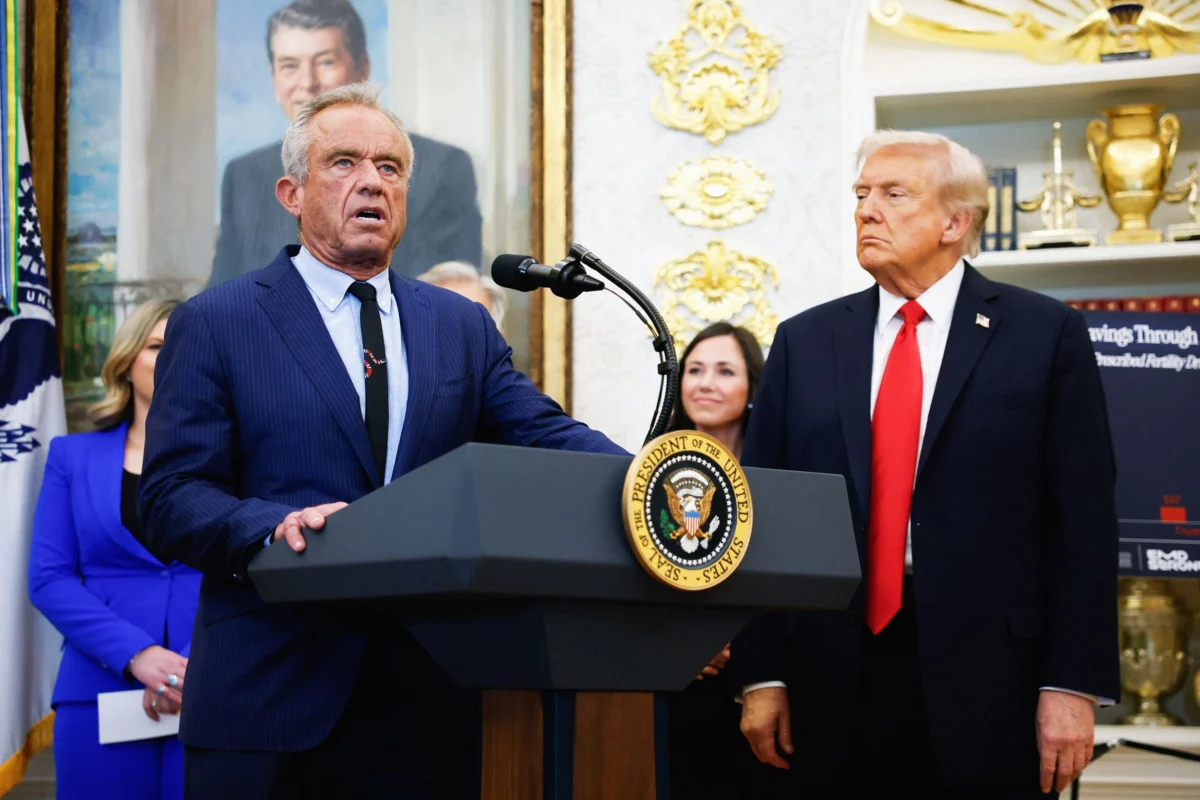
The Trump administration has officially introduced Moms.gov, a centralized digital platform designed for "new and expecting mothers," as part of a broader, multi-agency initiative to address declining national birth rates and reshape the American approach to maternal health. The launch of the website coincided with a high-profile maternal health care summit on Monday, where President Donald Trump, joined by senior health officials, articulated a hardline pronatalist agenda. This strategy frames the current state of American fertility not merely as a demographic shift but as a fundamental threat to national security and economic stability. The administration’s new policy suite includes proposals for expanded access to fertility treatments, financial incentives for families, and a reexamination of environmental factors that officials claim are contributing to a "fertility crisis."
The Launch of Moms.gov and the Digital Infrastructure of Pronatalism
Moms.gov serves as the digital centerpiece of the administration’s outreach to American families. The website’s design utilizes soft pastel aesthetics and imagery depicting traditional family settings, signaling a shift toward what sociologists often describe as "pronatalist" or "traditionalist" messaging. Beyond its visual presentation, the platform aggregates resources for women of reproductive age, including directories for anti-abortion "pregnancy centers" and information from the Centers for Disease Control and Prevention (CDC) regarding workplace hazards.
Observers have noted that while the site lists potential environmental and occupational risks for pregnant women, it currently lacks detailed information regarding the legal protections afforded to pregnant employees under federal law, such as the Pregnant Workers Fairness Act. This omission has drawn scrutiny from labor advocates who argue that maternal health cannot be decoupled from economic and legal security. The administration, however, maintains that the primary goal of Moms.gov is to provide a supportive environment that encourages childbearing and provides direct resources for prenatal care.
A Chronology of the Maternal Health Care Initiative
The rollout of this national strategy has followed a specific timeline, beginning with the quiet development of Moms.gov earlier this year and culminating in the public policy announcements made this week.
- Development Phase: Coordination between the Department of Health and Human Services (HHS) and the White House to consolidate maternal health resources into a single federal domain.
- The IVF Proposal: On Monday, President Trump announced a proposal to encourage employers to include In-Vitro Fertilization (IVF) and other fertility treatments in their health insurance offerings. This move is intended to lower the financial barriers to assisted reproductive technology, which can cost between $15,000 and $30,000 per cycle.
- The Summit: Senior officials, including HHS Secretary Robert F. Kennedy Jr. and Mehmet Oz, the head of Medicare and Medicaid, delivered keynote addresses framing infertility as a systemic national crisis.
- Policy Expansion: Following the summit, the administration detailed the "Trump accounts" proposal, a financial incentive program aimed at long-term investment for American children.
The Rhetoric of National Security and the "Fertility Crisis"
During the summit, HHS Secretary Robert F. Kennedy Jr. provided an alarming assessment of the nation’s biological health, characterizing the decline in fertility as an "existential crisis." Kennedy pointed toward a "toxic soup" of endocrine-disrupting chemicals, pesticides, and heavy metals as the primary drivers of hormonal imbalances in both men and women. He specifically cited statistics suggesting that male sperm counts have seen a significant decline since the 1970s, asserting that contemporary teenagers possess half the sperm count of previous generations.
"It takes systemic change to turn America’s birth rates around," stated White House spokesperson Kush Desai in a response to inquiries regarding the administration’s focus on these metrics. Desai emphasized that the administration is "leaving no stone unturned," ranging from the research of chronic health issues to the implementation of policies targeting childcare and housing affordability.
However, the scientific community has expressed reservations regarding the data cited by the administration. Ashley Wiltshire, a fertility specialist at the Columbia University Fertility Center, noted that the specific claim regarding a 50% decline in sperm counts is based on research that has been challenged by more recent studies. A 2023 meta-analysis published in the Journal of Fertility and Sterility found that while male infertility is a growing global concern, sperm counts in many regions have remained relatively stable over the last five decades. Wiltshire cautioned that while environmental factors are worth investigating, the evidence does not currently support the narrative of a sudden, existential biological collapse.
Demographic Data and the "Underbabied" Population
Mehmet Oz, leading the Centers for Medicare and Medicaid Services (CMS), introduced the term "underbabied" to describe a significant portion of the American electorate. According to Oz, one in three Americans either has no children or has fewer children than they ideally desire. He argued that this trend leads to a "replacement rate" deficiency that threatens the long-term viability of social safety nets like Social Security and Medicare.
Current data from the CDC’s National Center for Health Statistics supports the fact that US birth rates are at historic lows. In 2024, the average number of children per woman in the United States dropped to 1.6, well below the "replacement level" of 2.1 required to maintain a stable population without immigration. While the US birth rate still currently exceeds the death rate—unlike in nations such as Japan or South Korea—the downward trend is consistent across almost all industrialized Western nations.
Economic Obstacles vs. Cultural Incentives
A central point of contention in the wake of the administration’s announcements is the disconnect between the proposed cultural incentives and the economic realities facing young families. While the administration emphasizes environmental toxins and "traditional" values, economic research suggests that the primary barriers to childbearing are financial.
According to a 2024 Pew Research Center study, the skyrocketing costs of housing, the lack of universal childcare, and the absence of federally mandated paid family leave are the leading reasons why American adults choose to delay or forgo parenthood. The median price of a home in the United States has risen significantly faster than median wages over the last decade, making the "trad wife" lifestyle depicted on Moms.gov financially unattainable for the vast majority of dual-income households.
The administration’s proposed "Trump accounts"—which would provide children with a $1,000 investment account accessible at age 18—and the discussion of $5,000 "baby bonuses" are seen as attempts to bridge this gap. However, critics argue these amounts are negligible compared to the estimated $300,000 required to raise a child to adulthood in the current economic climate.
The Voluntary IVF Proposal and Reproductive Autonomy
President Trump’s focus on IVF represents a notable pivot in the administration’s reproductive policy. By branding himself as the "father of fertility," Trump signaled a desire to distance the executive branch from more restrictive reproductive stances while simultaneously promoting population growth. The proposal suggests that the government will push for insurance companies to cover IVF, though it notably stops short of a federal mandate.
Without a mandate, health policy analysts suggest the proposal may only benefit employees at large, well-capitalized corporations that already offer competitive benefit packages. This has led to questions regarding whether the policy is intended to provide broad relief or if it is a symbolic gesture aimed at suburban voters concerned about reproductive access following the overturning of Roe v. Wade.
Uma Iyer, Chief External Affairs Officer for the National Women’s Law Center, expressed concern that the administration’s focus on "boosting" the birth rate is less about public health and more about state-level control over women’s bodies. Iyer characterized the Moms.gov initiative as part of a "broader effort to undermine women’s autonomy," suggesting that the framing of fertility as a national security issue historically leads to policies that prioritize the state’s demographic goals over individual reproductive choice.
Links to Project 2025 and Future Policy Implications
The policy framework unveiled this week shares significant DNA with "Project 2025," a comprehensive governing blueprint authored by the Heritage Foundation. Project 2025 explicitly advocates for a "pro-life, pro-family" transformation of the Department of Health and Human Services, including the promotion of the nuclear family and the use of federal data to track and encourage higher birth rates.
The administration’s emphasis on "Make America Healthy Again" (MAHA) also intersects with this pronatalist agenda. By focusing on masculinity, testosterone levels, and physical fitness—as seen in Secretary Kennedy’s public fitness campaigns—the administration is attempting to link national vitality to biological fertility.
As the administration moves forward with the implementation of Moms.gov and the proposed fertility incentives, the debate will likely center on the role of government in private family decisions. While the administration frames its actions as "leaving no stone unturned" to save the American family, opponents view it as an ideological campaign that ignores the systemic economic failures—such as the childcare crisis and the housing shortage—that actually dictate the reproductive choices of modern Americans.
The success of these initiatives will ultimately be measured by whether they can move the needle on national birth rates or if they remain primarily symbolic tools in a larger cultural and political struggle over the future of the American household.