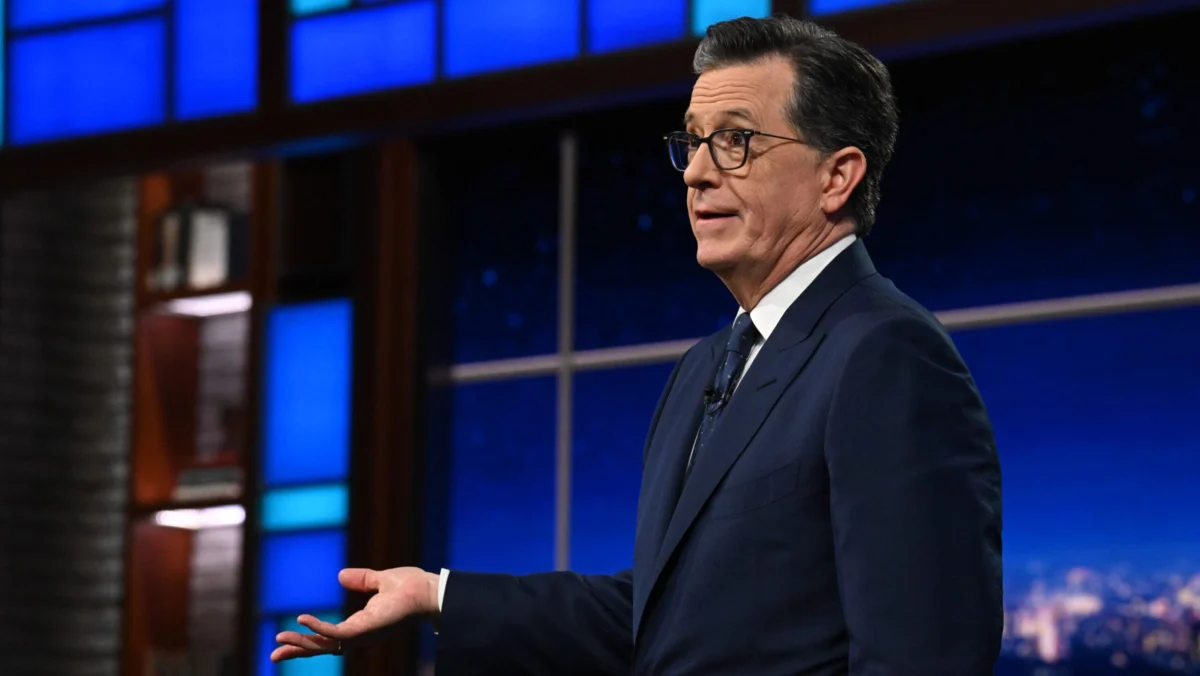
Nine months after the initial announcement that Stephen Colbert’s tenure at the helm of CBS’s The Late Show would conclude, the acclaimed host presided over what was presented as the series’ final episode, delivering an evening filled with characteristic humor, poignant reflection, and a surprising roster of celebrity guests, culminating in an appearance by musical legend Paul McCartney. The broadcast marked the end of an era for the late-night landscape, closing a chapter on a show that redefined political satire and emotional connection in a tumultuous decade.
The Farewell Broadcast: A Blend of Wit, Cameos, and Cosmic Absurdity
The final episode, aired to an expectant audience in the historic Ed Sullivan Theater and millions at home, commenced with Colbert’s signature monologue. Eschewing the grand, retrospective pomp often associated with series finales, Colbert revealed that the production team had initially planned an elaborate special. However, a collective realization that "every episode is special" led them to opt for a more "normal show," focusing on the "national conversation" as they had for years. This decision immediately set a meta-narrative tone, acknowledging the gravity of the moment while maintaining the show’s comedic integrity.
The monologue, surprisingly light on the incisive political commentary that had become Colbert’s hallmark, particularly concerning former President Donald Trump, was instead punctuated by a parade of unexpected celebrity cameos from the audience. Bryan Cranston, known for his dramatic roles, brought a touch of gravitas, while Paul Rudd delivered his trademark comedic charm, and Tim Meadows added to the buoyant atmosphere. The absence of a direct mention of Trump, a figure frequently lampooned on the show, was a notable departure, highlighting Colbert’s decision to perhaps broaden the scope of his final comedic reflections. The closest the show came to referencing the former president was during Colbert’s conversation with Paul McCartney, where McCartney recalled the heavy, "bright orange" makeup applied on The Ed Sullivan Show. Colbert’s quip, "That’s very popular in certain circles," subtly evoked the former president’s distinctive complexion without naming him, followed by the humorous suggestion, "that’s where it started."
A running gag throughout the evening involved a succession of stars believing they were slated to be Colbert’s final guest, including Ryan Reynolds, building anticipation for the true final visitor. This playful misdirection culminated in Colbert’s introduction of his "infallible" final guest: the Pope, a "white whale" guest he had long publicly expressed a desire to host. However, in a pre-recorded segment, a crew member informed Colbert that the Pontiff was refusing to leave his dressing room, having canceled due to unsatisfactory snacks—specifically, a disappointment with hot dogs. An arm draped in papal vestments dramatically hurled hot dogs into the hallway, cementing the comedic bit.
It was in this moment of faux-disappointment that Paul McCartney emerged, asking, "What about me?" The legendary Beatle, feigning a casual drop-in, claimed he was "just in the area" running errands. McCartney then presented Colbert with a framed photograph of The Beatles performing on The Ed Sullivan Show, a poignant gesture linking the show’s current residency to a seminal moment in music and television history.
The interview with McCartney was soon interrupted by a series of increasingly severe "technical difficulties," with audio and visual glitches distorting the broadcast. Investigating backstage, Colbert encountered astrophysicist Neil DeGrasse Tyson, appearing in another surprise cameo. Tyson explained that the glitches were caused by a "giant interdimensional wormhole" – a rift in the space-time continuum triggered by "two contradictory realities" co-existing, specifically, a show being "No. 1 in late night but also gets canceled." This meta-commentary on the show’s unexpected end and its strong performance introduced a fantastical element, with Tyson himself ultimately swallowed by the anomaly.
The wormhole storyline provided a unique narrative device for a gathering of late-night luminaries. Colbert was joined by his esteemed colleagues and friends: Jon Stewart, his mentor and former host of The Daily Show, and the "Strike Force Five" collective – John Oliver, Seth Meyers, Jimmy Kimmel, and Jimmy Fallon. This unprecedented assembly of competing hosts offered Colbert sage, albeit comedic, advice on confronting the metaphorical "hole." Stewart urged perseverance, stating the real question was "how you choose to walk through it." Oliver echoed the sentiment, acknowledging the existential threat to all late-night shows. The group collectively reminded Colbert of his resilience through past crises, such as the 2016 election and the COVID-19 pandemic, temporarily banishing the wormhole through their collective wisdom.
However, the wormhole’s return to the Ed Sullivan Theater signaled the true, fantastical end. It began to consume the studio, its audience, bandleader Louis Cato, and eventually Colbert himself. The segment evolved into a musical climax, with Colbert joining Elvis Costello and Jon Batiste for a performance of "Jump Up." Finally, Paul McCartney returned to the stage with Colbert and the Late Show band to perform The Beatles’ iconic "Hello, Goodbye." In a symbolic act, McCartney switched off the lights of the Ed Sullivan Theater, as the wormhole engulfed the entire building, leaving only a miniature replica in a snow globe on a New York City sidewalk, playing The Late Show theme song. Colbert’s dog, Benny, sniffed around the miniature memento, with Colbert’s voice, now off-camera, bidding, "Come on, Benny," a subtle and tender farewell.
A Reciprocal Relationship: Colbert’s Message to His Audience
The emotional core of the finale was established early in the episode, with Colbert delivering a heartfelt message to his audience. He described The Late Show as "the joy machine," acknowledging the immense effort required for its daily production. "If you choose to do it with joy, it doesn’t hurt as much when your fingers get caught in the gears," he mused, offering a glimpse into the dedication and passion that fueled his team.
Colbert lauded his staffers for their strong bonds and praised the audience for their unwavering support and energy, tracing this connection back to the very first episode of The Colbert Report in 2005. On that seminal night, he famously introduced the concept of "truthiness" and vowed to "feel the news at you." Reflecting on his transition to The Late Show on CBS, Colbert explained how he and his team adapted their mission. "We were here to feel the news with you," he articulated, adding, "I don’t know about you but I sure have felt it. We love doing this show for you, but what we really love is doing this show with you." This profound statement encapsulated the reciprocal emotional relationship he cultivated with his viewers, transforming the traditional late-night format into a shared experience of processing the world’s complexities through humor and empathy.
The Road to Cancellation: Financial Pressures and Lingering Questions
The conclusion of The Late Show with Stephen Colbert comes approximately nine months after CBS announced its decision to end the program. The official statement from CBS and its parent company, Paramount Global, cited the cancellation as a "purely financial decision," attributing it to the "challenging linear TV environment." Paramount further asserted that the move was "not related in any way to the show’s performance, content or other matters," aiming to quell immediate speculation.
However, despite these official declarations, the cancellation fueled widespread speculation regarding potential underlying reasons beyond mere economics. Colbert’s Late Show had been a critical and ratings success, frequently outperforming its competitors in the coveted 11:35 PM slot, particularly after his pivot to sharper political commentary following the 2016 presidential election. For instance, in the 2017-2018 television season, The Late Show consistently surpassed NBC’s The Tonight Show Starring Jimmy Fallon in total viewership, a significant achievement given Fallon’s earlier dominance. It maintained strong viewership and critical acclaim, securing numerous awards throughout its run. The show earned the Emmy for Outstanding Variety Talk Series in 2023, just months after the cancellation announcement, underscoring its continued artistic recognition.
Political Undercurrents and Controversy
A significant point of contention and a source of the "widespread speculation" was Colbert’s prominent role as a critic of former President Donald Trump. His comedic takedowns and incisive political commentary often went viral, shaping public discourse. Days before news of The Late Show‘s end broke, Colbert had openly criticized Paramount’s controversial $16 million settlement of a lawsuit filed by Trump. The lawsuit stemmed from a 60 Minutes interview with then-Vice President Kamala Harris, Trump’s 2024 election opponent.
Colbert’s public disapproval of the settlement sparked immediate questions about its potential influence on the network’s decision regarding his show. The former president himself capitalized on the news, celebrating the cancellation on his Truth Social platform. "I absolutely love that Colbert got fired," Trump wrote, adding, "His talent was even less than his ratings. I hear Jimmy Kimmel is next." This reaction further fueled the narrative that political considerations might have played a role.
In a candid exit interview with The Hollywood Reporter, Colbert addressed the speculation directly. He acknowledged the validity of public skepticism, stating, "There is a reason why people believe that — the network had clearly already done it once by cutting that $16 million check [to the Trump administration]." He further elaborated on the lack of rationale provided by CBS for the settlement, noting, "even their lawyers said there was no reason to cut the check, and then they did and gave no rationale for why they changed their minds, and then suddenly they got their broadcast license." This statement implied a quid pro quo or at least a highly questionable decision that could foster distrust and suggest a willingness to appease political figures. While not explicitly stating a direct link to his show’s cancellation, Colbert’s comments painted a picture of a network potentially influenced by external pressures, complicating the "purely financial decision" narrative.
Regarding the reported figure of The Late Show losing $40 million a year, a number Colbert had playfully referenced, he told THR that this figure "came as a surprise," indicating that even he, as the show’s host, was not privy to such financial details or found them unexpected given the show’s performance. This added another layer of mystery to the official justification for the show’s abrupt conclusion.
Colbert’s Legacy and Impact on Late Night
Stephen Colbert’s journey to The Late Show was unconventional and highly anticipated. He rose to prominence as the host of Comedy Central’s The Colbert Report, which debuted in 2005. There, he cultivated the satirical persona of a right-wing pundit, a "well-intentioned, poorly informed high-status idiot" as he described it, pioneering the concept of "truthiness." The Colbert Report garnered critical acclaim, including multiple Peabody Awards and Emmy Awards, and cemented Colbert as a unique voice in political satire.
When David Letterman announced his retirement from The Late Show in 2014 after 33 years in late-night television, Colbert was named his successor. This transition, which saw Colbert shed his Colbert Report persona to host as himself, was a significant challenge. He inherited a legacy of comedic brilliance and sharp interview skills from Letterman, a titan of the genre. The initial months of The Late Show with Stephen Colbert in September 2015 were a period of adjustment as Colbert found his footing, balancing his natural wit with the demands of a broader network audience and a more traditional late-night format.
The 2016 presidential election proved to be a turning point. As the political landscape grew increasingly polarized and surreal, Colbert’s intelligence and ability to dissect complex issues with humor resonated deeply. His monologues became must-watch segments for many, providing catharsis and critical analysis during a turbulent political era. The show consistently delivered high-quality interviews, musical performances, and comedic bits, earning a reputation for being both smart and entertaining. His Emmy win for Outstanding Variety Talk Series in 2023, just as the show’s fate was sealed, was a testament to its enduring quality and impact. In his acceptance speech, Colbert reflected on the show’s evolution: "I had initially set out to make a late night show about love, he later realized ‘we were doing a late night comedy show about loss. That’s related to love, because sometimes you only truly know how much you love something when you get a sense you might be losing it.’" This poignant observation underscored the show’s emotional depth and its ability to connect with audiences on a profound level.
The Evolving Late-Night Landscape and Industry Challenges
The cancellation of The Late Show with Stephen Colbert serves as a stark reminder of the profound shifts occurring within the television industry. The "challenging linear TV environment" cited by Paramount Global points to a broader trend of declining traditional viewership as audiences migrate to streaming platforms and on-demand content. Advertising revenues for linear television have been under pressure, forcing networks to re-evaluate costly productions, even successful ones.
Late-night television, once a cornerstone of network programming, faces particular challenges. The traditional monologue and celebrity interview format, while still popular, competes with a seemingly endless array of digital content. Viral clips from late-night shows often garner more views online than the full episodes do on broadcast television, complicating the financial models that have historically supported these programs. Networks are increasingly looking for cost-effective content that can attract younger demographics across multiple platforms. In this evolving ecosystem, even a show with strong critical acclaim and solid ratings like Colbert’s could become a casualty of larger corporate restructuring and financial optimization strategies. The decision to end a show that was both a critical darling and a ratings leader signals a potential recalibration of what constitutes "success" in the modern media landscape.
What’s Next for Stephen Colbert?
As one chapter closes, another begins for Stephen Colbert. The avid J.R.R. Tolkien fan is set to embark on a new creative endeavor, co-writing an upcoming installment of the Lord of the Rings franchise. This project takes him into the realm of fantasy literature and film, a passion he has frequently discussed on his show.
Beyond Middle-earth, Colbert has hinted at future collaborations with his longtime creative team. He previously told Seth Meyers in January that he and his "longtime collaborators, many of whom work with him at The Late Show, will ‘do something else together.’" This suggests a continuation of the strong bonds and creative partnerships forged over years in late-night.
In his recent interview with The Hollywood Reporter, Colbert confirmed that he began fielding scripts immediately after the cancellation announcement and expressed an openness to "creating another show," maintaining his desire to perform. "Got to stay in front of the lens, baby," he joked, indicating that his public presence is far from over.
Immediately following the finale, Colbert plans to spend time with his family, who were present at the Ed Sullivan Theater for his final episode. This includes attending his brother’s wedding in D.C. and celebrating his son’s college graduation, which took place just days before the finale. These personal milestones underscore a period of transition not just professionally, but also in his personal life, as he moves from the demanding daily grind of late-night television.
The conclusion of The Late Show with Stephen Colbert marks the end of a significant era in late-night television, leaving behind a legacy of sharp political commentary, genuine emotional connection, and innovative comedic storytelling. While the reasons behind its cancellation remain a subject of debate, Colbert’s impact on culture and his unique ability to navigate complex times with wit and heart are undeniable, ensuring his place as one of the most influential voices of his generation.