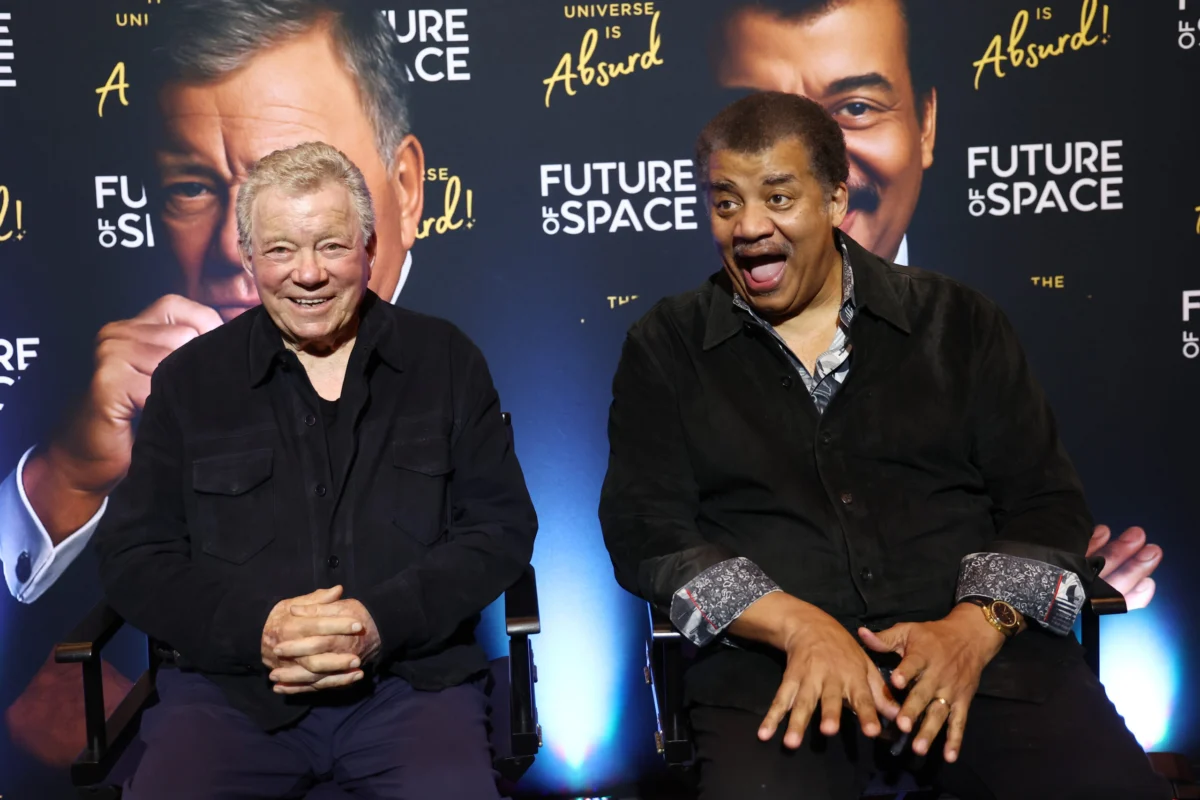
The event, meticulously organized by Future of Space, an organization dedicated to creating immersive experiences and dialogues around science and space themes, drew a diverse crowd to the historic Saban Theatre in Beverly Hills. Known for its rich history dating back to the 1930s and its opulent Art Deco architecture, the venue provided a fitting backdrop for a conversation spanning decades of scientific discovery and personal adventure. Attendees, ranging from curious laypersons to professionals in the aerospace industry—including at least one Blue Origin engineer noted by The Hollywood Reporter—were treated to a unique blend of scientific exposition, philosophical musings, and candid personal anecdotes from two close friends whose intellectual camaraderie was palpable throughout the evening.
A Friendship Forged in Ice: The Genesis of a Cosmic Duo
The bond between Shatner, 95, and Tyson, 65, is a relatively recent development, yet it has clearly blossomed into a deep friendship characterized by mutual respect and playful banter. Their connection, as revealed during the discussion, began in the most extraordinary of circumstances: a 2024 trip to Antarctica. This shared adventure to one of Earth’s most remote and awe-inspiring continents evidently cemented a rapport that now effortlessly bridges the realms of Hollywood stardom and astrophysics. The sight of these two formidable intellects, one a cultural titan of science fiction and the other a leading voice in scientific communication, exchanging barbs and insights offered a testament to their genuine connection, making the complex topics they explored feel remarkably accessible and engaging.
Unraveling Quantum Mysteries: The Infinitesimal and the Indivisible
A significant portion of the evening was dedicated to the mind-bending realm of quantum physics, a subject often perceived as intimidating but rendered digestible through Tyson’s masterful explanations and Shatner’s probing questions. Tyson captivated the audience by illustrating the baffling nature of the electron. "The electron is so small," he articulated, "we do not know how small it is. Every measurement of the electron is smaller than our attempts to measure it. As far as we’re concerned, it’s infinitesimally small." This concept, fundamental to quantum mechanics, challenges classical notions of matter and scale, suggesting a universe far stranger than our macroscopic intuition would allow.
The discussion then veered into the historical context of quantum theory. Tyson noted that Shatner, born in 1931, entered the world just a year before James Chadwick’s groundbreaking discovery of the neutron in 1932. This timeline provided a springboard for Tyson to explain the core tenets of quantum physics: "In the 1920s, we learned that the universe is not continually divisible. You reach a point, you have a certain amount of energy, then you have less energy and less and less and less. There’s a point where there’s a unit of energy and you cannot have less than that. That is a quantum of energy." This concept, pioneered by Max Planck in 1900 with his introduction of Planck’s constant, revolutionized physics by positing that energy, like matter, exists in discrete packets rather than continuous streams. It led to the development of quantum mechanics, which describes the behavior of matter and energy at atomic and subatomic levels, fundamentally altering our understanding of reality.
Shatner, ever the astute provocateur, challenged this assertion with historical precedent. He argued that scientists had previously made similar claims about the indivisibility of the atom, only to be proven wrong as further discoveries revealed subatomic particles. "They said it about every new discovery of the entrails of a molecule, of an atom," Shatner quipped, using a distinctly non-scientific term. When Tyson questioned his choice of "entrails," the Star Trek icon retorted, "I’m trying to use the language that I understand. It’s not your language because you are a Ph.D." Tyson, quick with a comeback, deadpanned, "Yeah, that word [entrails] didn’t appear in my thesis at all." This exchange, typical of their dynamic, highlighted the chasm and the bridge between scientific rigor and layman’s understanding, a theme central to public science communication.
From Starship Captain to Actual Astronaut: Shatner’s Journey to the Final Frontier
One of the most anticipated segments of the evening revolved around William Shatner’s historic 2021 space flight aboard Blue Origin’s New Shepard rocket. At 90 years old, Shatner became the oldest person to travel to space, a feat that resonated deeply with fans and space enthusiasts globally. He recounted the experience with vivid detail and a candidness that brought the audience into the capsule with him.

The journey began with an arduous climb up an 11-story gantry to reach the New Shepard capsule. Shatner vividly recalled a moment of apprehension upon noticing gas emanating from a vent. When informed it was hydrogen, his mind immediately conjured images of the Hindenburg disaster, a stark reminder of the inherent risks of rocketry. "So now, with trepidation, I enter the ship and I’m in the chair, a five-point buckle, and the countdown begins," he narrated. The tension escalated when ground control announced an "anomaly." Shatner recalled his internal panic: "What the fuck is an anomaly?" Despite the momentary scare, the countdown continued. Then came another chilling announcement: "All right, everybody, we’re removing the gantry. Anybody who wants to get off, get off now." His response, delivered with characteristic theatricality, encapsulated his public persona: "And I go, OK. And I think, ‘I can’t, I’m Captain Kirk. I can’t.’" This moment underscored the blend of human vulnerability and heroic resolve that defined his journey.
The launch itself was a visceral experience. Shatner described the intense G-forces as "an elephant sitting on your chest," a crushing sensation that abruptly ceased as the rocket reached its apogee, ushering in the profound weightlessness of suborbital flight. "And then suddenly it’s off and suddenly you’re floating," he concluded, capturing the sudden transition from extreme pressure to ethereal freedom. Once unbuckled, Shatner eschewed the playful antics of previous Blue Origin passengers, such as Jeff Bezos tossing Skittles. "I thought, ‘That’s not gonna be me,’" he joked, emphasizing his more reflective approach to the experience.
The Overview Effect and Grief for Earth
The most profound part of Shatner’s space journey, however, was his emotional reaction upon landing. He recounted being overwhelmed with uncontrollable weeping as Jeff Bezos, Blue Origin’s founder, greeted him with cameras rolling. "I’m crying uncontrollably, and I don’t know why," he admitted. After much reflection, he realized he was experiencing "grief" for the Earth. This emotional outpouring aligns with what astronauts often describe as the "Overview Effect"—a cognitive shift in awareness reported by some astronauts and cosmonauts during spaceflight, often while viewing the Earth from orbit. It involves a profound understanding of the interconnectedness of life and the fragility of our planet.
Shatner connected this grief to his prior experiences filming Voice of the Planet, a show that took him to environmentally imperiled locales. He recounted visiting the Himalayas, only to be aghast at the sheer volume of garbage left behind by hikers and climbers. "Shit is all over the place in this pristine mountains and it echoes the shit that we’ve left all over the planet," he lamented. His deep concern for environmental degradation was palpable, further amplified by the scientific revelation that "microplastics are floating in our blood. As I speak to you, I could drop dead from microplastics. It’s a tragic thing that we’re doing to our planet, and I was in grief for the Earth and the beauty that we see all around us." This powerful statement served as a poignant reminder of humanity’s impact on its home, seen through the unique lens of someone who had briefly ascended beyond it.
The Physics of Weightlessness: An Earthly Explanation
Following Shatner’s description of weightlessness, Tyson stepped in to provide a scientific explanation, addressing Shatner’s observation that the English language lacks an adequate term for this sensation due to its rarity. Tyson used a relatable analogy: cutting the cables in an elevator. A person inside a free-falling elevator would experience weightlessness because they and the elevator are accelerating downwards at the same rate; a scale beneath them would read zero. He then extended this to orbital mechanics: "If someone is just above the Kármán line, which is recognized as the official boundary of space, they are simply falling toward Earth at the same rate that Earth is curving away from them." The Kármán line, typically defined at 100 kilometers (62 miles) above mean sea level, is the altitude where the atmosphere becomes too thin for conventional aircraft to fly, meaning that at this point, orbital flight requires aerodynamic lift no longer, but rather centrifugal force. Tyson concluded, "So anybody in orbit is weightless because they are continually free-falling toward Earth, not because they’re in space." This explanation demystified a phenomenon often misunderstood, grounding the fantastical experience in the principles of physics.
Humans vs. Robots: The Soul of Exploration
The conversation then shifted to the enduring debate about the role of humans versus robots in space exploration. Shatner, who had previously questioned the necessity of sending "vulnerable" humans into space on The Late Show With Stephen Colbert, revealed a significant shift in his perspective since his own spaceflight. "The voyage of exploration, which going to Mars will be… needs to be experienced by a human being," he asserted. He articulated a profound belief that human consciousness, emotion, and intuition are indispensable for true discovery. "It takes the human being’s experience, it takes the soul, the brain, the conscious and the unconscious being that we are to experience this magical thing called exploration," he explained.
While acknowledging that "a cold robot can send back the facts probably better," Shatner emphasized that the qualitative, experiential dimension of exploration is uniquely human. "Only a human being can experience that. It’s not the same experience to send mechanical entities… What a marvelous thing for a human being to discover whatever there is to discover on Mars as opposed to a cold robot running along there and running out of power." His argument resonated with the human desire for direct engagement with the unknown, the romance of discovery that robots, however advanced, cannot replicate.

Tyson, ever the pragmatist with a flair for relatable summaries, distilled Shatner’s eloquent argument into a concise, memorable point: "Let’s summarize what you just said. No one has ever given a ticker-tape parade for a robot. No one has ever named a middle school after a robot." This quip perfectly encapsulated the human need for heroes, for relatable figures who embody our aspirations and expand our horizons, a role that robots, despite their immense utility, cannot fulfill in the collective imagination.
Shatner’s Heavy Metal Debut and a Legacy of Breaking Barriers
Amidst the cosmic contemplation, Shatner also surprised the audience with news of his forthcoming heavy metal album, slated for release in October. At 95, his ventures into new musical genres continue to defy expectations. "Why does everyone approach me with a smile when they hear ‘heavy metal album’?" Shatner deadpanned, aware of the incongruity. Later, bristling at applause for his age, he quipped, "I don’t like being applauded for my age. Applaud me for my heavy metal album." He even performed a song titled "Rage" from the album, backed by a trumpeter, showcasing his characteristic spoken-word style adapted to a heavier sound. This musical foray adds another fascinating chapter to a career already marked by artistic experimentation, including previous spoken-word albums like "The Transformed Man" and "Has Been," which garnered critical acclaim for their unique blend of poetry and pop culture.
Toward the close of the evening, Shatner shared a personal realization: "I know I feel an affinity toward this mysterious thing we call the universe and I’m beginning to understand my place in the great unknown." This reflective moment, encapsulating a lifetime of wonder and curiosity, prompted a poignant response from Tyson. "Do you know what your place in this great unknown is?" Tyson asked, before delivering a powerful historical affirmation: "You lip-kissed a Black woman on television for the first time."
Tyson was, of course, referring to the legendary "Plato’s Stepchildren" episode of Star Trek, which aired in 1968. In this iconic scene, Captain Kirk (Shatner) was forced to kiss Lt. Nyota Uhura (Nichelle Nichols). This moment, initially controversial, became a watershed event in television history, widely recognized as the first interracial kiss on American network television. It occurred during a tumultuous period of the Civil Rights Movement, making its impact profoundly significant. The kiss transcended mere entertainment, becoming a powerful statement against racial segregation and a symbol of hope for a more inclusive future. Nichols herself famously recounted how Dr. Martin Luther King Jr. persuaded her to stay on Star Trek, emphasizing the importance of her character as a positive role model for Black children. Tyson’s acknowledgment underscored Shatner’s inadvertent yet undeniable contribution to social progress, placing his cultural legacy firmly within the broader narrative of human advancement.
A Grand Finale and Continued Engagement
The evening concluded with a blend of artistic expression and scientific gravitas. Tyson, accompanied by a pianist, read three meaningful quotes along with the concluding paragraphs of his 2007 book, Death by Black Hole: And Other Cosmic Quandaries, leaving the audience with a sense of wonder and intellectual contemplation. Shatner’s performance of "Rage" further demonstrated his boundless energy and willingness to explore new creative avenues.
Following the formal presentation, the pair participated in a meet and greet for VIP ticket holders. Tyson, in particular, remained for an extended period, engaging with fans on a wide array of topics, from the mysteries of alien life to the rapidly evolving landscape of artificial intelligence. This post-event interaction underscored the dedication of both figures to connecting with their audience and fostering a shared sense of curiosity about the universe and humanity’s place within it. The event, a testament to the power of cross-disciplinary dialogue, left attendees not only entertained but also enriched with new perspectives on science, human experience, and the truly absurd, yet wondrous, nature of the cosmos.