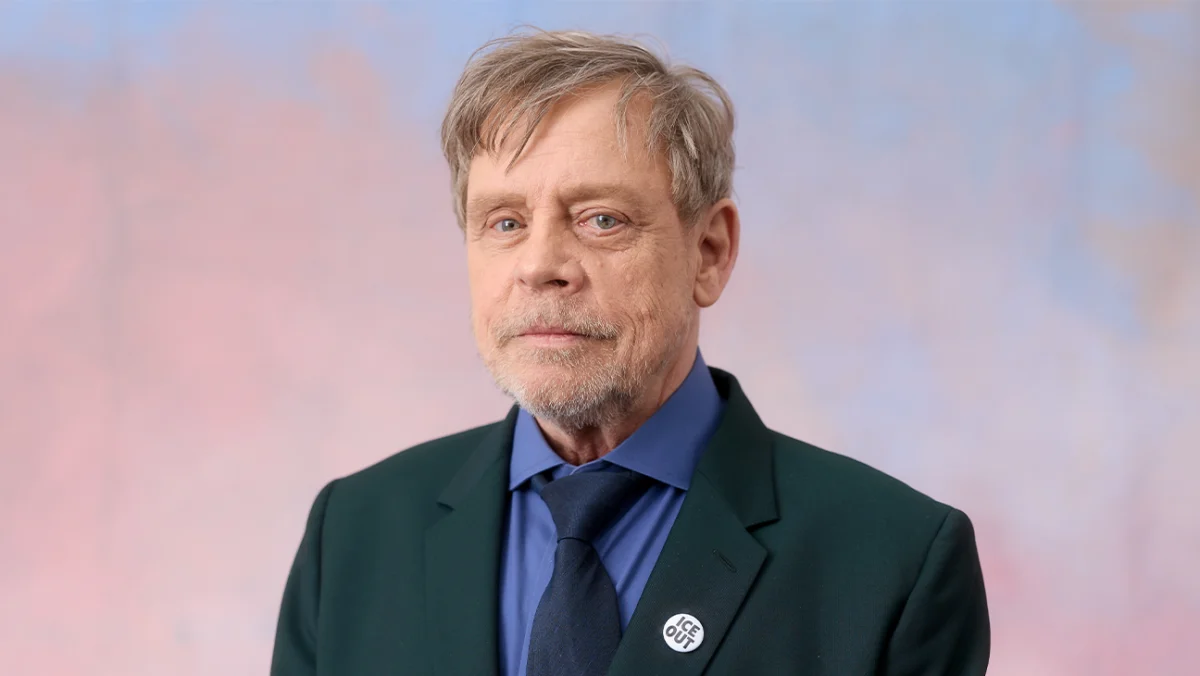
The long-standing public animosity between iconic Star Wars actor Mark Hamill and former President Donald Trump escalated dramatically this week following a provocative social media post by Hamill depicting Trump in a grave. The incident, which quickly went viral before Hamill deleted the original image, sparked a swift and scathing rebuke from the White House’s rapid response team, igniting a broader discussion about the boundaries of political commentary, social media ethics, and the perceived impact of inflammatory rhetoric in a deeply polarized nation.
The Genesis of the Controversy: A Deleted Image and a Potent Caption
On Wednesday, May 7, 2026, Mark Hamill, widely recognized for his portrayal of Luke Skywalker, shared an image on his Bluesky account that immediately drew widespread attention and controversy. The photo, a digitally manipulated or satirical graphic, depicted Donald Trump lying in what appeared to be an open grave, with a tombstone situated behind him. The headstone prominently featured the dates "1946-2024," implying the former president’s demise. Adding to the image’s provocative nature, the words "If Only" were superimposed across the graphic, underscoring a sentiment of wishful thinking from the poster.
Accompanying this striking visual, Hamill included a caption that left little ambiguity regarding his intentions, despite the later clarification. He wrote, "If Only- He should live long enough to witness his inevitable devastating loss in the midterms, be held accountable for his unprecedented corruption, impeached, convicted & humiliated for his countless crimes. Long enough to realize he’ll be disgraced in the history books, forevermore. don_TheCON." The caption, a litany of grievances and aspirations for Trump’s political and legal downfall, clearly articulated Hamill’s deep-seated opposition to the former president, framing the "If Only" not as a wish for physical death, but for a comprehensive public and political reckoning. The inclusion of "don_TheCON" further echoed a common pejorative used by Trump’s critics.
The post, even before its deletion, rapidly circulated across social media platforms, amplified by both supporters and detractors of Hamill. While some lauded the actor for his outspoken criticism, others condemned the image as tasteless, disrespectful, and potentially dangerous, particularly given the volatile political climate. The use of a grave and a death date, regardless of the accompanying text, proved to be the central point of contention, overshadowing Hamill’s stated desire for accountability rather than actual harm.
White House Rapid Response: A Vehement Counter-Attack
The reaction from Donald Trump’s political apparatus was swift and unsparing. The White House’s "Rapid Response 47" communications account, known for its aggressive defense of the former president and counter-attacks against his critics, quickly engaged on X (formerly Twitter). The account shared a screenshot of Hamill’s original Bluesky post, ensuring its wider dissemination even as Hamill moved to delete it from his own platform.
In its accompanying text, the Rapid Response 47 account labeled Hamill "one sick individual." The post continued, "These Radical Left lunatics just can’t help themselves. This kind of rhetoric is exactly what has inspired three assassination attempts in two years against our President." This statement marked a significant escalation, directly linking Hamill’s social media commentary to serious threats against a political figure. The claim of "three assassination attempts in two years" was a stark and alarming accusation, designed to frame Hamill’s post within a broader pattern of dangerous political extremism emanating from what the account termed the "Radical Left."
The White House’s response served multiple purposes: to condemn Hamill publicly, to rally Trump’s base by portraying him as a victim of extreme opposition, and to deflect any potential criticism of Trump by turning the focus onto the perceived extremism of his opponents. This strategy is characteristic of political rapid response operations, which often aim to control narratives and demonize critics by associating their actions with more severe implications. The use of terms like "sick individual" and "Radical Left lunatics" exemplifies the often-harsh rhetoric employed in contemporary political discourse.
Hamill’s Clarification and the Nuance of Intent
Following the intense backlash and the White House’s direct accusation, Mark Hamill returned to Bluesky on Thursday, May 8, 2026, to offer a clarification. Recognizing the controversy generated by the image, he posted again, this time explicitly titling his update an "Accurate Edit for Clarity."
In his follow-up, Hamill stated, "‘He should live long enough to… be held accountable for his… crimes.’ Actually, I was wishing him the opposite of dead, but apologize if you found the image inappropriate." This statement attempted to reframe the "If Only" sentiment, emphasizing that his desire was for Trump to face legal and political consequences while alive, rather than expressing a wish for his death. He acknowledged the problematic nature of the image itself, offering an apology for its potential misinterpretation or offense. Crucially, alongside this apology and clarification, Hamill reiterated his original comments about Trump facing accountability and humiliation for perceived corruption and crimes. He also posted a new photo of the former president, this time depicting him with exaggerated, "wild hair," a less morbid and more satirical image, perhaps in an effort to demonstrate his intent for political caricature rather than literal malice.
Hamill’s decision to clarify and apologize for the "inappropriate" image, while standing by his core criticism, highlights the tightrope walk public figures often navigate on social media. The visual component of a post can sometimes overpower its textual context, leading to misinterpretations and unintended consequences, especially in a highly charged political environment. His clarification aimed to draw a distinction between his strong political opposition and any implication of wishing physical harm, a distinction often lost in the heat of online debates.
A History of Opposition: Mark Hamill’s Consistent Anti-Trump Stance
Mark Hamill’s recent post and the subsequent skirmish are by no means an isolated incident but rather the latest chapter in a long and very public history of the actor’s fervent opposition to Donald Trump. Hamill has been one of Hollywood’s most vocal critics of the former president, consistently using his significant platform to express his disapproval of Trump’s policies, rhetoric, and conduct.
His activism has taken various forms, from scathing tweets and social media posts to participating in political advertisements. In previous election cycles, Hamill lent his voice and celebrity to campaigns opposing Trump, including appearing in ads for the Biden-Harris ticket. His criticism often employs humor and satire, but also direct and unambiguous condemnations. For instance, he has frequently mocked Trump’s speeches and public appearances, sometimes even using his iconic Joker voice (from his extensive voice acting work) to lampoon Trump’s statements, drawing parallels between the former president’s style and that of a comic book villain.
This consistent stance underscores a broader trend of celebrity political engagement. From Hollywood legends to music icons, many public figures leverage their influence to support or oppose political candidates and causes. While some argue that celebrities should remain apolitical, others contend that they, like any citizen, have a right and even a responsibility to speak out on issues they care about, particularly given their reach. Hamill’s long-standing activism positions him firmly in the latter camp, making his latest controversial post understandable within the context of his established political identity.
A notable anecdote illustrating the depth of Hamill’s aversion to Trump occurred after the 2020 election. Hamill revealed that he had seriously considered leaving the United States if Trump were re-elected in 2024 (a slight chronological discrepancy in the original article, as Trump was not re-elected in 2024, but the sentiment remains). He recounted to The Times that his wife, Marilou Hamill, ultimately convinced him to stay. "She’s very clever," he previously told The Times. "She didn’t respond right away, but a week later she said, ‘I’m surprised you would allow him to force you out of your own country.’ That son of a bitch, I thought. I’m not leaving." This personal revelation highlights the profound emotional impact Trump’s presidency had on Hamill, demonstrating that his political commentary stems from deeply held convictions rather than mere fleeting opinions.
The Broader Landscape: Political Rhetoric, Social Media, and the Threat of Violence
The exchange between Mark Hamill and the White House Rapid Response 47 account is more than just a celebrity feud; it reflects several critical dynamics in contemporary American politics. The claim by the White House account that "This kind of rhetoric is exactly what has inspired three assassination attempts in two years against our President" introduces a grave and highly contentious element into the discussion. While political rhetoric has long been debated for its potential to incite, directly linking specific social media posts to assassination attempts is a serious accusation that requires careful consideration.
The history of political violence in the United States is complex and tragic, with instances ranging from the assassinations of presidents and civil rights leaders to attacks on political rallies and individual politicians. In recent years, concerns about the rise of politically motivated violence have intensified, fueled by deep partisan divisions, the spread of misinformation, and the often-incendiary nature of online discourse. Studies by organizations monitoring political extremism have noted an uptick in threats against public officials and a general coarsening of the political environment.
Social media platforms play a dual role in this landscape. They democratize communication, allowing voices like Hamill’s to reach millions directly, bypassing traditional media gatekeepers. However, they also create echo chambers, facilitate the rapid spread of misinformation and inflammatory content, and can contribute to a sense of dehumanization of political opponents. The anonymity or semi-anonymity of online interactions often lowers inhibitions, leading to more aggressive and less civil exchanges than might occur in face-to-face interactions. Platforms like Bluesky and X, while having content moderation policies, struggle to police the vast volume of content and the nuances of intent versus interpretation.
The White House’s claim of "three assassination attempts in two years" against "our President" (presumably referring to Donald Trump, even though he is no longer the sitting president, but rather the leading candidate for the 2024 election) would require substantiation. Such claims, if unverified, can themselves be a form of inflammatory rhetoric, designed to heighten a sense of victimhood and demonize opponents. It’s critical for public discourse to differentiate between strong criticism, satire, and direct incitement to violence. While Hamill’s image was provocative, his stated intent was for legal and political accountability, not physical harm. However, the interpretation of such imagery in a highly charged atmosphere can easily diverge from the author’s original intent.
Implications for Public Figures and the Future of Political Discourse
This incident carries several implications for public figures and the broader political landscape. For celebrities like Mark Hamill, their immense reach comes with increased scrutiny and responsibility. While they have the right to free speech, their words and images carry greater weight and can be interpreted in myriad ways by a diverse audience, some of whom may not grasp satire or nuance. The rapid-fire nature of social media means that a post can go viral and elicit official responses before the creator has a chance to clarify.
The episode also underscores the challenges of maintaining civility and respectful debate in an era of extreme political polarization. When a popular actor posts an image suggesting a political opponent’s death (even metaphorically for accountability), and a political office responds by linking it to assassination attempts, the rhetorical bar is significantly lowered. This dynamic contributes to a cycle of escalation where each side feels justified in its outrage and counter-attacks, making productive dialogue increasingly difficult.
Furthermore, the incident highlights the ongoing debate about content moderation on social media. While Hamill deleted his post, the question of whether platforms should proactively remove such content, and where the line is drawn between offensive political commentary and harmful rhetoric, remains a complex and contentious issue. Different platforms have varying policies, and the application of these policies often faces criticism from all sides of the political spectrum.
In conclusion, the renewed public feud between Mark Hamill and Donald Trump, sparked by a controversial social media post, serves as a microcosm of the intense and often volatile political climate in the United States. It showcases the power of celebrity voices, the instant and far-reaching impact of social media, and the perilous tightrope walk between political expression and perceived incitement. As the nation gears up for future elections, such exchanges are likely to continue, pushing the boundaries of acceptable discourse and forcing a continuous reevaluation of how public figures, political entities, and citizens engage with each other in an increasingly interconnected and polarized world. The incident ultimately underscores the enduring challenge of navigating free speech in an age where a single image can ignite a national debate and draw official condemnation, regardless of the author’s clarified intent.