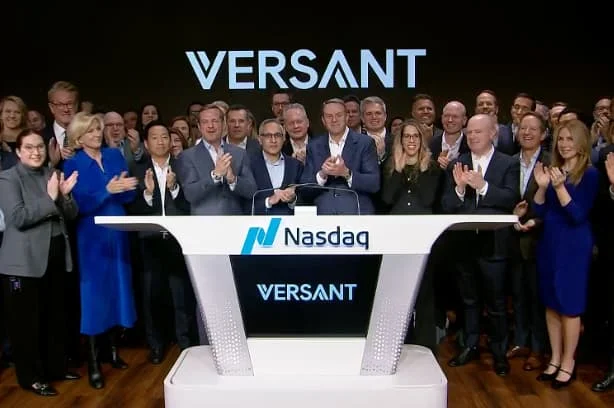
Versant Media Group is scheduled to release its first quarterly earnings report as a publicly traded entity this Tuesday, marking a pivotal moment for the media industry as investors receive their first comprehensive look at the financial health of the newly independent company. The report follows the company’s high-profile debut on the Nasdaq on January 5, 2026, a move that culminated from one of the most transformative corporate restructurings in recent media history. As a spinoff from Comcast Corporation, Versant Media Group represents a concentrated bet on the enduring value of cable networks and digital media properties at a time when the traditional pay-TV model faces unprecedented structural headwinds.
The upcoming disclosure is expected to provide granular detail on a portfolio that includes some of the most recognizable brands in American television, including CNBC, MS Now, USA Network, Golf Channel, Syfy, E!, and Oxygen. Beyond linear television, the company also controls a suite of influential digital and transactional platforms, such as the movie ticketing giant Fandango, the review aggregator Rotten Tomatoes, and niche digital services like GolfNow and Sports Engine. For years, these assets were consolidated within the broader NBCUniversal television results, often overshadowed by the growth of streaming services and the scale of Comcast’s connectivity business. Now, as a standalone "pure-play" media company, Versant must prove it can manage the decline of traditional cable while scaling its digital alternatives.
The Genesis of Versant: A Strategic Separation
The path to Versant’s independence began in late 2024 when Comcast announced its intention to spin off its cable networks into a separate public company. The decision was widely interpreted as a strategic maneuver to insulate Comcast’s core broadband and wireless businesses from the secular decline of the cable bundle. By offloading these networks—many of which were once the crown jewels of the NBCUniversal acquisition—Comcast sought to provide shareholders with a clearer growth narrative centered on high-speed internet and theme parks.
Following the announcement, the transition was led by Mark Lazarus, who assumed the role of CEO of Versant Media Group. Lazarus, a veteran media executive with deep roots in sports and news broadcasting, spent much of 2025 preparing the organization for its public debut. This preparation included an investor day in December 2025, where the leadership team outlined a "business model transition" intended to shift the company’s reliance away from traditional distribution fees toward a more diversified revenue stream.
Financial Performance and Market Reception
Ahead of its January listing, Securities and Exchange Commission (SEC) filings revealed the financial reality facing Versant’s assets. The company’s portfolio generated $7.1 billion in revenue in 2024, a figure that highlighted a downward trajectory from $7.4 billion in 2023 and $7.8 billion in 2022. This steady erosion of the top line reflects the broader industry trend of "cord-cutting," as millions of American households opt for streaming services over traditional cable packages.
Despite these challenges, Versant debuted with a market capitalization of approximately $6.4 billion. However, the first two months of trading have been volatile. The stock has retreated by roughly 25% since its January 5 opening, bringing its current market capitalization to approximately $4.8 billion. Market analysts attribute much of this decline to technical selling pressure typically associated with spinoffs, as institutional investors who held Comcast shares for its dividend or broadband exposure divest their newly issued Versant shares, which carry a different risk profile.
The Tuesday earnings report will be the first opportunity for the company to address this stock performance with hard data. Investors will be looking for signs that the rate of revenue decline is stabilizing and for updates on the company’s cost-management strategies.
The Anchor of Live Programming: Sports and News
A central pillar of Versant’s pitch to the investment community is its concentration on live, "appointment-viewing" content. During the December investor day, CEO Mark Lazarus emphasized that 62% of the company’s audience is driven by live sports and news programming. Unlike scripted dramas or sitcoms, which are easily replicated on on-demand streaming platforms, live news (CNBC and MS Now) and sports (Golf Channel and USA Network’s various rights) remain the primary reasons consumers retain their cable subscriptions.
Analysts at Raymond James have noted that Versant’s portfolio is uniquely positioned compared to peers who own a larger number of "lower-value" general entertainment networks. While Versant lacks the massive "Tier One" rights of the NFL or the NBA, its secondary sports lineup—including significant golf rights, NASCAR, and WWE—provides essential value to cable distributors. This value is critical for maintaining "carriage" in the basic cable bundle, ensuring that Versant continues to collect affiliate fees from providers like Comcast, Charter, and Cox.
Distribution Stability and Upcoming Risks
One of the most significant advantages Versant carried into its spinoff was a set of long-term distribution agreements negotiated by NBCUniversal prior to the separation. These deals with major providers, including Charter Communications and Google’s YouTube TV, ensure that Versant’s networks will remain available to the majority of pay-TV subscribers through at least 2027 or 2028.
"More than half of our pay-TV subscribers are governed by agreements that go through 2028 and beyond," stated Anand Kini, Versant’s COO and CFO. "We view this as really important because the long-term nature of these partnerships highlights the stability of our business and also provides great visibility in the years to come."
However, this stability will soon be tested. According to industry sources, two significant distribution agreements are up for renewal later this year. These negotiations will serve as the first real-world test of Versant’s leverage as an independent company. In an era where content blackouts are becoming increasingly frequent—as seen in recent disputes between Disney and Charter—the outcome of these talks will be a major indicator of Versant’s long-term viability.
The Digital Pivot and M&A Strategy
While the cable networks provide the bulk of the company’s current cash flow, the long-term growth strategy is focused on digital platforms. Versant’s leadership has set an ambitious goal: a 50/50 revenue split between traditional pay-TV and digital/transactional businesses.
To achieve this, the company is leaning heavily on Fandango and Rotten Tomatoes. These properties offer a direct-to-consumer relationship that is untethered from the cable bundle. Recent acquisitions have further signaled this intent. Versant recently completed the purchase of Free TV Networks, a provider of over-the-air digital broadcast channels, and Indy Cinema Group, a cloud-based cinema operating system that has been integrated into Fandango’s operations.
These moves suggest that Versant is positioning itself not just as a broadcaster, but as a comprehensive entertainment infrastructure company. By owning the ticketing platform (Fandango), the critical consensus (Rotten Tomatoes), and the broadcast channels, Versant aims to capture value at multiple points in the entertainment lifecycle.
Broader Industry Context and Analyst Outlook
Versant’s journey is being closely watched as a bellwether for the "pure-play" media model. The recent history of similar ventures has been mixed. Newsmax, which went public on the NYSE last year, saw an initial surge in share price followed by a steep decline, illustrating the market’s skepticism toward linear-heavy assets.
Furthermore, the broader media landscape remains in a state of flux. Warner Bros. Discovery recently contemplated a similar split of its assets before ultimately moving toward a merger-and-acquisition path with Paramount Skydance. This highlights the ongoing debate in boardrooms: is it better to be a massive, diversified conglomerate, or a lean, focused entity?
Wall Street analysts remain cautious but intrigued. Goldman Sachs analysts initiated coverage with a "Neutral" rating in January, citing the "secular challenges in the linear networks business" while expressing encouragement regarding the company’s efforts in the digital platform space. Conversely, some value-oriented investors see Versant as a "cash cow" play, betting that the company can generate enough free cash flow from its declining cable business to fund a successful transition to a digital future.
Conclusion: A Litmus Test for Media
As the markets prepare for Tuesday’s report, the focus will be on whether Versant can prove that there is a sustainable "middle ground" in the media industry. If the company can demonstrate that its news and sports assets are resilient enough to offset the decline in general entertainment, it may provide a blueprint for other media giants looking to unlock value through spinoffs.
The first quarterly report will not solve all of Versant’s challenges, but it will provide the data necessary for Wall Street to determine if the company’s $4.8 billion valuation represents a bargain or a warning sign of further declines to come. For Mark Lazarus and his executive team, the task is clear: they must convince the market that Versant is not a "legacy" company in its twilight, but a transitioning power in the new media economy.