
The cinematic landscape often sees ambitious projects that challenge conventional storytelling, and few films embody this spirit as profoundly as Darren Aronofsky’s 2006 epic, The Fountain. Recently, a re-examination of its original theatrical trailer has resurfaced, offering a poignant reminder of its singular vision and the complex journey of its creation. Released nearly two decades ago, The Fountain remains a testament to artistic perseverance, a film that, despite a tumultuous production and a modest box office performance, has cultivated a dedicated cult following and continues to spark debate and admiration for its profound exploration of love, loss, and the human quest for immortality.
The Genesis of an Ambitious Vision
Darren Aronofsky, already lauded for his distinct directorial voice demonstrated in Pi (1998) and the critically acclaimed Requiem for a Dream (2000), embarked on The Fountain as his third feature film. The project was conceived as an intensely personal narrative, reportedly inspired by conversations with his then-partner, actress Rachel Weisz, about the fear of death and the desire for eternal life. Aronofsky envisioned a sprawling, multi-temporal narrative spanning a millennium, interweaving three distinct yet thematically linked storylines. His initial ambition for the film was monumental, attracting significant interest from Hollywood.
The first iteration of The Fountain‘s production began in 2002 with a substantial $70 million budget, a figure indicative of a major studio production. Brad Pitt was cast in the lead male role, with Cate Blanchett slated to play the female protagonist. This high-profile casting and substantial budget signaled Warner Bros.’ initial confidence in Aronofsky’s unique vision. However, the production faced significant challenges, primarily stemming from creative differences between Aronofsky and Pitt. Reports at the time suggested Pitt’s discomfort with aspects of the script and the director’s unconventional approach led to his abrupt withdrawal just weeks before principal photography was set to commence. This unforeseen setback, coupled with escalating pre-production costs, forced Warner Bros. to halt the project indefinitely. The collapse of this initial production was a severe blow, leaving the future of The Fountain in jeopardy and Aronofsky’s artistic vision on the brink of abandonment.
Resurrection and Reimagination: The Film’s Rebirth

Undeterred by the initial failure, Aronofsky spent the subsequent years meticulously rewriting the script. His goal was not to compromise the core essence of his narrative but to streamline it, making it "sparser" and more focused, enabling production with a significantly reduced budget. This period of intense creative re-evaluation proved crucial, transforming the script into a more distilled and poignant work. By 2004, Aronofsky had successfully resurrected the project, securing a new budget of $35 million—less than half of its original allocation. This financial constraint necessitated a more inventive approach to visual effects and production design, ironically leading to some of the film’s most distinctive aesthetic choices.
With the project re-greenlit, a new cast was assembled. Hugh Jackman stepped into the multifaceted lead role, portraying Tomas, Tommy, and Tom across different eras. His commitment to the physically and emotionally demanding parts was immediate and profound. Rachel Weisz, who had remained attached to the project despite its initial collapse and shared a deep personal connection to the story’s themes, was cast as Izzi, the object of Tommy’s eternal devotion. The supporting cast included veteran actress Ellen Burstyn, Stephen McHattie, Mark Margolis, and Cliff Curtis, whose portrayal of a conquistador added a historical dimension to the narrative.
Filming commenced under a renewed sense of purpose. Aronofsky, faced with budget limitations, opted for practical effects and innovative visual techniques over extensive computer-generated imagery. A notable example is the film’s stunning cosmic sequences, which were achieved through macro-photography of chemical reactions and microscopic organisms, creating an organic, ethereal aesthetic that remains unique in cinema. This artistic choice not only conserved funds but also imbued the film with a timeless, handcrafted quality, distinguishing it from the CGI-heavy blockbusters of its era.
A Tapestry of Themes: Love, Death, and the Infinite
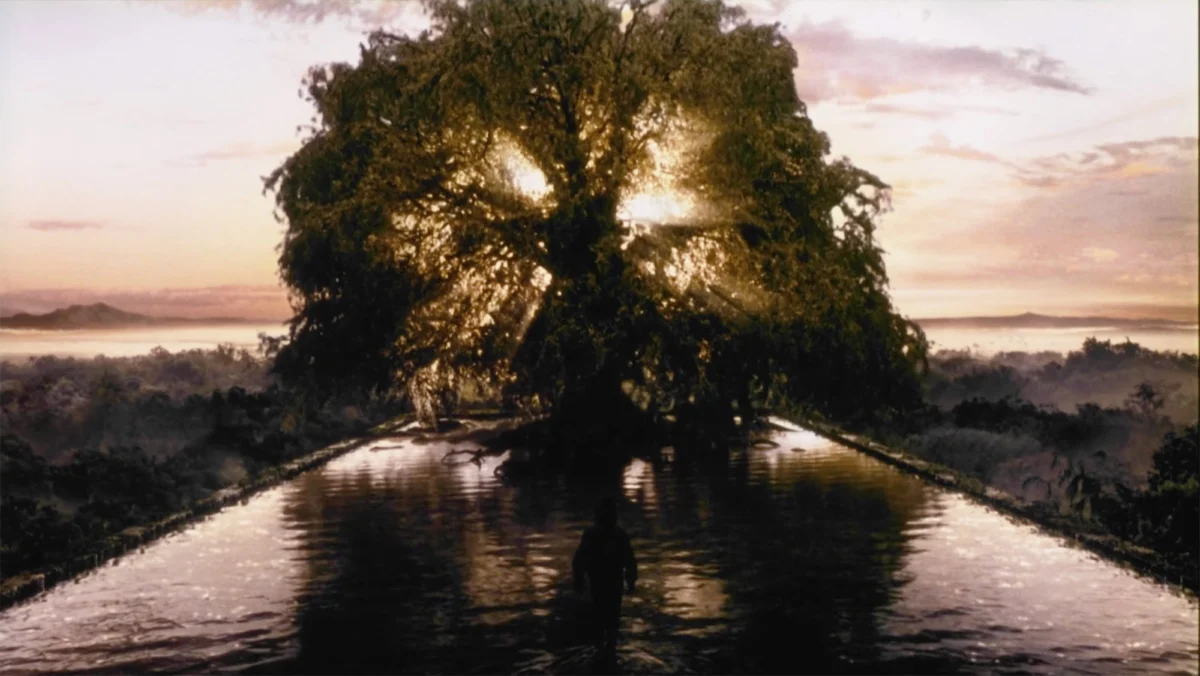
The Fountain is a deeply philosophical film, weaving together three seemingly disparate timelines to explore universal themes. The primary narrative centers on Tommy Creo (Jackman), a modern-day scientist desperately searching for a cure for his wife Izzi’s (Weisz) brain tumor. His scientific quest for immortality is juxtaposed with two other storylines: one set in 16th-century Mesoamerica, where a conquistador named Tomas (also Jackman) seeks the mythical Tree of Life for his Queen Isabella (Weisz); and another set in a distant future, where a bald astronaut named Tom (Jackman) travels through space with a dying tree, enclosed in a bubble, on a journey to a golden nebula.
At its core, the film is a meditation on mortality and the human desire to transcend death. It grapples with grief, the acceptance of impermanence, and the spiritual notion of rebirth and interconnectedness. The recurring motif of the Tree of Life serves as a powerful symbol, representing eternal life, wisdom, and the cycle of existence. Mayan mythology, particularly the concept of Xibalba (the underworld), provides a rich cultural backdrop for the conquistador segment, grounding the fantastical elements in ancient spiritual traditions. The film ultimately suggests that true immortality lies not in defying death but in embracing life, love, and the cyclical nature of existence. As the evocative line from the trailer states, "Our bodies are prisons for our souls," hinting at a liberation that comes with understanding life’s transient beauty.

The Sonic Soul: Clint Mansell’s Iconic Score
Integral to The Fountain‘s profound emotional impact is its masterful score, composed by Clint Mansell. Mansell, a frequent collaborator with Aronofsky, crafted a musical landscape that is as ambitious and emotionally resonant as the film itself. The score, primarily featuring string arrangements, piano, and subtle electronic textures, provides a powerful undercurrent to the narrative, guiding the audience through moments of despair, hope, and transcendental awe.
The track "Death Is the Road to Awe" has become particularly iconic, transcending the film to become a widely recognized piece of contemporary classical music, frequently used in other media. Mansell’s compositions for The Fountain are not mere accompaniment; they are an essential storytelling element, articulating the characters’ inner turmoil, the vastness of space, and the enduring power of love. The score’s ability to evoke profound emotion without relying on dialogue or overt exposition is a testament to Mansell’s genius and his deep understanding of Aronofsky’s vision. It remains one of the most celebrated film scores of the 21st century.
Initial Release and Critical Reception
Warner Bros. released The Fountain in US theaters on November 22nd, 2006. Despite its artistic ambition and the star power of Jackman and Weisz, the film struggled at the box office. It garnered a domestic total of approximately $10.1 million and a worldwide gross of just $16.5 million against its $35 million production budget. This commercial underperformance can be attributed to several factors, including its unconventional narrative structure, philosophical depth, and a marketing campaign that struggled to convey the film’s unique genre-defying nature to a broad audience. It was not a typical Hollywood offering, and its intellectual and spiritual themes were perhaps too niche for mainstream success at the time.
Critically, The Fountain received a polarizing reception upon its release. Review aggregators like Rotten Tomatoes report a "mixed or average" score, reflecting the divisive opinions among critics. Many praised Aronofsky’s audacious vision, the stunning cinematography by Matthew Libatique, the innovative visual effects, and Mansell’s unforgettable score. Hugh Jackman and Rachel Weisz also received commendation for their committed performances across multiple roles. However, some critics found the narrative to be overly abstract, pretentious, or difficult to follow, citing its ambitious themes as occasionally overshadowing coherent storytelling. The film’s non-linear structure and symbolic imagery alienated some viewers accustomed to more straightforward narratives.

Cult Status and Enduring Legacy
Despite its initial commercial and critical challenges, The Fountain has steadily gained recognition as a cult classic in the years following its release. Its unique blend of science fiction, fantasy, historical drama, and spiritual allegory has resonated deeply with a dedicated audience who appreciate its profound themes and artistic bravery. The film’s "rewatchability" is often cited by fans, who find new layers of meaning and emotional depth with each viewing.
The Fountain‘s legacy extends beyond its dedicated fanbase. It cemented Aronofsky’s reputation as a fearless auteur, willing to take significant creative risks even after a major setback. The film demonstrated his resilience and unwavering commitment to his artistic vision, proving that even a compromised production budget could not stifle his unique storytelling. This experience arguably influenced his subsequent acclaimed works like The Wrestler (2008) and Black Swan (2010), showcasing his ability to craft deeply personal and emotionally resonant narratives across various genres.
Discussions surrounding The Fountain continue in academic circles and online forums, with analyses dissecting its intricate symbolism, philosophical underpinnings, and narrative ambiguities. Its visual and auditory splendor, particularly Mansell’s score, ensures its continued presence in cinematic discussions about original filmmaking. There is a persistent desire among its adherents for a theatrical re-release, a testament to the belief that the film’s immersive visual and sound design truly deserves to be experienced on the big screen, allowing audiences to fully appreciate its grandeur and intricate details.
In conclusion, Darren Aronofsky’s The Fountain stands as a unique and indelible mark on modern cinema. It is a film born from creative struggle and artistic defiance, a testament to the power of a singular vision. While it may not have achieved mainstream success upon its debut, its enduring power lies in its ability to provoke thought, stir emotion, and inspire a deep appreciation for storytelling that dares to venture into the most profound questions of human existence. Its trailer, revisited today, serves as a powerful gateway to a film that continues to captivate, challenge, and ultimately, awe.