


The Walt Disney Company reported quarterly revenue and earnings on Monday that exceeded Wall Street’s expectations, bolstered by a historic performance in its experiences segment, which includes theme parks, resorts, and its burgeoning cruise line. Despite the financial beat, the company’s stock faced a 7% decline in early trading as investors weighed a cautious outlook for the second quarter and the looming decision regarding the successor to Chief Executive Officer Bob Iger. The fiscal first quarter, which concluded on December 27, 2025, showcased a company in the midst of a profound structural transition, balancing the legacy of linear television against the high-growth potential of streaming and the reliable profitability of its physical destinations.
Financial Performance and Quarterly Highlights
For the fiscal first quarter, Disney reported overall revenue of approximately $26 billion, representing a 5% increase year-over-year. This figure surpassed the consensus estimates provided by analysts via LSEG. Net income for the period stood at $2.48 billion, or $1.34 per share. While this was a slight decrease from the $2.64 billion, or $1.40 per share, recorded in the prior-year period, the company’s adjusted earnings per share (EPS) told a more robust story. When accounting for one-time items, such as tax charges linked to the company’s recent acquisition of a majority stake in Fubo, Disney reported an adjusted EPS of $1.63.
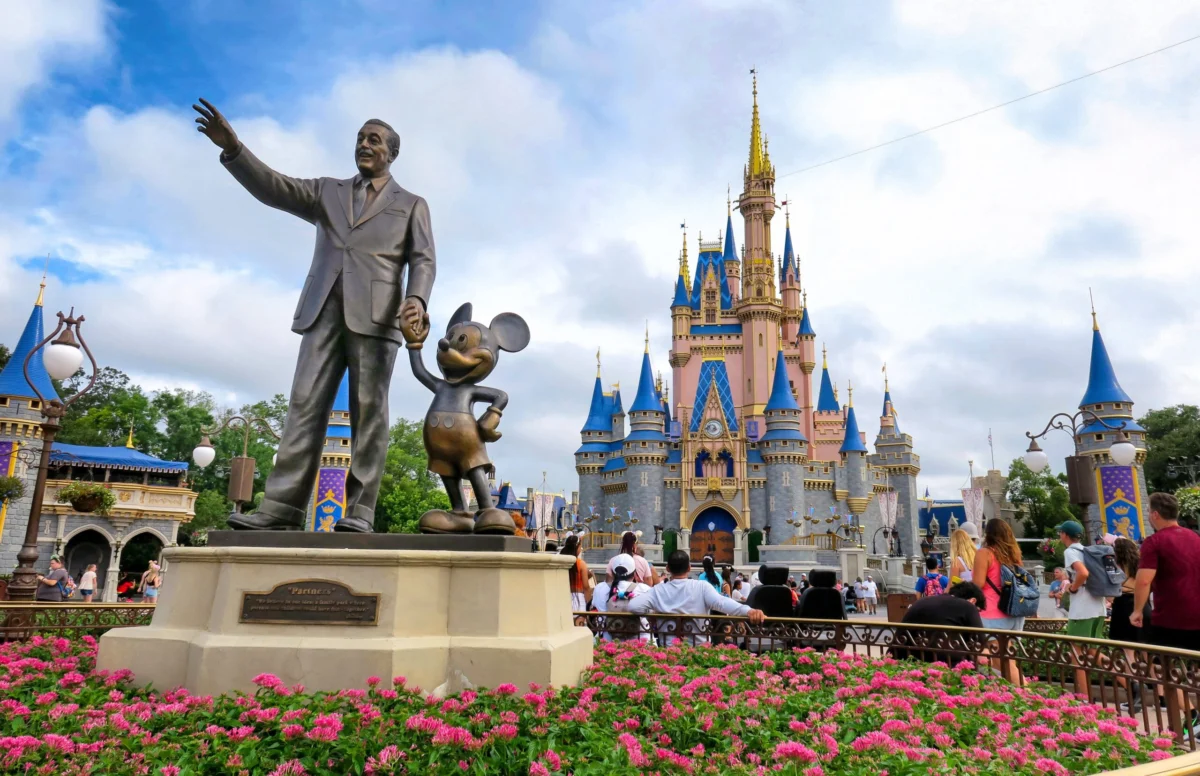
The standout performer of the quarter was the Disney Experiences unit. CFO Hugh Johnston confirmed to CNBC that the segment generated more than $10 billion in quarterly revenue for the first time in the company’s history. Domestic theme parks were the primary engine of this growth, recording $6.91 billion in revenue, a 7% increase compared to the same quarter last year. International parks also saw a 7% revenue bump, reaching $1.75 billion. However, Johnston noted a divergence in consumer behavior: while domestic attendance remained strong, international visitation to U.S.-based parks showed signs of softening, a trend the company is monitoring closely as it moves into the second half of the fiscal year.
The Experiences Division: A Pillar of Stability
The record-breaking $10 billion revenue mark for the experiences division underscores its role as Disney’s primary profit driver. During the first quarter, this segment reported $3.31 billion in operating income, a 6% increase year-over-year. This figure is particularly striking when compared to the entertainment division, which produced $1.1 billion in operating income—nearly a third of what the parks and cruises generated.
Josh D’Amaro, Chairman of Disney Experiences, has overseen a period of "turbocharging" the parks, a strategy aimed at maximizing capacity and per-guest spending through technological integration and intellectual property (IP) expansion. However, the company issued a tempered outlook for the second quarter, anticipating "modest" growth in operating income for the unit. This caution is attributed to several factors, including the aforementioned "headwinds" in international visitation and significant capital expenditures. Disney is currently preparing for the launch of a new ship in the Disney Cruise Line fleet and is finalizing the "World of Frozen" expansion at Disneyland Paris, both of which carry substantial pre-launch and pre-opening costs.
Streaming Profitability and Theatrical Success
Disney’s entertainment segment, which encompasses its streaming services, theatrical releases, and linear networks, reported total revenue of $11.61 billion, up 7% from the previous year. A significant portion of this growth was driven by the streaming business—comprising Disney+ and Hulu—where revenue rose 11% to $5.35 billion.
In a strategic shift mirroring Netflix’s policy change last year, Disney has ceased reporting specific subscriber numbers, choosing instead to focus on revenue and operating income as the primary metrics for streaming health. The company projected that its streaming unit will achieve approximately $500 million in operating income in the second fiscal quarter, an increase of roughly $200 million compared to the same period in 2025. This move toward consistent profitability in streaming is a cornerstone of Bob Iger’s return strategy.
The theatrical unit also provided a boost, following a dominant 2025 box office performance. Key contributors during the quarter included Zootopia 2 and new installments within the Avatar and Predator franchises. This resurgence in cinema is vital for Disney, as theatrical hits feed the content pipeline for Disney+ and provide fresh IP for theme park attractions, creating a "flywheel" effect that sustains the company’s various business arms.

Sports and the ESPN Transition
The sports segment, now reported separately from other linear and entertainment businesses, remains a complex area of Disney’s portfolio. Revenue for the segment, which is dominated by ESPN, rose 1% to $4.91 billion. However, operating income for the unit fell by 23% to $191 million.
Several factors pressured ESPN’s bottom line this quarter. The company faced increased programming and production costs associated with new, more expensive sports rights agreements. Additionally, the ongoing "cord-cutting" trend led to a decline in subscription and affiliate fees from traditional cable bundles. The segment also absorbed a $110 million hit to operating income stemming from a temporary blackout of Disney-owned networks on YouTube TV during a contract dispute in the fall. Despite these challenges, advertising revenue within the sports segment grew, driven by higher rates for premium live events, signaling that the demand for live sports remains a critical asset for Disney’s long-term strategy.
The Succession Question: Iger’s Final Act
Hanging over the financial results is the critical question of who will succeed Bob Iger as CEO. This marks Disney’s second attempt at a leadership transition in six years. The previous handoff to Bob Chapek in 2020 ended abruptly in 2022 when the board ousted Chapek and reinstated Iger to stabilize the company and pivot toward streaming profitability.
The Disney board is scheduled to meet this week and is widely expected to vote on a successor. The company had previously committed to announcing a replacement in the first quarter of 2026. The two leading internal candidates are Josh D’Amaro, who runs the highly profitable experiences division, and Dana Walden, Co-Chairman of Disney Entertainment, who is credited with Disney’s recent creative successes in television and streaming.
During Monday’s call with investors, Iger expressed confidence in the company’s trajectory, stating that his successor will be dealt "a good hand." He noted that the company has moved past the era of preserving the status quo and is now positioned for growth. CFO Hugh Johnston echoed this sentiment, pointing to the "turbocharged" parks and the theatrical turnaround as evidence that the company is ready for new leadership. While Johnston declined to comment on specific candidates, he emphasized that the strategic groundwork laid over the last three years has de-risked the transition for the next CEO.
Chronology of Key Recent Events
- November 2022: Bob Iger returns as CEO, replacing Bob Chapek.
- December 2023: Disney begins integrating Hulu content into the Disney+ app to create a unified streaming experience.
- October 2025: Disney closes a deal to acquire a 70% stake in Fubo, integrating the internet TV provider into its entertainment ecosystem.
- Late 2025: A contract dispute leads to a temporary blackout of Disney networks on YouTube TV, impacting fiscal Q1 2026 earnings.
- January 2026: Disney dominates the 2025 global box office, setting the stage for strong theatrical revenue in the first quarter.
- February 2, 2026: Disney reports Q1 2026 earnings, revealing record $10B revenue for the Experiences unit but a 7% dip in stock price.
Outlook and Market Implications
Looking ahead, Disney remains committed to an aggressive capital return program, stating it is on track to repurchase $7 billion in stock during fiscal 2026. The company also anticipates double-digit growth in adjusted EPS for the full year and expects to generate $19 billion in cash from operations.
However, the immediate market reaction—a 7% drop in share price—suggests that investors are wary of the "modest" growth projections for the parks in the upcoming quarter. The experiences unit has long been the "safety net" for Disney while it navigated the turbulent waters of the streaming wars and the decline of linear TV. Any sign of slowing momentum in the parks, combined with the uncertainty of the CEO search, creates a volatile environment for the stock.
The broader implication of this report is that Disney is successfully transforming into a modern media conglomerate where streaming and physical experiences are inextricably linked. The profitability of Disney+ and the record revenues at the parks suggest that Iger’s "restoration" phase is nearing completion. The focus now shifts from fixing the business model to ensuring a seamless leadership transition that can maintain this momentum in a rapidly evolving global media landscape. As the board prepares to name a successor, the mandate will be clear: continue the digital evolution while safeguarding the high-margin physical assets that remain the heartbeat of the Disney empire.