


As the Eurovision Song Contest approached its climactic détente in Vienna, the city itself became a vibrant, yet deeply divided, stage for geopolitical tensions, particularly within its cultural heart, Maria-Theresien-Platz. Over two consecutive days, this historic public square witnessed opposing demonstrations, reflecting a stark polarization over Israel’s participation in the annual music competition. The confluence of artistic spectacle and profound political dissent underscored the increasingly complex challenge faced by the European Broadcasting Union (EBU) in maintaining its long-held stance of neutrality.
The Unfolding Drama in Vienna: Maria-Theresien-Platz as a Microcosm
Maria-Theresien-Platz, a grand public space flanked by the Natural History Museum and the Museum of Art History, and named after Empress Maria Theresa – a monarch whose reign included significant, often intensely antisemitic, policies towards Jewish communities in the Habsburg Empire – served as the symbolic epicenter of Vienna’s internal conflict. This choice of venue, whether intentional or coincidental, added a layer of historical resonance to the contemporary protests.
On Thursday, a modest gathering of Israel supporters convened in the square for an event optimistically marketed as a "Eurovision Flashmob." Despite the branding, the assembly was far from a spontaneous "mob." Participants, many clad in "Mazel Lov" shirts, linked hands and sang "Hava Nagila," a traditional Jewish folk song, while some draped themselves in Iranian flags pre-dating the 1979 revolution. A jazz band played softly as a light drizzle fell, creating an almost surreal atmosphere.
Yet, beneath this outwardly subdued scene, a palpable frisson of tension permeated the air. The presence of individuals resembling plainclothes security personnel, distinguishable by their Bluetooth headsets and constant vigilance, coupled with police vans idling nearby, signaled a heightened security posture that had characterized the entire week. This quiet demonstration was a counterpoint to the more vociferous protests that had preceded it and would follow, revealing the deeply personal and often quiet expressions of support amidst a broader climate of controversy.
Osnot Slomovitz, a long-term Vienna resident and Israeli-born national, encapsulated the sentiment of many attendees. She expressed her support for Israel’s contestant, Noam Bettan, whose live performance she had found "amazing" with "a song so good." When pressed on the political dimensions of Eurovision, Slomovitz articulated a weariness common among those seeking peace: "It was too complicated. I’m raising my kids here and we try to live in peace and quiet. We have a lot of security in our area — which is sad, actually, but this is how we have to live." Her statement underscored the daily realities faced by many Jewish and Israeli communities in Europe, where security concerns have become an unfortunate norm.
Israel’s Presence and the Unprecedented Security Measures
Israel’s participation in Eurovision 2026 was never a given, nor was it without significant operational challenges. The contest proceeded with Israel but notably without five boycotting nations and a host of sponsors who had withdrawn their support, signaling a widespread, albeit fractured, protest against its inclusion. Noam Bettan, Israel’s representative, was considered a strong contender by oddsmakers, ranking fifth most likely to win the top prize, further intensifying the political scrutiny.
The security protocols surrounding the Israeli delegation were exceptionally stringent, a testament to the prevailing geopolitical climate. Amit Cotler, an Israeli journalist covering Eurovision since 2018 for Channel 13 News, detailed the extraordinary measures. Historically, even telecast directors were not privy to all security protocols for Israeli contestants. This year, the operation involved a tripartite effort, with Israel’s Shin Bet and Mossad intelligence agencies working in conjunction with elite Austrian security units, according to various reports.
Cotler recounted observing a procession of vans with tinted windows, complete with multiple police escorts, winding their way around what appeared to be Westbahnstrasse, a road bordering the stadium hosting Eurovision. He indicated that Noam Bettan was likely within one of these highly secured vehicles. Despite the visible and invisible layers of protection, Cotler noted a relative sense of calm in Vienna compared to previous Eurovisions he had covered in Basel and Malmö. He vividly recalled the hostile reception in Malmö, stating, "Last year, there wasn’t a single day in which someone on our team didn’t break down and cry. That’s how hostile the reception was." This provided a stark contrast, suggesting that while tensions remained high in Vienna, the atmosphere, at least for the Israeli press, felt somewhat less oppressive.
In the bustling press barracks, a large convention space adorned with pink and purple hearts, Israeli journalists shared tables with German and Greek correspondents. Cotler remarked on the camaraderie, stating, "The Greek journalists like us. One of them was wearing a hostage pin last year, so we started sitting next to them." This small detail highlighted the human connections forged even amidst national divisions. However, despite the relative calm, neither Cotler nor his colleague Yaniv Dornbush were optimistic about Israel’s chances or the broader implications. Dornbush candidly stated, "If we win, it’s the end of Eurovision, I think," a sentiment Cotler qualified by interjecting, "It’s going to be complicated." Their concerns reflected a broader understanding that a victory for Israel could further politicize an event already struggling to maintain its apolitical facade.
The Call for Boycott: A Resounding Protest on Nakba Day
The very next day, Maria-Theresien-Platz transformed, hosting a significantly larger and more vociferous demonstration. Organized by "Palestina Solidaritat," this event was an "alternative song protest" deliberately timed to coincide with Nakba Day, a day of remembrance for Palestinians mourning the loss of their land and the displacement that followed the 1948 war, which led to the establishment of the modern state of Israel.
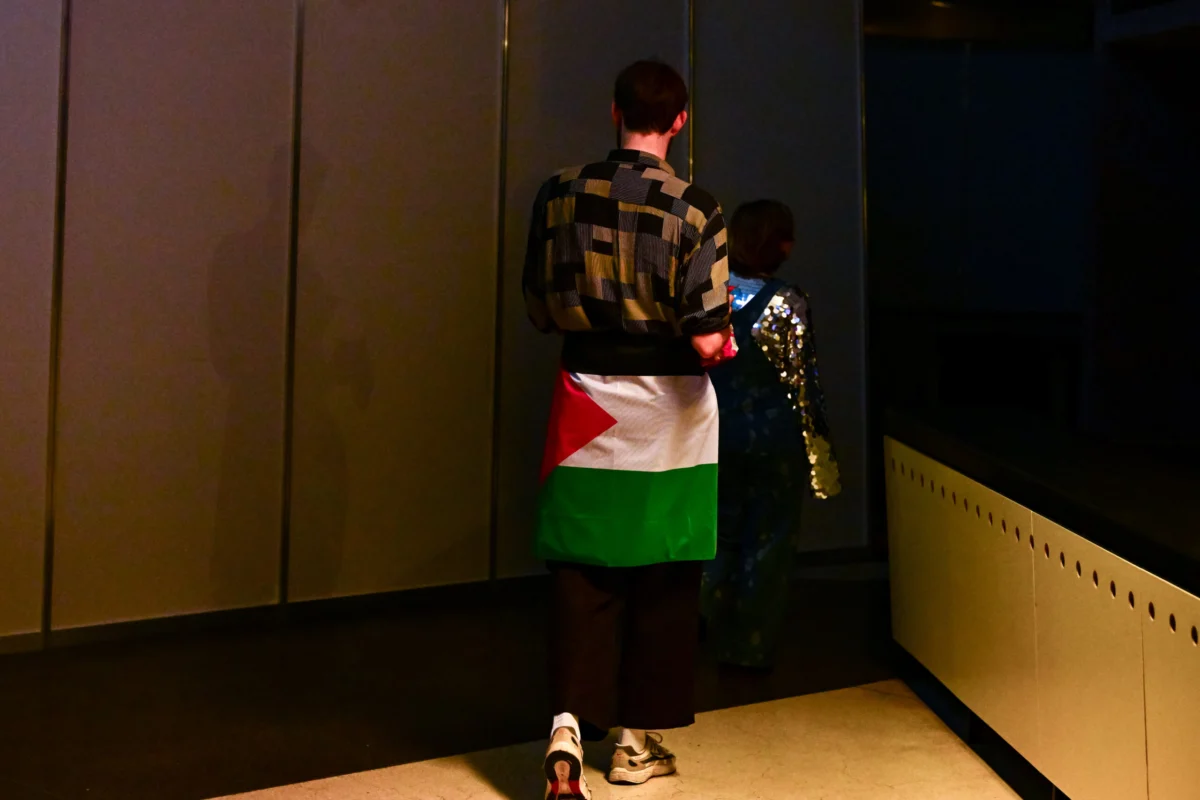
The protest had been extensively advertised across Vienna for weeks, with flyers depicting a microphone drenched in stage blood and a flaming Eurovision logo, leaving no ambiguity about its anti-Eurovision and pro-Palestinian stance. Over a hundred demonstrators converged, many wearing keffiyehs and watermelon earrings—symbols of Palestinian solidarity—and waving Palestinian flags. Banners were strung along the famous hedges of Vienna’s natural history museum, visually asserting their presence and message.
The protest’s messaging was sharp and direct. One woman held a sign proclaiming, "I hate a neutral-ass bitch," a pointed critique, presumably, of the European Central Broadcasting Union (EBU). For many activists, the EBU’s foundational bylaws, which pledge neutrality, felt antiquated and hypocritical in 2026, especially given the ongoing conflict. Amnesty International had recently condemned Israel’s participation in Eurovision as a "betrayal of humanity," amplifying the calls for a boycott and challenging the EBU’s impartiality.
On stage, Topoké, a self-described Pan-Africanist, artist, and educator, helped lead the proceedings, energizing the crowd with the mantra, "Silence is violence." He urged attendees to be "much, much louder so the people in the Museum Quarter can hear us," directly referencing a café specifically set up for Israeli Eurovision fans. This "Israeli fan cafe" itself was a point of contention, having only materialized after numerous renowned Viennese coffee shops reportedly declined to host Israeli fans. The cafe had recently been defaced, further underscoring the animosity.
Nina Maleika, another singer, articulated the core purpose of the protest: to counter the Eurovision "propaganda show" with a "much more beautiful musical protest." She condemned Israel’s participation, stating, "The settlers can continue their ways with impunity, and yet the apartheid terror state is still invited to participate in the Eurovision. A boycott of Israel is definitely necessary today, including in the arts." Her words reflected the widespread sentiment among pro-Palestinian activists that cultural institutions should not provide a platform for states accused of human rights violations.
Eurovision’s Enduring Dilemma: Art, Politics, and Neutrality
The EBU, as the organizer of Eurovision, has consistently upheld its principle of maintaining a non-political event, focusing on music and cultural exchange. Its rules explicitly forbid political statements, booing, or flags other than those of participating nations. However, this neutrality has been increasingly challenged in recent years, particularly in the context of geopolitical conflicts. The decision to include Israel, while banning Russia following its invasion of Ukraine, has been highlighted by critics as inconsistent and politically motivated. The EBU’s defense often centers on the distinction between a state’s government actions and its public broadcaster’s membership in the EBU. However, for a growing number of activists and even some participating nations, this distinction has become untenable.
The boycotts by five nations and the withdrawal of sponsors underscore the deep divisions within the European cultural and political landscape. While the EBU maintained its stance, the financial and reputational costs of this year’s controversy were undoubtedly significant. This situation forces a critical examination of whether Eurovision can truly remain "apolitical" in an interconnected world where art and culture are often intertwined with identity and political expression. The debate over cultural boycotts, a tactic with historical precedents from the anti-apartheid movement in South Africa, has resurfaced with renewed intensity, pushing institutions like the EBU to confront the limits of their neutrality.
Behind the Spectacle: The Technical Prowess and Press Corps Dynamics
Away from the protests, within the press barracks, the atmosphere reflected a different kind of reality. The convention space, adorned with pink and purple hearts, felt somewhat insular, even cliquey. Press badges, delineating nationality and publication prestige, subtly reinforced a caste system within the media pool. Yet, the underlying purpose of the gathering remained the celebration of music and technical achievement.
A semi-final rehearsal offered a glimpse into the immense technical prowess of the production. The stage lights, twirling "like ballet dancers," and the stairs glowing with "breathy intervals suggesting sentience," created a breathtaking visual spectacle. The cameras, gliding silently with "the precision of surgical robots," seamlessly captured every angle. Even more impressive were the stagehands, who executed set transformations between acts in a mere 35 seconds—a feat of human coordination and efficiency that the observer mused could offer "hope for humanity in our valiant struggle against AI." This glimpse into the meticulously choreographed show reminded everyone of the event’s core appeal and why being on that stage meant so much to the 166 million worldwide viewers who typically tune in.
Vienna’s Internal Conflict: Balancing Festival Spirit with Moral Imperatives
The city of Vienna itself found itself navigating a complex moral and logistical landscape. As a host city, it was committed to facilitating the event and ensuring public safety, including the right to peaceful protest. Yet, the underlying tension was palpable among its residents. A conversation with an Austrian researcher and mega-Eurovision fan illuminated this internal conflict. She planned to attend both the potentially larger protest slated for a main arterial leading to the stadium and the concert itself.
"I’m so split," she confessed, articulating a sentiment likely shared by many. "I understand why people don’t want to watch Eurovision this year, but I also don’t think either side is helped by me not watching it. Basically, I don’t think punishing the whole country [of Israel] for Netanyahu’s politics is fair." Her perspective highlighted the nuance often lost in black-and-white political discourse, distinguishing between a government’s policies and the cultural representation of its people.
She recalled cringing last year when Yuval Raphael, an Israeli survivor of the October 7th attack, was booed by the audience. "I didn’t think that was right," she stated, underscoring the discomfort many feel when human suffering is politicized and individuals are targeted. For her, Eurovision had historically offered a refuge: "One of the reasons why I love Eurovision is because it’s historically been, in a way, naive. It’s like this ideal world where you can pretend, for one evening, that everything is fine. You can imagine a future in which all countries can compete against each other with ridiculous sets and costumes and fire and wind effects."
However, she concluded with a poignant acknowledgement of the current reality: "But, I also understand why some people find it impossible to enjoy, especially this year." This reflection perfectly captured Vienna’s predicament – a city known for its rich cultural heritage and diplomatic traditions, caught between the desire for celebration and the inescapable weight of global political realities.
The Road Ahead: Eurovision at a Crossroads
The 2026 Eurovision Song Contest in Vienna has become a profound symbol of the challenges facing cultural events in an era of heightened geopolitical tensions. The dual protests, the unprecedented security measures, the boycotts, and the internal struggles of both participants and audiences, collectively underscore that the idea of a purely "apolitical" global spectacle may be increasingly unattainable.
The EBU’s commitment to neutrality is under severe strain. Moving forward, it will face mounting pressure to re-evaluate its guidelines, perhaps needing to define more clearly the circumstances under which national broadcasters, and by extension their countries, can participate. The financial implications of sponsor withdrawals and the reputational damage from widespread public criticism could force a re-think.
The events in Vienna also highlight a broader societal debate about the role of art and culture in political activism. For many, cultural boycotts are a legitimate and powerful tool for non-violent protest, while for others, they unfairly punish artists and audiences for political actions beyond their control, undermining the very spirit of cultural exchange.
As the curtains close on this year’s contest, the echoes of both the music and the protests will undoubtedly resonate. Eurovision, once envisioned as a naive ideal of unity through song, now stands at a crossroads, forced to confront its own identity and purpose in a world where the lines between art, politics, and humanity are irrevocably blurred. The contest’s ability to navigate these complexities will determine its relevance and future as a truly unifying, or perpetually contentious, international event.